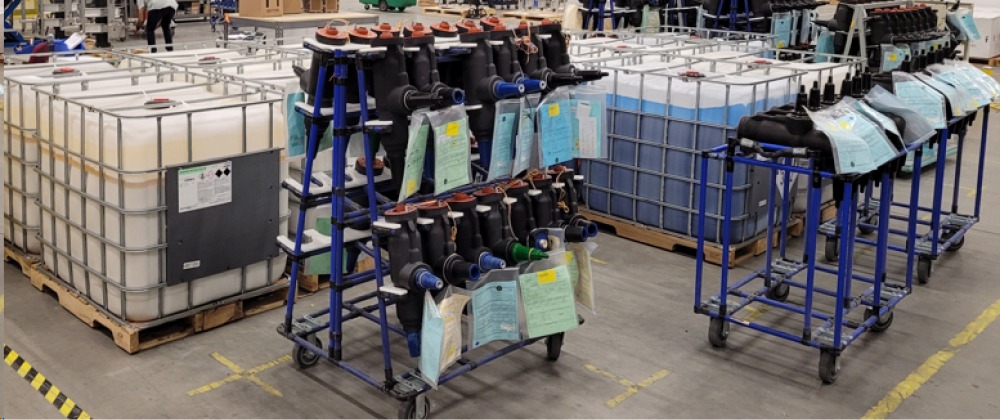
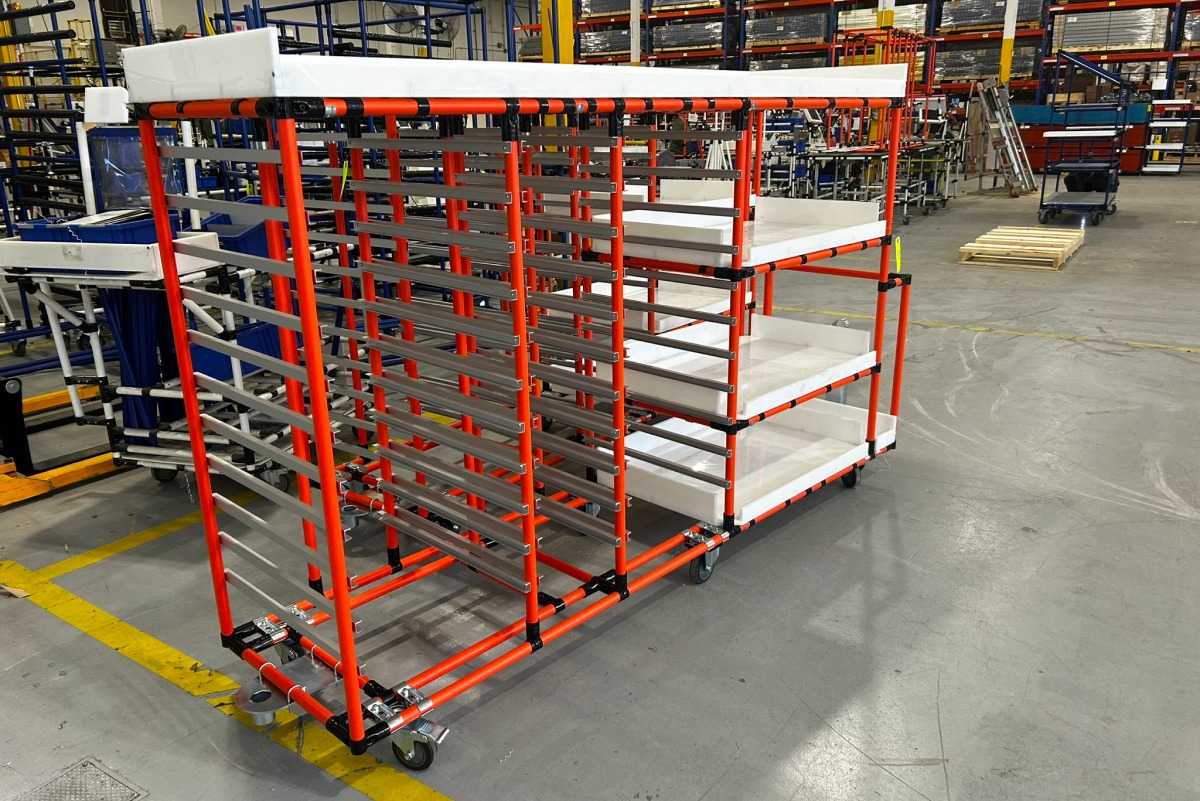

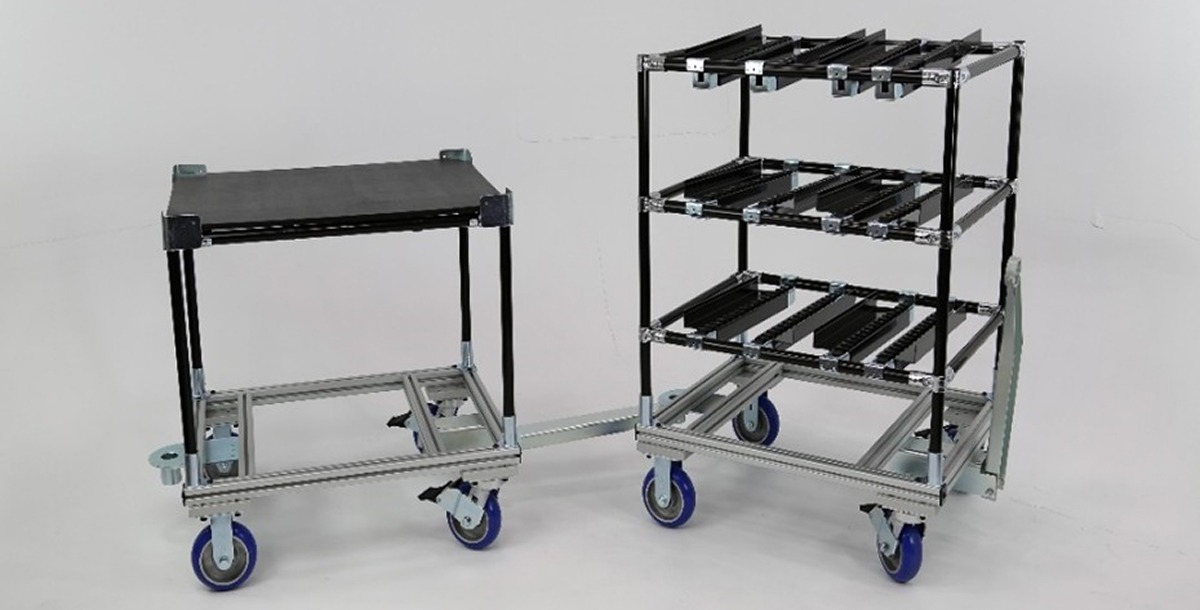
In Canadian manufacturing environments—where production flexibility and floor space optimization are critical—modular WIP carts play a key role in maintaining efficient workflows.
In lean manufacturing, a work-in-process (WIP) cart plays a critical role in reducing waste while supporting efficient and consistent production flow. However, traditional steel-welded WIP carts are not aligned with lean principles. Once built, they are difficult to modify and often require significant costs and production downtime to adjust.
In Canadian manufacturing environments—where production requirements frequently shift and flexibility is essential—fixed material handling solutions quickly become a limitation.
A better approach is to use a modular WIP storage cart built from Flexpipe steel tubes, joints, and accessories. These systems can be easily adapted as production needs evolve. A Flexpipe mobile WIP cart helps reduce bottlenecks, protect semi-finished parts, improve visual management, and provide clearly defined locations for all work-in-process items.
The result is a scalable and reconfigurable WIP cart solution. Layout, dimensions, levels, and storage configurations can all be adjusted to support changing production demands without disrupting operations.
From improving workflow and reducing part damage to minimizing excess WIP inventory and lowering material handling costs, Flexpipe modular systems provide a practical solution for lean manufacturing environments.
A work-in-process (WIP) cart is a temporary storage and transport solution used to move semi-finished parts between workstations in a lean manufacturing environment.
In modern Canadian production facilities—where product mix, batch sizes, and workflows frequently change—continuous improvement is essential. As a result, WIP carts must be adaptable. Production teams need the ability to quickly modify cart dimensions, layout, and storage configurations to match evolving requirements.
Traditional steel-welded or fixed carts do not offer this level of flexibility. Once built, they are difficult and costly to change. Modular systems like Flexpipe, on the other hand, are designed to evolve with your operations.
There are several types of WIP carts used across manufacturing and distribution environments, including kitting carts, picking carts, and tugger carts.
A kitting cart is used to gather and organize all the materials and subcomponents required to assemble a specific quantity of finished goods. These carts are typically designed with dedicated locations for bins, custom trays, and a flat working surface to support efficient handling.
In Canadian manufacturing operations—especially in high-mix production environments—kitting carts play a key role in ensuring that the right components are available at the right workstation, at the right time.
The materials stored in a kitting cart are directly tied to production work orders, which define both the product type and the required production volume. This helps standardize operations, reduce picking errors, and improve overall workflow consistency.
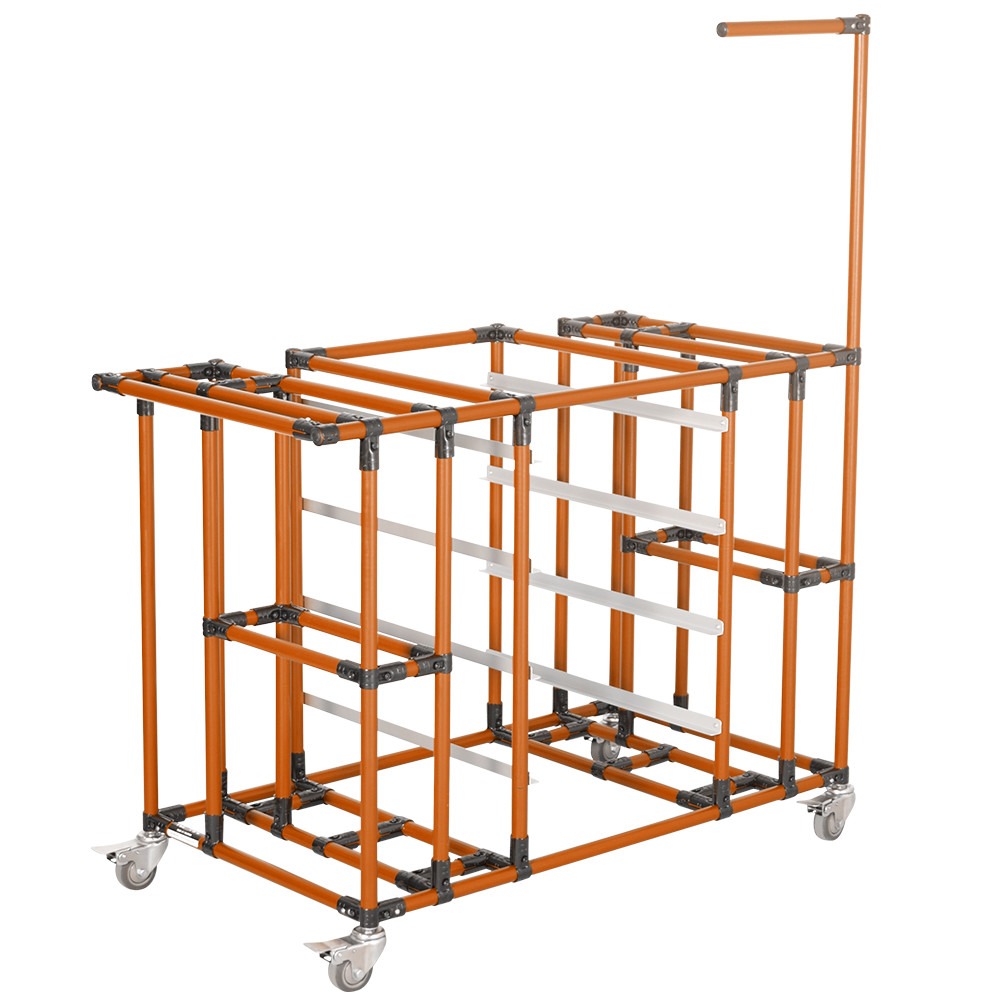
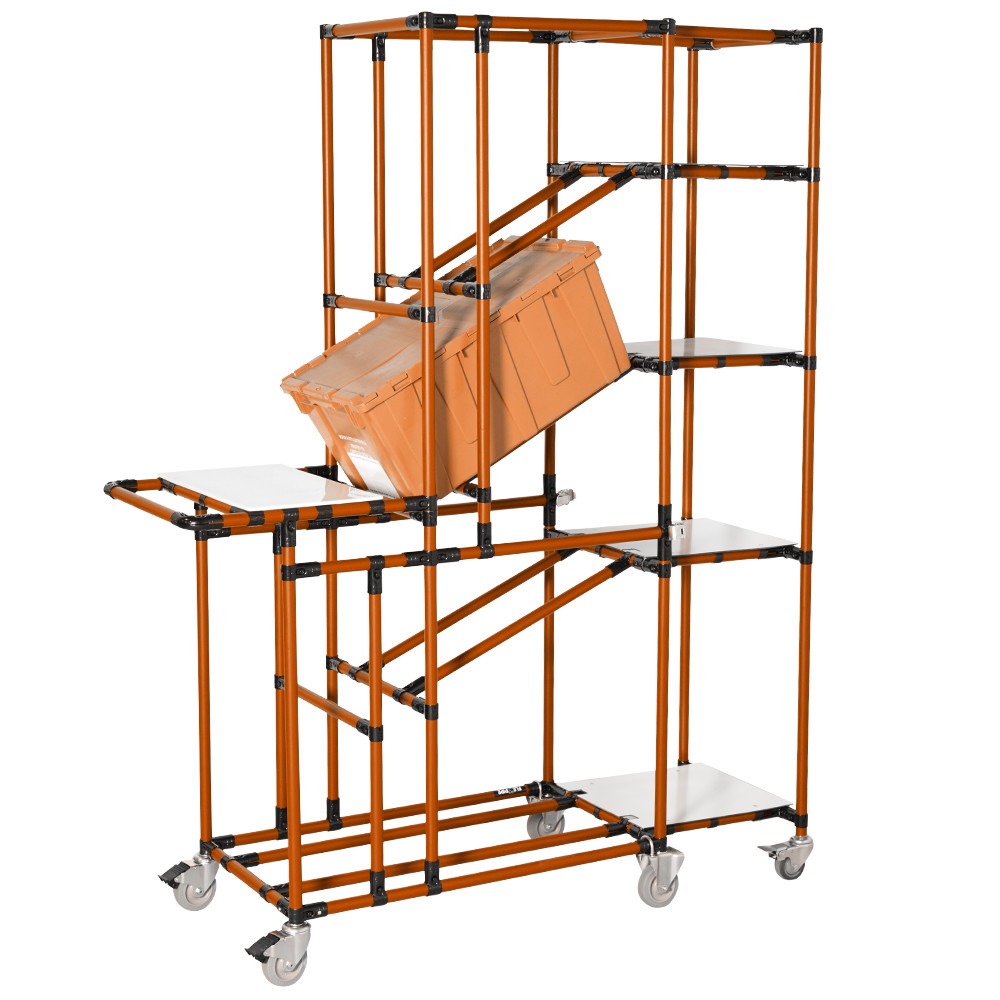
Picking carts are used for order fulfillment in warehouse and distribution environments. They allow inventory and warehouse personnel to efficiently pick and organize items required to complete customer orders.
In distribution centres—where accuracy and speed are critical—picking carts help streamline the process of retrieving finished goods stored on shelving systems. Operators can move through aisles while consolidating items for each order, reducing unnecessary travel and handling time.
These carts are typically designed with a flat working surface to support counting, sorting, and staging of parts. They can also accommodate tools such as RFID scanners or mobile devices, helping improve order accuracy and traceability.
Tugger carts are linked carts designed to move materials efficiently across production and warehouse environments. They can be pulled manually by an operator or, more commonly, by a battery-powered tugger.
While smaller cart setups may be moved by hand, the most ergonomic and safety-focused approach is to use a motorized tugger. This allows operators to transport multiple carts at once with minimal physical effort, reducing strain and improving overall workplace safety.
Tugger cart systems are particularly useful for moving larger volumes of materials over longer distances, helping maintain a consistent flow of parts across the facility.

In lean manufacturing environments, controlling the volume of work-in-process (WIP) is essential to maintaining a smooth, predictable workflow. Poor WIP control leads directly to delays, excess handling, higher costs, and production bottlenecks.
It’s a constant balancing act : Too much WIP results in overproduction, congestion, and wasted resources, while too little WIP creates inefficiencies, idle time, and disrupted production flow.
In any lean production process, each part moves through a defined sequence of workstations from start to finish. Materials are first kitted and delivered to the initial workstation using a kitting cart.
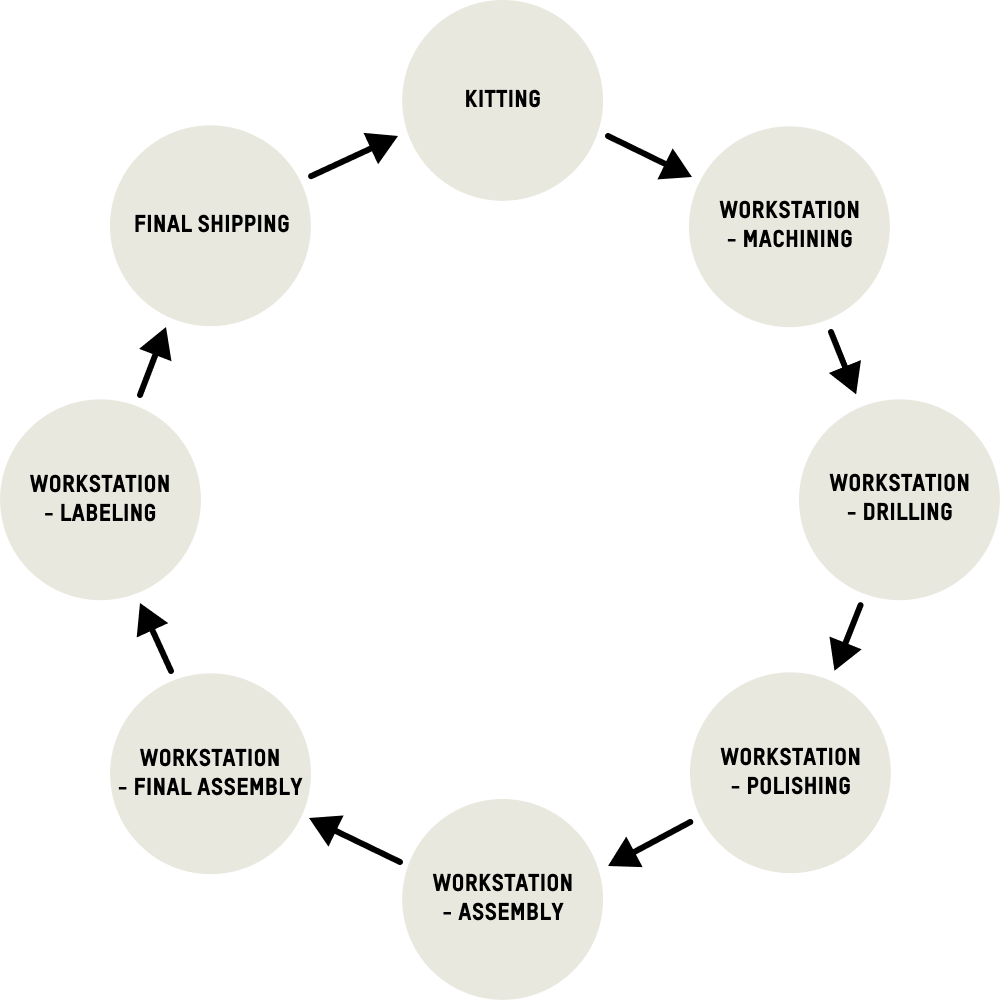
Each workstation completes a specific task before passing the semi-finished part to the next stage in the process. Kitting carts ensure a consistent and controlled transfer of parts between workstations, supporting a continuous flow until the final product is completed and ready for shipment.
If WIP levels are too high, bottlenecks develop and disrupt the entire production flow. This often leads to lost time, where operators remain underutilized despite ongoing labour costs.
On the other hand, insufficient WIP creates the same outcome: certain workstations become starved of work, leaving operators idle and reducing overall efficiency.
The following approaches are commonly used in lean manufacturing environments to better manage WIP levels. In practice, achieving optimal WIP control often requires a combination of these methods rather than relying on a single approach.
In a one-piece flow system, products move through the production process one unit at a time instead of in batches. This reduces the amount of WIP in circulation and helps create a more balanced and continuous flow.
Reality : In practice, very few manufacturing environments can fully implement one-piece flow. Producing one unit at a time often limits the ability to achieve economies of scale and may not be viable for all operations.
Pull systems are demand-driven, meaning production is triggered by actual customer orders rather than forecasts. To maintain efficiency and avoid the limitations of one-piece flow, manufacturers typically define a minimum order quantity (MOQ).
Reality : While pull systems improve WIP control, they also introduce complexity. Manufacturers must account for product variability, as different configurations often require unique setups and have varying cycle times.
Every operation has a defined cycle time. Continuously improving cycle times enables each workstation to increase its output and overall productivity. Continuous improvement initiatives that reduce assembly time directly contribute to higher throughput.
Reality : While cycle time management is fundamental in lean manufacturing, the real objective is to balance production across all workstations. Increasing throughput at one station can create downstream bottlenecks if the next process cannot keep pace.
Buffer management involves maintaining a controlled level of inventory between workstations. This ensures that each station has enough work to operate efficiently without interruptions or idle time.
Reality : Although buffers help stabilize production flow, they must be carefully managed. Excess buffer inventory can interfere with responsiveness to actual customer demand and lead to inefficiencies.
The primary benefit of effective WIP control is waste reduction. Maintaining the right level of WIP helps avoid unnecessary inventory costs, reduces idle or downtime across workstations, and limits excessive handling of semi-finished parts.
In lean manufacturing environments, change is constant. Production requirements, part dimensions, materials, consumables, and even facility layouts evolve regularly.
Continuous improvement means continuously adapting. Whether it involves reconfiguring a production line, adjusting a workstation, optimizing a lean cell, or fine-tuning WIP levels, flexibility is essential.
Traditional welded carts and fixed material handling structures are not designed for this level of adaptability. Any modification typically requires cutting, welding, and extended downtime, resulting in significant costs and operational disruption.
In contrast, modular WIP carts built with the Flexpipe system offer a far more flexible and scalable solution. They can be easily reconfigured on-site, allowing teams to quickly adjust layouts, dimensions, and storage configurations without interrupting production.
Across every key performance metric—reconfiguration speed, flexibility, and cost efficiency—modular material handling systems provide a clear advantage over welded alternatives.
The primary function of WIP carts is to transport semi-finished parts between production stages. They support the continuous movement of materials from one workstation to the next, helping maintain a consistent production flow.
WIP carts are commonly used throughout the entire manufacturing process—from machining and drilling to polishing and final assembly. They are also frequently positioned near testing stations and in-process quality control points.
From moving components between workstations to transferring finished goods to packaging and labeling areas, WIP carts play a central role in keeping production organized and efficient.
WIP carts are designed to transport semi-finished parts between workstations. They support controlled workflow and are essential for managing WIP levels and buffer zones within production environments.
Flow racks, on the other hand, are static storage systems used to organize materials and consumables. They hold bins on inclined levels, allowing items to flow forward for easy access and efficient replenishment.
WIP Carts :
Move semi-finished parts between production stages.
Flow Racks :
Inventory presentation where material bins sit on angled shelves.
A mobile flow rack is not a WIP transport solution, but rather a point-of-use material supply system positioned directly beside a workstation or lean cell. Its primary role is to provide operators with immediate access to the components and consumables required to complete their tasks.

Mobile flow racks are commonly used as line-side racks, as they are placed alongside production lines to support continuous operations. Each level is typically set at an angle of approximately 15 degrees and equipped with stoppers to keep bins securely in position.
Operators retrieve materials from the front of the rack, while replenishment is handled from the back by support personnel. This front-to-back flow supports efficient restocking while ensuring uninterrupted access to parts.
By keeping materials within reach, mobile flow racks reduce unnecessary movement, help maintain operator focus, and contribute to a more efficient and streamlined production environment.
Several common issues can negatively impact WIP management in lean manufacturing environments.
One of the most frequent problems is insufficient control over WIP levels. Without proper monitoring, production can quickly become unbalanced, leading to inefficiencies and bottlenecks.
Another common mistake is maintaining excessive buffer inventory. While buffers are necessary, too much inventory increases carrying costs and can hide underlying process inefficiencies.
Overloading WIP carts is also a recurring issue. Excess weight or poorly distributed loads can lead to damaged semi-finished parts and reduced handling efficiency. This is particularly problematic with welded carts, whereas modular WIP carts can be designed to match specific load requirements.
Limited visibility of WIP levels and a lack of adaptability to changing product dimensions or production requirements are additional challenges. These issues are more difficult to address with fixed structures and are significantly easier to manage with modular systems.
A work-in-process (WIP) cart is used in manufacturing to transport semi-finished parts between workstations. It supports a continuous production flow and helps reduce handling inefficiencies. Modular WIP carts can be configured to match part dimensions, reducing the risk of damage during transport.
The load capacity of a WIP cart depends on its design, materials, and caster selection. Most industrial carts support between 200 and 1,100 pounds. For modular systems, capacity can be calculated using engineering tools such as a deflection calculator to ensure safe and reliable performance.
WIP carts are generally better suited for moving semi-finished parts between workstations, as they are designed to support workflow and operator handling. Pallets, in contrast, are typically used for transporting heavier raw materials and often require forklifts, making them less flexible for in-process movement.
Yes. Unlike welded carts, modular WIP carts can be easily reconfigured to adapt to changing production needs. Adjustments can be made directly on-site, often within a few hours, without specialized equipment or extended downtime.
Yes. WIP carts play a key role in lean manufacturing by improving flow between workstations, reducing unnecessary movement, and supporting better organization. Modular designs further enhance flexibility, allowing continuous adaptation as processes evolve.
Lean manufacturing requires constant adjustment to maintain optimal workflow and WIP levels. As production needs evolve, material handling solutions must be able to adapt quickly without introducing delays or excessive costs.
A modular system provides the flexibility to reconfigure layouts, adjust capacities, and respond to changing requirements directly on the shop floor.
The Flexpipe material handling system is designed to support continuous improvement by enabling fast, cost-effective modifications without disrupting production.