

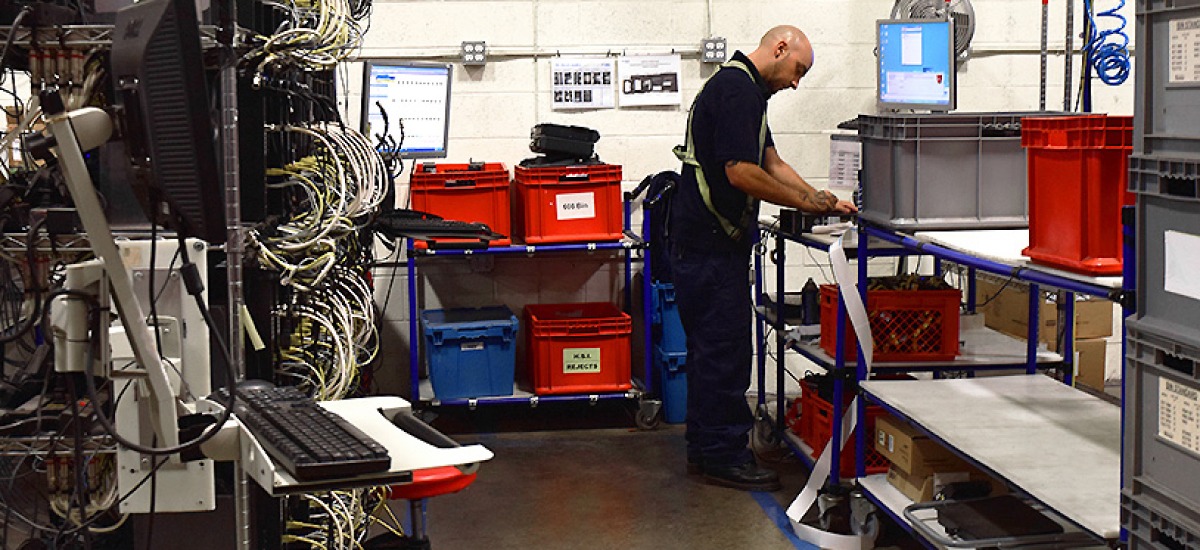
Lean Manufacturing in Electrical Equipment Production: A Comprehensive Guide
In the electronics industry, lean manufacturing improves customer value by maximizing productivity and eliminating manufacturing waste. Adopting lean manufacturing can lower costs, streamline workflow, and empower employees to be their best.
Within electrical equipment manufacturing, lean manufacturing helps companies provide electronic products faster, with fewer defects, and at much lower costs. This benefits customers by providing them with multiple options at better prices and faster deliveries.
Table of Contents
1. The Origins of Lean Manufacturing
The first production workflow process was Henry Ford’s Model T assembly line. A single Model T car frame would move along a linear production line where sequential work cells would complete different tasks. While revolutionary, Ford’s Model T assembly line didn’t allow for any variations of the finished product. Something more was needed.
Sakichi Toyoda, Kiichiro Toyoda, and an engineer named Taiichi Ohno of Toyota kept the continuous production workflow of Ford’s assembly line but upgraded it with several process improvements that allowed them to offer different options to customers. Toyota then took portions of the PDCA (Plan, Do, Check, Act) cycle from Walter Shewhart – an American engineer and statistician – and Edward Demming – an American management consultant and engineer.
Combining all these different ideologies alongside elements of statistical process control (SPC) and statistical quality control (SQC) gave rise to the Toyota Production System (TPS). This new TPS “system” of lean manufacturing was introduced to Western businesses by a Japanese consultant named Masaaki Imai when he released his 1985 book entitled, “Kaizen: The Key to Japan’s Competitive Success.”
Importance of Lean Manufacturing and Continuous Improvement in the Electronics Industry
Within the electronics industry, a product’s lifecycle can be exceptionally short. What was popular yesterday is now outdated. As such, electronic manufacturers are under constant pressure to create new and innovative products to keep up with changing customer preferences. This requires seamless synchronization across the manufacturer’s supply chain so that electronics suppliers can quickly meet constantly changing customer demands and preferences.
Electronic technologies themselves are also always changing. This means electronic manufacturers must combine lean manufacturing best practices with lean-related supply chain and inventory management approaches like Just-In-Time (JIT).
With JIT, the focus is on matching electronic parts/inventory counts to customer demand. This ensures manufacturers aren’t left with electronic parts and inventory they can no longer use because those parts have become outdated.
Ultimately, whether driven by constantly changing customer preferences, advancements in new technologies, or just the ever-present threat posed by competitors trying to offer faster and better electronic equipment and products with more options – in the end – lean manufacturing in electrical equipment production has quickly become the manufacturing process of choice.
2. Lean Principles in Electrical Equipment Production
Successfully adopting lean principles within electrical equipment manufacturing begins and ends with understanding, embracing, and pushing Kaizen – which is Japanese for “continuous improvement”. While there are multiple layers to Kaizen – both in terms of complexity and the many different types of continuous improvement methodologies electronic manufacturers can adopt – success with electronic lean manufacturing ultimately does come down to some rather simple concepts.
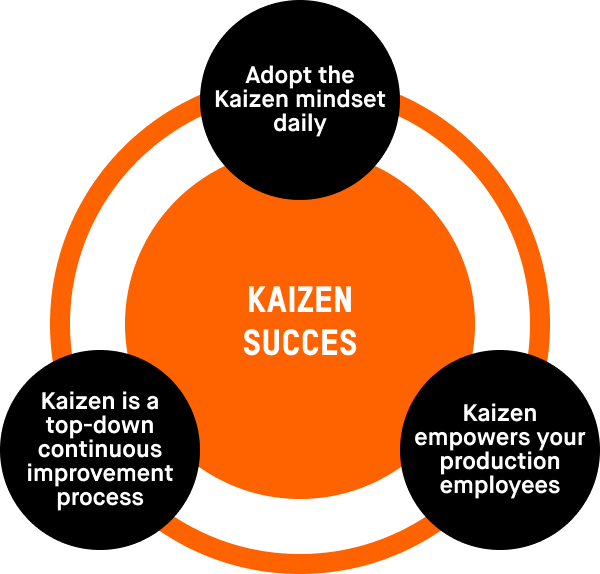
First, contrary to what many Western companies may believe, Kaizen is not a once-a-quarter, twice-a-year, or even an annual event. Kaizen is a belief system. It is a way of working. It is a mindset. To adopt Kaizen means adopting a continuous improvement approach to everything you do, every second of your workday.
Second, Kaizen is a top-down doctrine. It must be embraced, welcomed, and pushed by a company’s most senior management team. Kaizen is not a run-of-the-mill or flavor-of-the-month strategy. This isn’t a set-it-and-forget-it proposition either. It requires a disciplined workforce that continuously eliminates waste throughout the manufacturing process.
Third, Kaizen is meant to empower your workforce to take charge of their workflow, workspaces, and work environment. From production technicians to line-side operators, supervisors, and production managers, everyone is responsible for continuous improvement, and everyone must always remain vigilant about eliminating waste.
Flexpipe ESD compliant options for the electrical industry
A critical aspect of electronics manufacturing is adherence to Electro Magnetic Compatibility (EMC) requirements through proper Electrostatic Discharge (ESD) protection. For electrical equipment manufacturers, ESD-compliant material handling solutions are not optional – they’re essential for product integrity and safety.
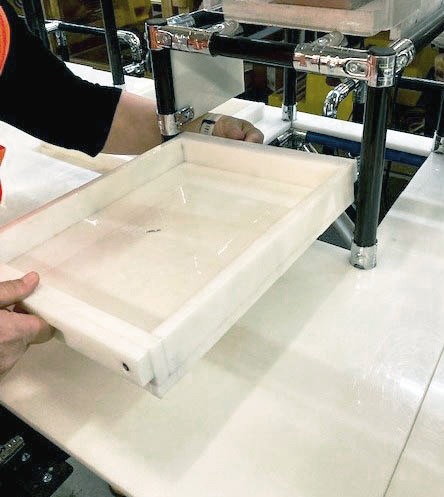
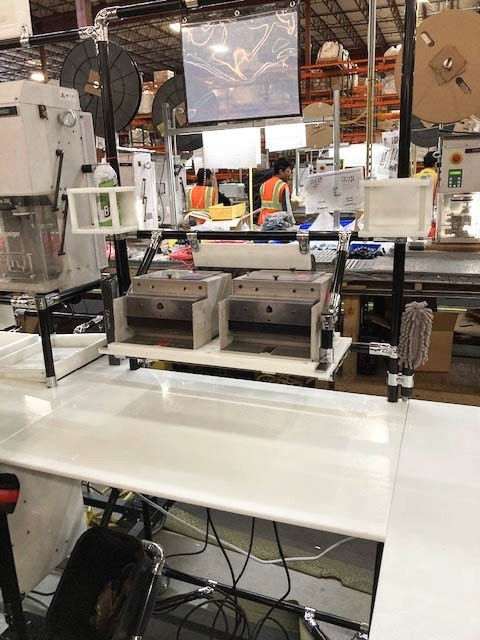
These polymer-based materials are specifically formulated to reduce static electricity, protecting sensitive electronic components throughout the manufacturing and assembly process. Using Flexpipe ESD-compliant connectors, roller tracks, pipes, decking material, and casters is an absolute must. The ESD-compliant decking material is essential for pullout drawers, work surfaces, and tabletops, while Flexpipe’s ESD-compliant steel tubes (pipes), roller tracks, and casters ensure mobile carts, flow racks, and trolleys are also protected.
All Flexpipe components used in electronics manufacturing are ESD-compliant, including:
- Casters for mobile carts and trolleys
- Connectors and joints
- Roller tracks and pipes
- Decking material for work surfaces and tabletops
Five Essential Kaizen Tools for Electronic Equipment Manufacturers
There are five essential Kaizen and lean manufacturing tools that all electronic equipment manufacturers must adopt. One of these is 5S which improves workstation layout and workflow. Another is using weekly Gemba walks to align work objectives. Adopting Just-in-Time (JIT) inventory management approaches is another as is using value stream maps. Finally, adopting a Pull system ensures electronic manufacturers aren’t left holding finished product inventory they don’t have demand for.
1. 5S Methodology
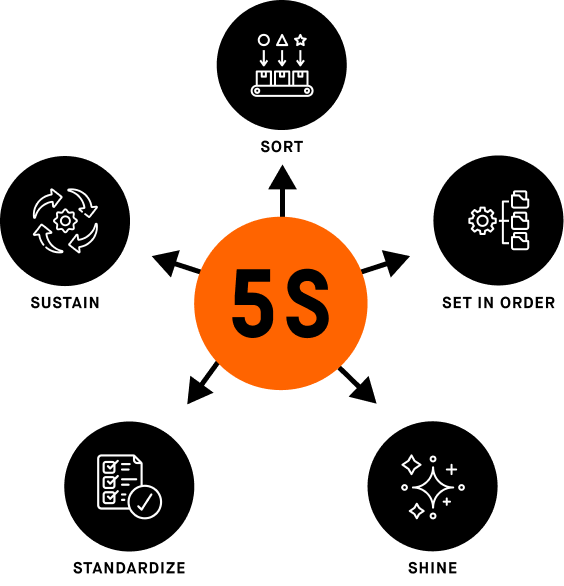
Using the 5S methodology helps to improve workflow while ensuring a clean, efficient, and lean workstation and work environment. 5S stands for Sort, Set in Order, Shine, Standardize, and Sustain. By adopting 5S, electronic equipment production employees will no longer be wasting valuable time looking for critical tools, consumables, and information.
Adopting the 5S methodology for electrical workstations will improve workflow, reduce cycle times, simplify assembly times, and lead to a cleaner, more efficient workstation.
Sort: Approach the workstation with the production employee. Identify all non-value-added tools, consumables, instructions, materials, and other items and set them aside. What remains should be all the critical work-related consumables, tools, and items the production employee needs to perform their job.
Set in Order: Ensure all work-related consumables, tools, and items have specifically designated locations for storage. Use labels, decals, and stickers for proper identification, and use simple fail-safe solutions like Kaizen foam where you can cut out the shape of a given tool within foam material to ensure only that tool fits.
Shine: Develop an end-of-the-day or end-of-shift cleanup schedule for all employees using this workstation. If your electronic manufacturing facility runs multiple shifts, then having employees clean their workstations and ensure all consumables and tools have their rightful place will make it easier for the next shift to get started without having to randomly search for what they need.
Standardize: Once your electronic workstation has been optimized, standardize the same layout and process across all similar workstations or locations performing similar tasks.
Sustain: Ensure compliance and buy-in from all levels of your production with periodic 5S inspections, audits, and Gemba Walks.
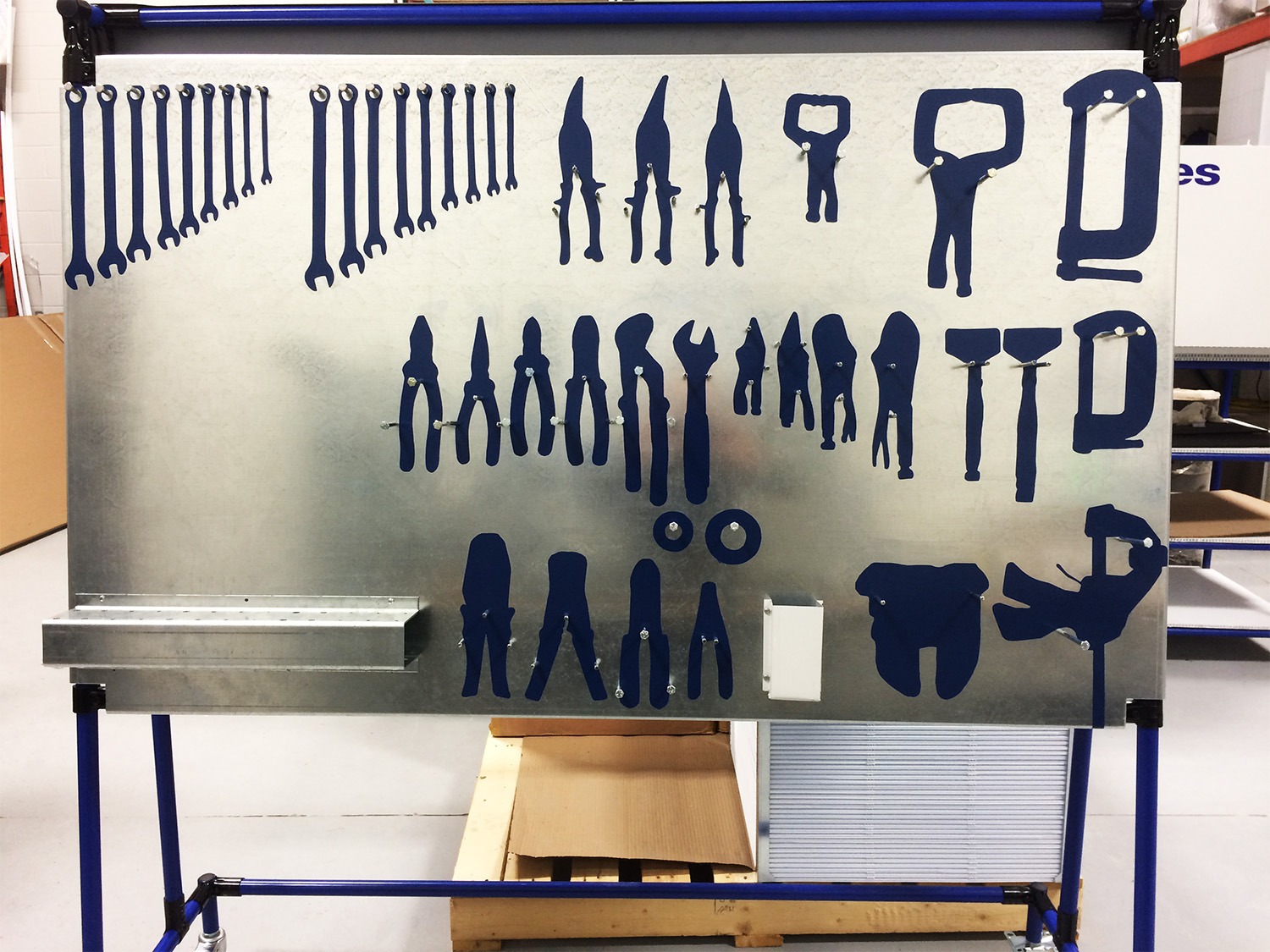
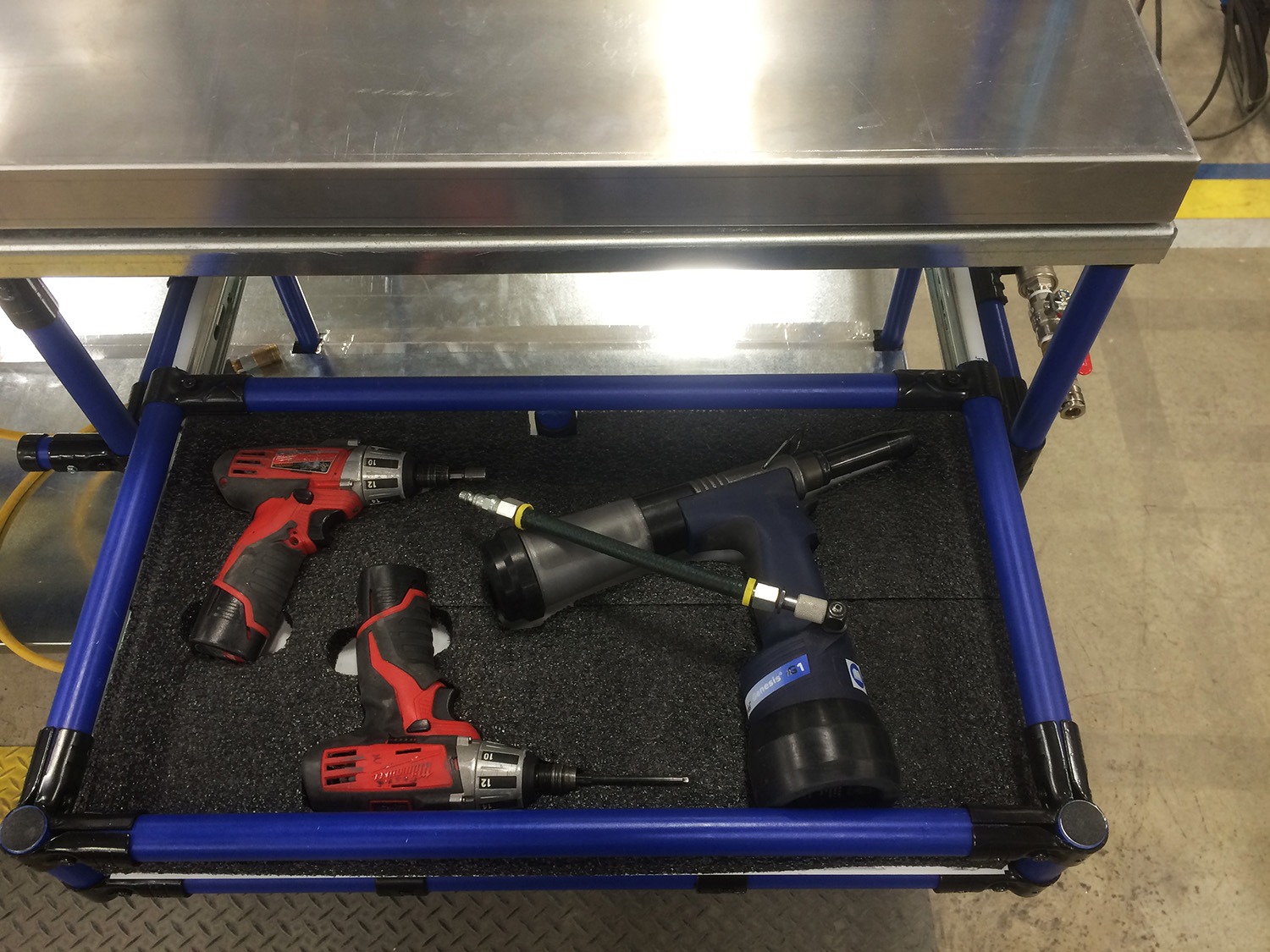
Simple visual markers (left image) and Kaizen foam (right image) make tool placements simple and fast. Both visual markers and identifiers along with Kaizen foam ensure proper placement of tools and consumables while acting as an error-proofing Poka Yoke device to ensure everything is always placed in the right location.
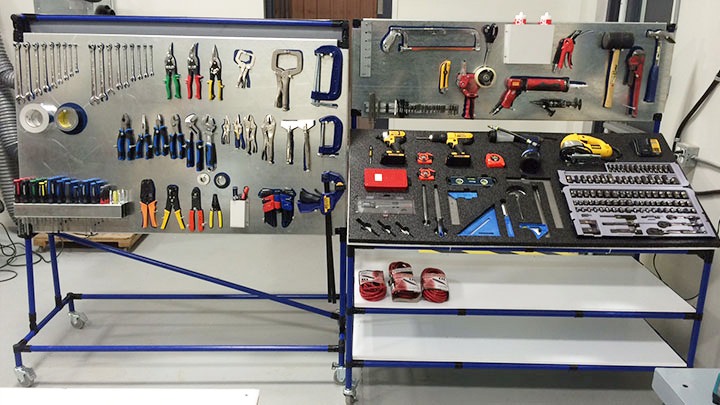
Combining both visual placement locations and Kaizen Foam ensures the ultimate in cleanliness. No more wasted time trying to find the right tool. No more stealing essential tools from other electrical production workstations or randomly leaving essential consumables and tools in other areas. Everything has a location and ensures a seamless transition of work responsibilities.
New Product: Kaizen Foam – Black and red (D-5SFOAM2040)
Discover our Kaizen foam solution for creating 5S shadow boards – ensuring perfect tool organization and immediate accessibility. Made from high-quality polyethylene foam, this multi-layer system allows easy customization for any tool shape while maintaining workplace efficiency.
2. Gemba Walks
When translated from Japanese, Gemba means “the real place”. A Gemba walk is simply an opportunity for production managers to see how work is being performed in a given workstation or manufacturing location.
Ideally, you should plan a Gemba walk once or twice a week to each of the manufacturing work cells or departments within your shop floor. Simply put, a Gemba walk should focus on the following goals.
- Witness the work in person.
- Ask what the employee is doing and why.
- Verify that the employee has all the tools, materials, and instructions needed.
- Ask them if they have any problems.
- Find a resolution to their problem – if there is one.
- Show respect and appreciation for their work.
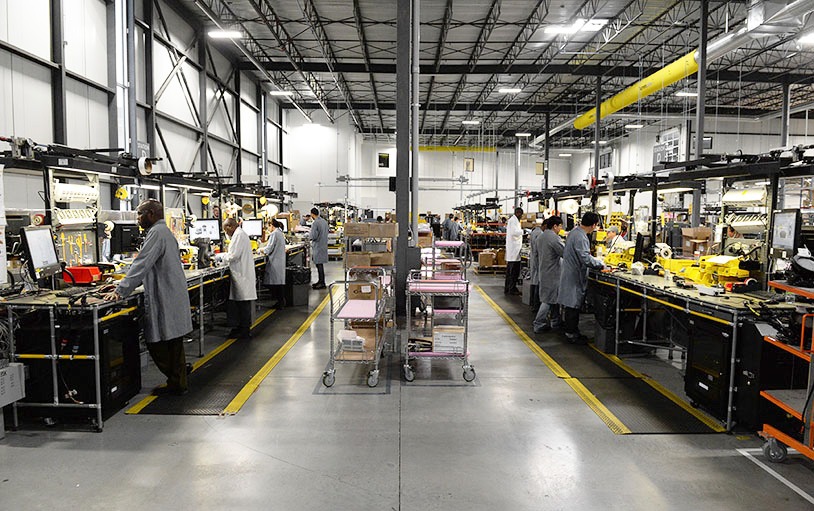
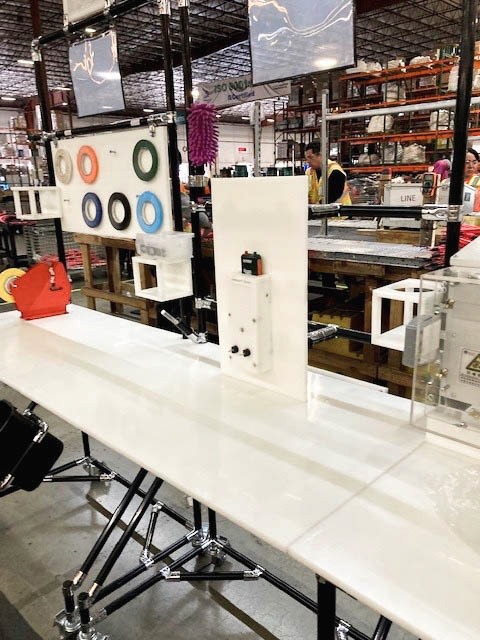
Uniformity across similar electronic assembly workstations ensures seamless and uninterrupted workflow. Each of these workstations is constructed using steel tubes and joints – allowing for simple and immediate adjustments in terms of workspace, table length, and workstation layout.
3. Just-in-Time Inventory and Supply Chain Management
Another tool is adopting a “Just-In-Time” (JIT) inventory and supply chain management approach to ensure your inventory counts of electronic parts and materials perfectly match current demand.
Adopting JIT alongside a Pull system is especially important in electronic lean manufacturing as JIT effectively eliminates the most common wastes associated with conventional inventory management approaches.
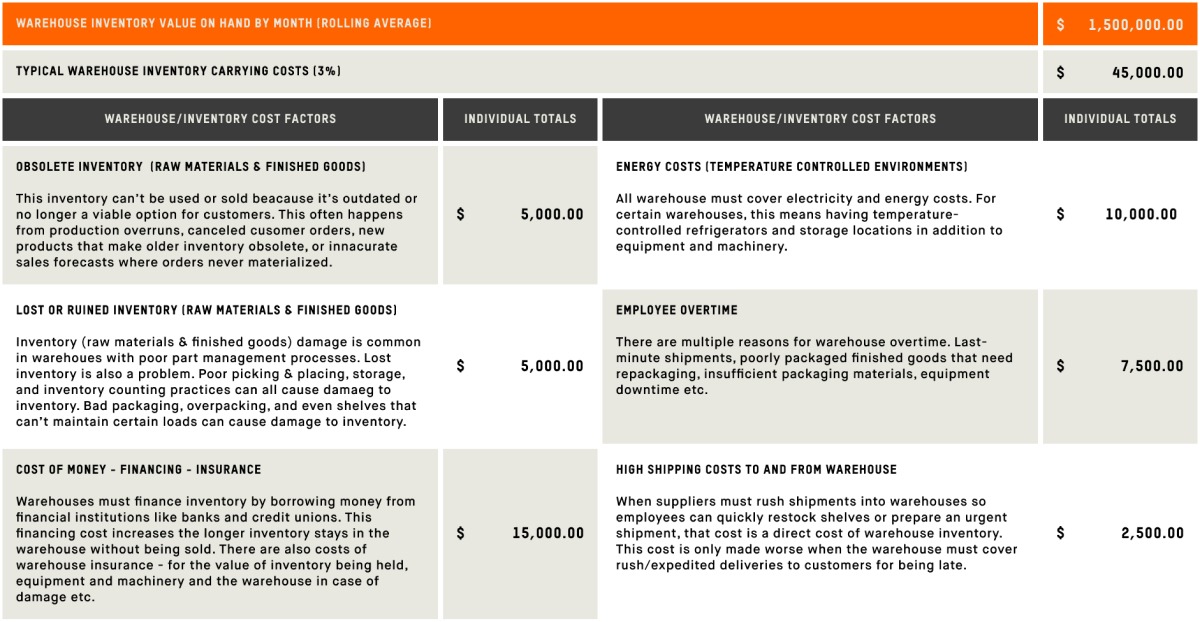
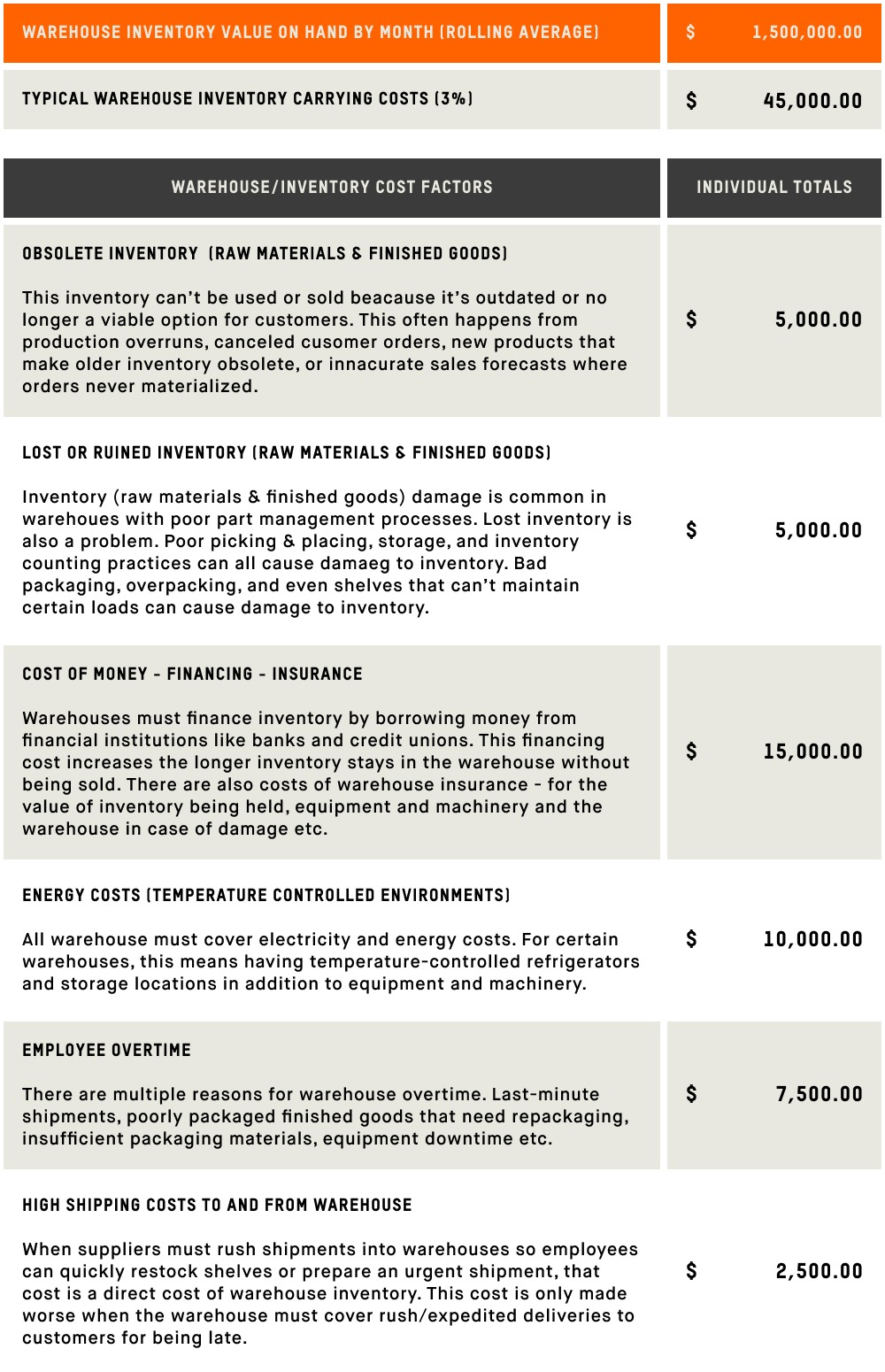
JIT eliminates the high costs of obsolete inventory. With JIT you only receive the parts you need to finish your current orders. Your supplier doesn’t ship any more than the current demand requires. JIT also reduces the cost of inventory financing. Because you only take in what you are going to use, you’re not having inventory sit on your shelves for weeks or months at a time.
Lastly, JIT reduces the costs of inventory and warehouse employee overtime, and high freight costs to and from your inventory location while also eliminating inventory obsolescence.
4. Value Stream Mapping
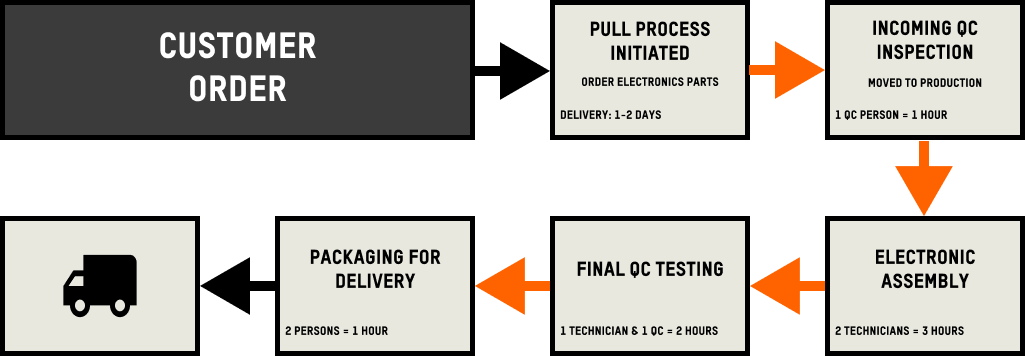
Value Stream Mapping is another important lean manufacturing tool. With value stream mapping, you define your electronic manufacturing processes from a bird’s eye view to identify bottlenecks and roadblocks in your manufacturing process and workflow.
By identifying each step in your manufacturing process, you’re able to analyze the individual cycle times for each operation relative to how many technicians, operators, or production and company employees are needed for each work task.
Once these variables are defined, electronic manufacturers can drill down and analyze production cycle times more closely – looking to understand why some cycle times are higher than others in certain workstations while constantly looking for ways to reduce these times.
5. Adopting a Pull System For Electric Equipment Manufacturers
Finally, combining JIT with a Pull System ensures your finished product inventory perfectly matches your real-time customer orders, and no more finished products remain. Pull systems were made popular by Dell Computers in the early 2000s with their “Push-Pull” strategies.
With Dell’s Push-Pull strategy, Dell was able to “Push” computer options to customers that Dell controlled. By controlling how many choices customers had, Dell made customers feel as if they were getting customized and personalized computers.
Once customers chose their options, Dell “Pulled” the electronic parts needed to assemble the finished computer and shipped within a day or two.

Simplifying Kaizen – A Continuous Improvement Feedback Loop
Contrary to popular belief, Kaizen and lean manufacturing are not all that complicated. The true essence of lean manufacturing is making incremental improvements and then improving upon those improvements.
In many ways, Kaizen and lean manufacturing is a never-ending continuous feedback loop – one where every successful change that reduces waste leads to subsequent changes until a manufacturing work process and workflow are optimized.
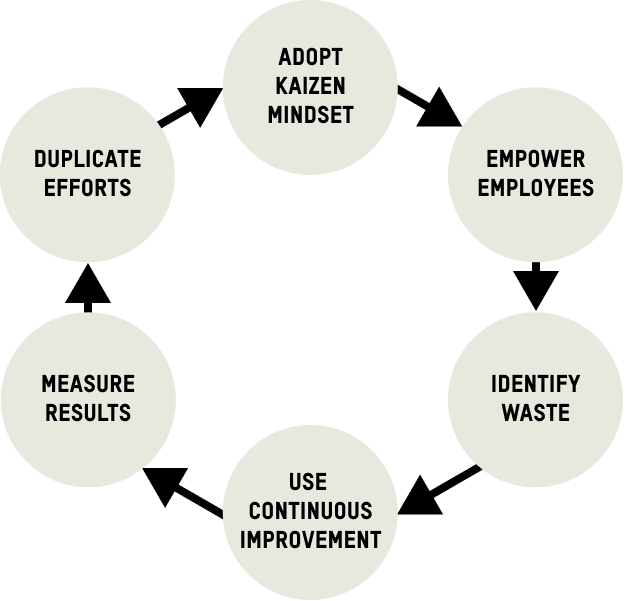
1 – Start by embracing the Kaizen mindset from the highest senior manager within your manufacturing facility down to every single employee.
2 – Ensure all employees are empowered to effect change. This means they are relied upon for their insight and expertise when needing to improve a given process or workflow. Nobody knows their work tasks better than them – so give them the power to identify and eliminate problems.
3 – Identify the waste within your manufacturing process – no matter how small or inconsequential. Remember, Kaizen is an every-moment-of-the-day approach to continuous improvement. Even the smallest of changes can have a dramatic impact on manufacturing efficiencies.
4 – Develop creative continuous improvement by working alongside your employees to eliminate this waste. Work through the process, ask questions, and think collectively to eliminate problems.
5 – Measure the results of your solutions. Did your approach save time, and money, reduce defects, improve quality, or eliminate other common forms of manufacturing waste? Did your solution make things simpler, less complicated, and much easier?
6 – Duplicate your efforts across common manufacturing workstations. If you’ve enacted a change in one electronic manufacturing workstation or location that reduced waste and improved workflow, then enacting that change in the same process will significantly reduce waste.
3. Benefits of Lean in Electrical Equipment Manufacturing
All electronic manufacturers want to provide better electronic equipment and products with more customer options faster than their competitors and at much lower costs. When successful, these electronic manufacturers have happier customers, generate more sales, and increase their market share.
The Toyota Production System (TPS) was revolutionary in that its entire focus was on providing customers with more value. It’s why even today, Toyota vehicles have become synonymous with exceptional quality, reliability, and longevity.
While the following list of benefits for embracing Kaizen and lean manufacturing for electronic manufacturers is no doubt impressive – the overriding benefit is how adopting lean manufacturing will provide your customers will more value and a better overall buying experience.
- Improved Quality: In lean manufacturing, eliminating product defects is critical to providing premium quality products. Improved product and service quality are direct benefits of adopting a Kaizen mindset and using continuous improvement strategies.
- Increased Efficiency: Producing more with less while eliminating waste results in increased efficiency and productivity – and both have a direct impact on improving customer value and leading to a more engaged and motivated workforce.
- Reduced Costs: Reducing manufacturing waste reduces product costs and leads to higher profit and more money to invest back into product research and development (R&D).
- Faster Time-To-Market: In lean manufacturing, increasing speed and streamlining workflow invariably leads to being able to introduce new products faster to an ever-expanding customer base.
- Increased Employee Engagement and Motivation: Empowering employees to be their best and take charge of making improvements leads to a more motivated, happier, and more engaged workforce.
4. Common Challenges in Implementing Lean in Electrical Equipment Manufacturing
Implementing lean in an electronic manufacturing environment is by no means easy. Adopting a Kaizen and continuous improvement mindset is almost always met with some resistance on the part of manufacturing employees, technicians, line-side operators, production managers, or senior managers.
Ultimately, change is not easy. Not all employees are willing to entertain new approaches. Not all employees will embrace change. Resistance will become commonplace which is why patience, insistence, and making employees and managers part of the continuous improvement process is critical to success.
- Resistance to Change: Invariably, a “This is how we’ve always done it,” and “Why change now?” mentality are the most common employee objections – among others. Understand that employee resistance to change will happen. However, as employees are brought into the process, and as they start to see the improvements, this resistance will dissipate.
- Integrating JIT and Pull Systems: For lean principles for electrical manufacturing to work, adopting lean-driven inventory and supply chain management strategies alongside a Pull order fulfillment process can be a time-consuming and labor-intensive affair. Flawless synchronization across the company’s supply chain and its suppliers takes a substantial amount of time.
- High-Mix & Low-Volume Production: Offer too many product options across too wide a product portfolio with low volumes for each product offering and adopting lean principles for electrical manufacturing becomes that much more difficult. Lean, JIT, Pull Systems, and Kaizen work best with linear demand for low-mix product offerings in high volumes.
- Budget Constraints: While not always the case, lean manufacturing in electrical equipment production can involve replacing outdated manual work processes with automated equipment and machinery that reduces cycle times and production costs. Unfortunately, not all electronic manufacturers will have the budget to initiate these types of changes.
5. Material Handling in Lean Electrical Equipment Production
A fundamental key to successfully adopting Kaizen and lean manufacturing in electrical equipment production is having well-established material handling processes and simple-to-use material handling structures. These material handling processes and structures can never be static. They must be able to adjust to the constant demands of a lean manufacturing environment.
Ensuring optimized workflow and seamless material handling and material movement is an absolute must when adopting Kaizen and lean manufacturing. This is especially true for electronic equipment manufacturers, where managing electronic components of various sizes and configurations requires a flexible, scalable, and easily adjustable material handling solution.
Using the Same Kaizen Modular Material Handling Solutions of the Toyota Production System
An often-overlooked aspect of the Toyota Production System was how Kaizen and lean manufacturing arose out of necessity after the Second World War. While Western manufacturers could boast huge inventories of materials, components, and tools for their assembly lines, Japanese manufacturers had to do more with less.
Japanese manufacturers like Toyota simply did not have the capital or infrastructure to support large inventories. Needing to manage a smaller volume of materials with material handling structures they could easily change and modify as needed, Toyota started using bamboo as their key building material for their material handling structures.
Flexpipe’s Steel Tube and Joint System
Nowadays, bamboo has been replaced by Flexpipe’s cold-drawn steel bars. Accompanying these steel bars are high-strength steel joints, rollers for easy sliding of bins within structures, Kaizen foam for 5S tool placements, ESD-compliant decking material for electronics, swivel casters for easy maneuverability of mobile carts and trolleys and thick square pipes and corner square pipes for the base of large tugger carts.

Flow Rack Trolley Cart | Structure Showcase
Join us for a closer look at our flow rack trolley cart, featuring a sturdy square pipe base and 6-inch heavy-duty casters for efficient material handling. Perfect for both forklift towing and manual pushing, this system ensures safe and efficient delivery of materials throughout your facility.
The Ease of Use of Flexpipe’s Material Handling System
From material handling carts, warehouse picking carts, production kitting carts, tugger carts, and tugger trains to workstations, worktables, flow racks, shelving, work-in-process (WIP) racks, mobile carts to TAKT Boards and information and Point-Of-Use (POS) boards – every conceivable material handling structure, workstation or support structure can be made with Flexipe’s steel tube and joint system.
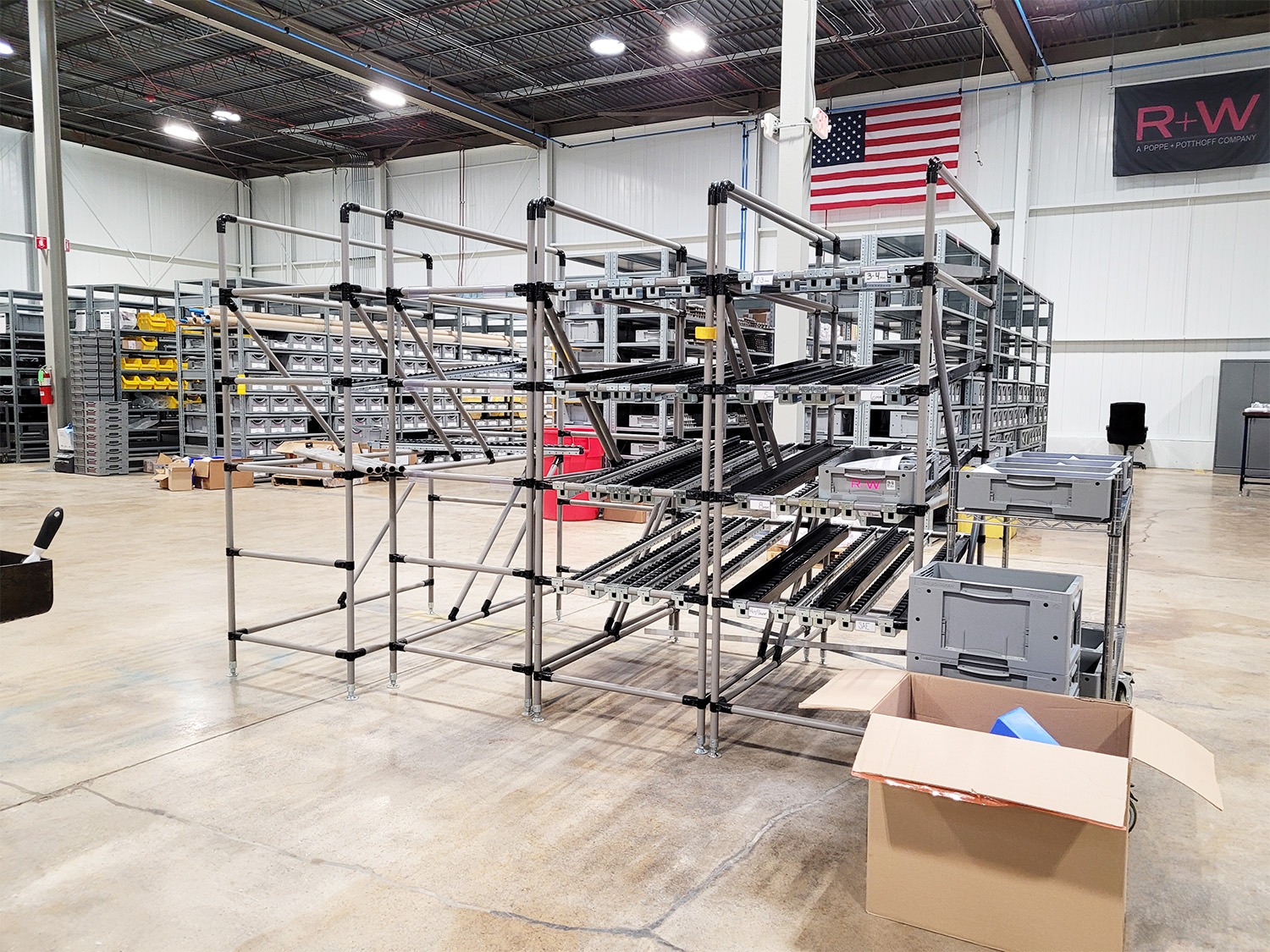
Line-side flow racks ensure that electronic supplies, materials, and parts can be loaded from outside the electronic workstation, giving technicians and operators easy access to production bins. The line-side flow rack above incorporates angled rollers at a slight incline of 15 degrees.
Bins are loaded at the back of the flow rack. Each bin slides to the bottom of the flow rack and is held in place with stoppers and a raised pipe section on each level. This ensures the bins are secured in place and do not move until the technician or operator removes the material bin.
Once the material bin is removed, the remaining bins will slide down the angled rollers, waiting for the next technician or operator. Meanwhile, stock replenishment for the line-side flow rack can continue from behind as new replacement bins are loaded onto the rack without interfering with the workflow in the electronic assembly area and workstation.
The Flexpipe material handling system allows electrical manufacturers to make their own material handling structures in-house. These structures can be modified, changed, adjusted, shortened, lengthened, or widened in a fraction of the cost and time compared to conventional welded steel tables, workbenches, carts, and other material handling structures.
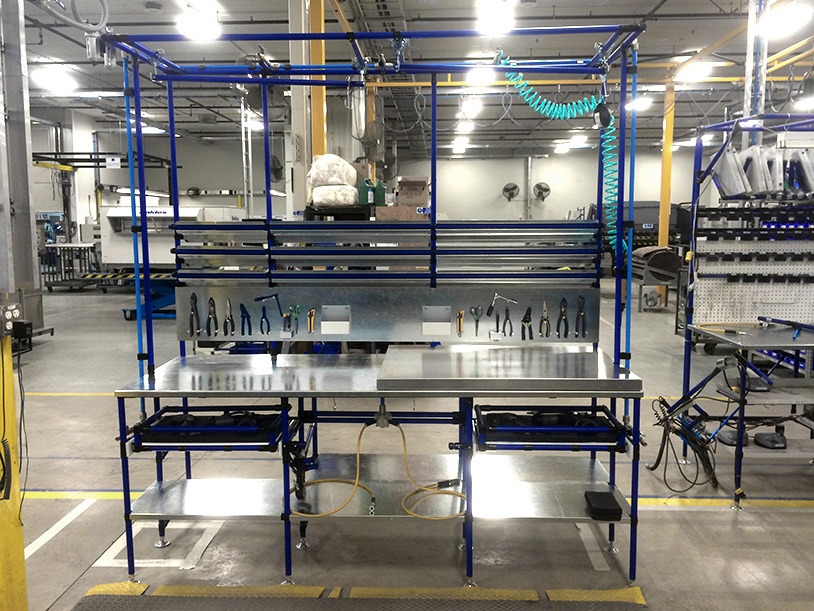
Flexpipe’s steel tube and joint system is the ultimate in customization. Electronic manufacturers can design, cut, assemble, and adjust any free-standing material handling structure and workstation. All these changes can be done by the company’s employees.
- Ultimate in modularity, flexibility, and scalability.
- Extremely low cost compared to fixed, welded structures.
- Eliminates high-cost steel-welded material handling structures that cannot be changed.
- No more working around fixed, steel-welded structures that can’t be moved.
- No more going outside to third parties to have existing structures modified.
- Changes can be made in-house in anywhere from 5 minutes to an hour.
6. Case Studies and Success Stories
There are countless examples of how Flexpipe’s steel tube and joint system has allowed electronic manufacturers to achieve significant cost reductions while dramatically improving lead times and customer value.
In many instances, these were manufacturers who used Flexpipe’s steel tube and joints to adopt lean manufacturing best practices and the Kaizen philosophy.
Hologic: Healthcare Manufacturer
One such example is that of Hologic. A critical healthcare and diagnostics company that manufactures a comprehensive line of mammography products, Hologic’s manufacturing processes, material handling structures, and workflow needed drastic improvements.
Hologic had numerous welded material handling structures and workstations across their production space. Employees often took tools and consumables from each other without ever returning them. Space was at a premium and workflow was severely affected.
Using Flexpipe’s steel tube and joints, the following changes were made.
- Eliminated cluttered workspaces and removed all welded workstations and welded material handling structures.
- Created over 70 different modular and scalable Flexpipe material handling structures with smaller, more compact profiles
- Used 5S philosophy and Flexpipe’s steel tube and joints to create cleaner, more efficient workstations.
- Improved safety and ergonomics by eliminating numerous tripping hazards due to poor work cell and workstation layout.
- Eliminated employees borrowing or misplacing tools and consumables.
- Increased productivity by 25% and saved an additional 20% of floor space.

Aldes Canada: Ventilation Manufacturer
A well-established manufacturer of commercial and residential ventilation equipment, Aldes Canada wanted to replace their high-cost, welded, fixed-structure workstations with Flexpipe’s modular and scalable steel tube and joint systems.
- The existing welded workstations were heavy, hard to move, and took up far too much space.
- These welded workstations could not be changed or modified in any way – making them ill-suited to the lean manufacturing environment within Aldes Canada
- The cost of the welded workstations was a little over $1,000 each – making them incredibly expensive.
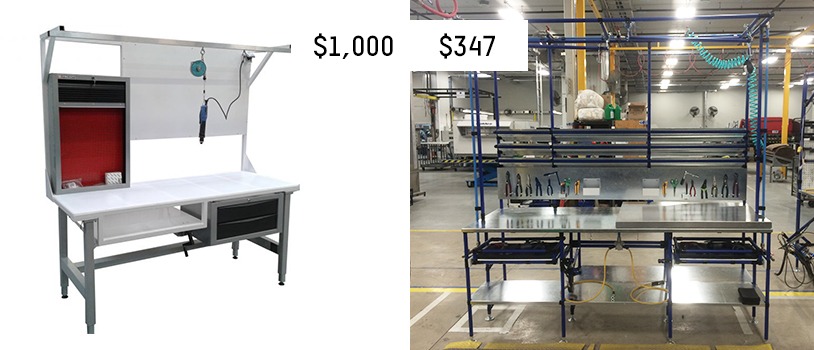
- Using Flexpipe’s steel tube and joint system, Aldes Canada was able to reduce the costs of their workstations by an incredible 65%.
- Flexpipe workstations were only $347 versus $1,000 fixed welded workstations.
- Over 125 Flexpipe structures have been built.

Safran Landing Systems
A world-renowned, market leader in aircraft landing and brake systems, Safran Landing Systems was an ardent supporter of lean manufacturing, having long ago adopted Kaizen within their manufacturing processes. Looking to expand their operations, Safran needed to reduce the cost of their workstation and material handling structures.
- Had recurring issues with misplaced parts and consumables due to chaotic parts storage, costing valuable manufacturing and assembly times.
- Replaced all welded work benches, structures, and workstations with customized Flexpipe replacements.
- Build over 600 modular, scalable, and fully customizable Flexpipe structures – from mobile kitting and material handling carts to trolleys, flow racks, workbenches, and workstations.
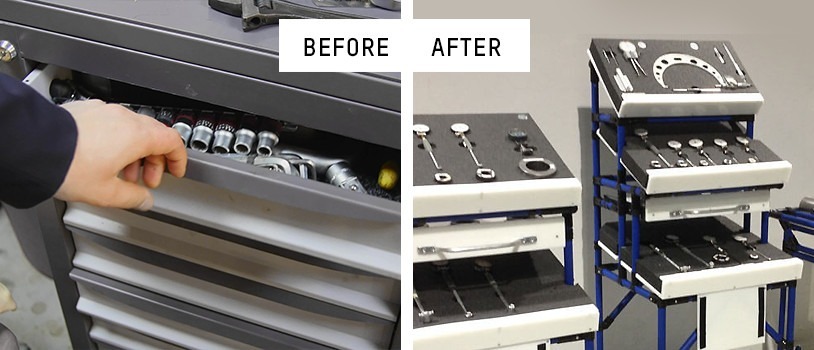
- Reduced the costs of their workstations and material handling structures by over 40%.
- Newer, modular, and scalable material handling and workstations dramatically improved material workflow and operating efficiencies.

7. The Future of Lean in Electrical Equipment Manufacturing
The future of lean manufacturing for electrical equipment manufacturers is a healthy one. Lean manufacturing and Kaizen are perfectly aligned with the quickly changing market dynamics that electrical equipment manufacturers face daily.
Lean manufacturing improves customer value because electrical equipment manufacturers must constantly pursue newer, faster cost savings and improved efficiencies. The end result is a manufacturing process that shortens delivery times on existing products, improves quality, and incentivizes manufacturers to further reduce costs and time-to-market lead times for new products.
Implementing Lean and Getting Started
The road to lean manufacturing is a long but enjoyable one. However, getting started is easy. It simply takes a willingness to improve existing manufacturing processes and the follow-through capabilities to continually push continuous improvements.
Success involves using the right lean manufacturing tools, empowering employees to be their best, and never settling for the status quo.
Key Takeaways
- Lean manufacturing helps electrical equipment manufacturers reduce waste, increase efficiency, and shorten time-to-market.
- Tools like 5S, Gemba walks, value stream mapping, JIT, and pull systems play a critical role in lean implementation.
- ESD-compliant material handling solutions are essential for protecting sensitive components in electrical manufacturing.
- Modular and scalable systems like Flexpipe make it easy to adjust workstations and carts as production needs evolve.
What is Flexpipe?
Flexpipe is a modular steel tube and joint system designed for lean manufacturing. It allows manufacturers to create fully adjustable carts, racks, and workstations at a fraction of the cost of welded structures — all while supporting continuous improvement.
Want to go further?
Discover why modular material handling is key to building efficient, scalable systems in the electrical manufacturing industry.
The Flexpipe Solution: The Ultimate Lean Manufacturing Tool
As a lean manufacturing partner to numerous manufacturers in multiple industries, Flexpipe’s steel tubes and joints are the perfect tool your company needs to embrace Kaizen and adopt lean manufacturing best practices.
Our expansive product line of modular and scalable material handling solutions is supported by a dedicated and experienced team of lean manufacturing professionals and a comprehensive library of learning tools and insights.
If you would like to learn more about how Flexpipe has helped other companies, please visit our Flexpipe case studies.
To get a first-hand look at the many different types of material handling structures you can assemble with Flexipe’s steel tubes and joints, please visit Flexpipe structures.
If you would like to download our free Flexpipe Creator Extension to help you design future Flexpipe structures, want to learn more about our Flexpipe products or have questions, contact us now.