Flexpipe Kaizen Tool


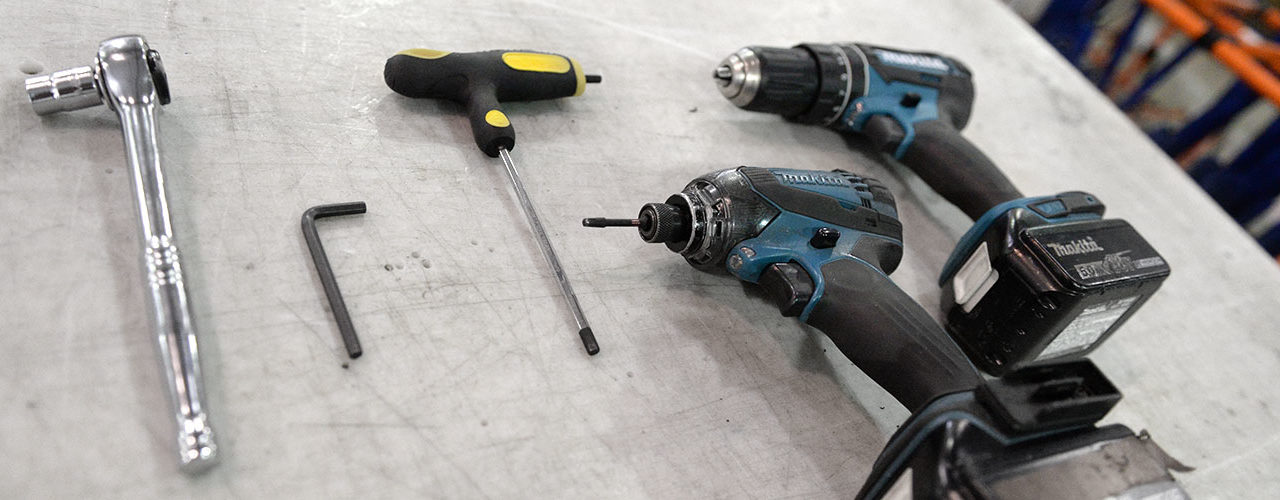
Top 5 tools for assembling

Top 5 tools for assembling

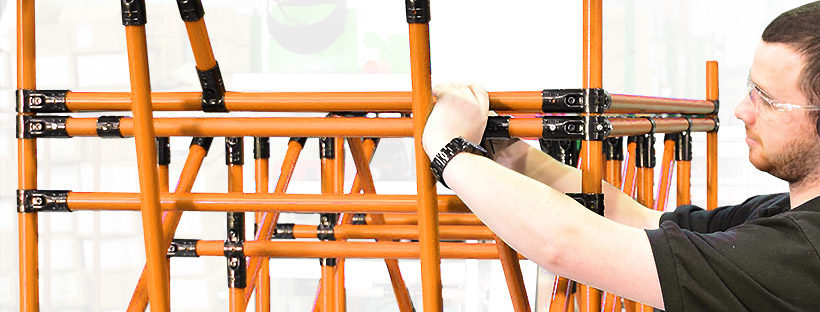
Assembling a Flexpipe structure can be an easy process and can be made even quicker if you use the appropriate tools. All Flexpipe joint sets are assembled with the same nuts and bolts. As such, you’ll just need a 5-mm hex head tool to carry out your project.

Depending on the scope of the project, it’s essential to know which tool can save you the most time and money. Here’s a list of the five tools we recommend, with their respective pros and cons.

Estimated reading time: 4 minutes


5 - The 5 MM Hex Key (Allen Key)

The hex key, or Allen key, is found in most toolboxes. This inexpensive tool, which is available in many stores, is perfectly adapted to carry out adjustments on existing structures or to build small projects. The hex key’s modest size enables you to work in those hard-to-reach places that other tools are unable to access.

TIP: Did you know that you can cut a long hex key into several pieces? These pieces can subsequently be used as a hex head on your drill. However, this tip does not work for impact drivers.

We don’t recommend using a hex key for assembling larger projects, as this may be painful for your hands and wrists. While the hex key is convenient, it’s not intended to be a time-saver.

 
4 - The Hex Socket (Dynamometric) Wrench

A hex socket wrench is a useful, light tool. One can choose a 5mm (1/4’’) unit with a preset cutting range of 2-100 inches per pound (9.8 Nm). This cutting range is the ideal strength to assemble Flexpipe structures. As such, your bolts will always be correctly tightened.

TIP: You may find it challenging to locate this preset tool, so we’ve done the searching for you! The tool is available for purchase on seekonk.com (US-based, delivery to Canada is possible).

While this tool is faster than the hex key and the T-handle, you’ll find others listed in this article that are quicker to use. You should keep in mind that a preset torque wrench is not a standard tool, and it can be challenging to find; it can be expensive, too.

If the one you are using is not preset, you’ll need to pay close attention to the torque setting. If it’s too tight, the bolt heads may become stripped, and you won’t be able to use the bolts again in future projects.

 
3 - The Cordless Drill

A cordless drill is a highly useful tool for projects that only require short assembly time. Given that most people have already used a drill, little employee training is necessary. Furthermore, you probably have one on hand in your facility!

It’s essential to adjust a drill before using it. You must select the “V1” speed setting: that is, the drill speed will be moderate, but with a high level of power. Failure to adequately set the speed level can lead to a wrist injury.

Also, be ready to compose with the tool’s weight when assembling a large-scale project. Speed is critical here; make sure you have the right torque setting, so you don’t strip the bolt heads and render them unusable for future projects.

 
2 - The T-Handle Hex Key

As a useful complement to the impact driver, the T-handle hex key is handy to tighten bolts, which are hard to reach. Its rubber grip makes it more ergonomic and comfortable than the hex key, and it is also very affordable.

As is the case for the hex key, this tool is not suitable for large-scale projects. If you do choose to use it, nonetheless, it may be painful for your hands and wrists. While it won’t provide the quickest execution time, the T-Handle hex key can prove to be useful in certain situations.

 
1 - The Impact Driver (Impact Gun)

The impact driver, also known as an impact gun, is the tool we recommend most. Why? Because it’s powerful, fast, and quite affordable. It’s best to set it at medium power for top performance.

Be sure to have the proper torque setting to avoid stripping the bolt heads, or else they will be useless for other projects. We also recommend purchasing a replacement battery, so your assembly process is not interrupted by a dead battery.

 
Tip about Flexpipe nuts and bolts:
All Flexpipe joint sets are assembled with M6-N nuts and M6-25B bolts. The term M6 refers to the outer metric diameter of the head, which is 6 mm.


Conclusion
Now that you know all the characteristics of these assembling tools, you should be able to determine which is the right tool to assemble your Flexpipe structures. Remember that it’s essential to evaluate the scope of your project correctly, so you purchase the tool that best suits your needs.

The 10 steps for a successful project

The 10 steps for a successful project

When it comes to setting up the process to assemble pipe and joint projects, there are certain principles you'll want to keep in mind. We've drawn up the following list of 10 steps to follow, so the construction of your structure goes as smoothly as possible. Read on for the details!

Before setting up a process to assemble a lean pipe structure, we suggest your pipe builders receive basic training on how to use the Flexpipe product. Also, make sure to have a suitable environment equipped with sufficient space and tables, a minimum of raw material, and all necessary tools so your team can carry out the work efficiently.

Our customers build lean pipe structures using different processes which differ depending on the company size, history with Flexpipe products, etc. In some companies, the designated builders change every week, which means that their processes will be different from companies who always use the same builders.

 
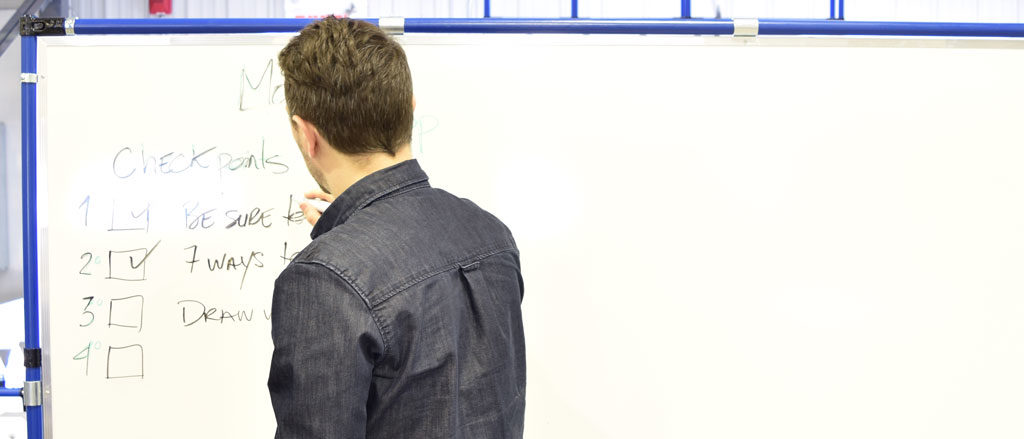
1 -  Fill in the 7-ways idea sheet
The first step consists of coming up with seven different ways to solve the problem at hand. To get you started, read the article Our 7-Ways Idea Template to Avoid Tunnel Vision. Then, download the Excel the 7-Ways Idea template.

Remember to use your wits, instead of reaching for your wallet – and try to think outside the box! Often, a bit of innovative thinking can go a long way and doesn't require additional investments.


2 -  Select and hand sketch the chosen idea
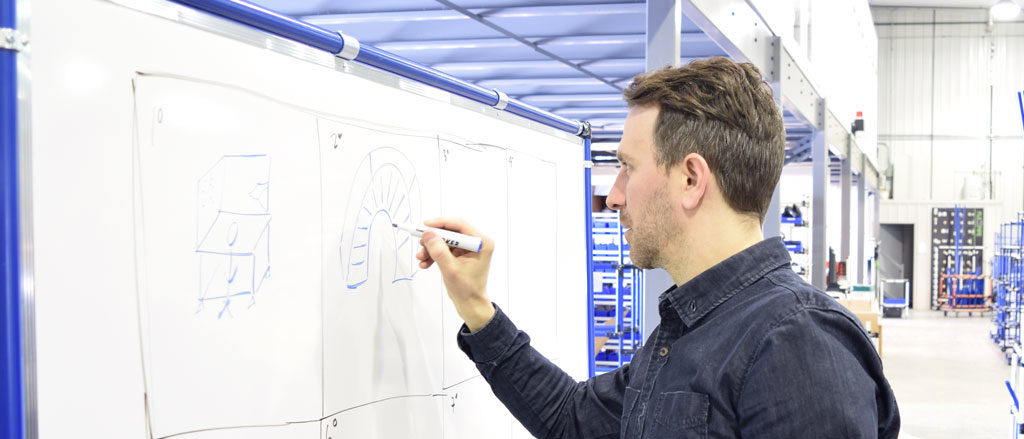
Usually, at this point, you'll have a pretty good idea in which direction to head in, but, if not, don't waste any more time on brainstorming and start "try storming." No more excuses: get things started and test the prototype! After, you can draw another sketch in greater detail, which includes what material you will need.
Download your printable project sheets here.
For more information on hand-sketching:


3 -  Draw up a list of what material you need and how much
Allow us for a moment to use a cooking analogy. As you know, pretty much every meal has a recipe. Try to cook a meal you've never prepared before without the recipe, and you'll most likely fail. The same goes for your project. Without a material list, odds are you're not going to get anywhere. Have a proper bill of material on an Excel sheet or at least on a list that you've jotted down by hand.

 
4 -  Order the required material
Unless you keep an inventory of parts at all times (a practice you should avoid, in keeping with the Lean philosophy), you will more than likely need to order some components — but try to use what you have on hand as any good moonshiner would!


5 - Make sure all material is available before starting to build
Have you ever noticed the one thing that all cooking shows have in common? The reason most chefs can complete a recipe within 30 minutes is not just thanks to the magic of video editing. Instead, the answer lies in the fact that they have all the recipe's ingredients in front of them ready to be used. So coming back to the assembly project, when you have all the materials available, you will drastically speed up the assembly process.


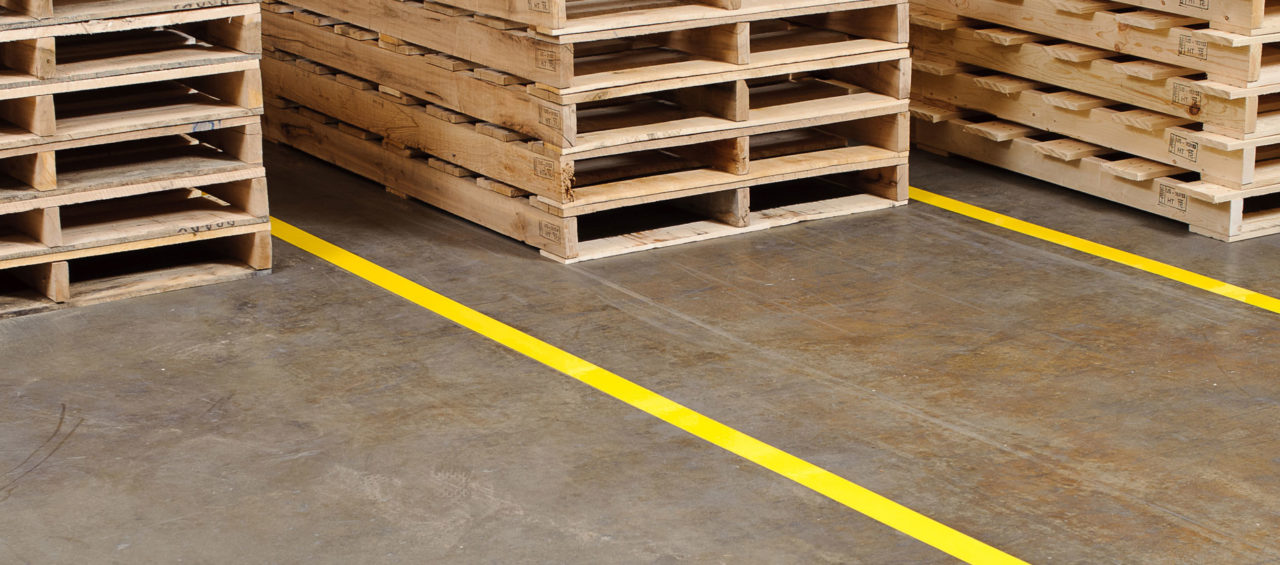
6 -  Mark the location of the project on the ground with tape
This is where your 5S floor marking skills will come in handy. If you're not familiar with floor marking principles, learn more on the 60 seconds visual workflow blog article. There are also plenty of great resources in online forums such as lean.org.

 
7 -  Build a prototype and see if it works
This principle is called a one-piece flow, and it is responsible for a drastic change in many manufacturing industries. According to this rule, building one product at a time from start to finish is more efficient than doing just one operation to many units before carrying out the next step. This will ultimately save you from making the same error on every unit.

 
8 -  Record the actual quantity of material used to construct the project
Document everything. This is a no-brainer. Well, many people - including us - often forget or underestimate the importance of documenting. This will become critical when the time comes to scale the project. Document how many components you use and feel free to record any individual building processes with which you might have had a problem.

 
9 -  Improve upon the first concept
This wouldn't be a lean method without including notions of continuous improvement. This step is all about optimizing your project before scaling it. Unlike step 7, the purpose of this step is to test the prototype and refine its design to make it more efficient in all aspects. Once you've reworked your prototype, build a second structure.

 
10 -  Calculate the benefits of the project once it's complete
There are many ways to calculate your ROI ("return on investment"). These will vary depending on the nature of the project and the KPIs ("key performance indicators") you choose.

Most of our customers use the Moonshine Shop to improve takt time or to decrease injury risks and floor space. These metrics are usually easy to calculate. However, they are just examples of the standard indicators we see in our industry. This method is versatile, and the results can be surprising.

To conclude, if you apply these steps correctly, you should quickly see the benefits generated from this process every time. No one likes to waste time, and, as we all know, time is money. We want to make sure that your time – and budget – are well spent!

Along those lines, we encourage you to consider using a Flexpipe crib, which is a storage structure for Flexpipe parts. You'll be surprised by the extent of its potential and see just how useful it is in your work environment.

Everything you need to know about our modular system starter kits

Everything you need to know about our modular system starter kits

First time are you using modular systems? Well then, a kit is the best way to ease your team into using this type of equipment because all the parts and examples of plans are already included. Read on for more detailed information about this kit and all the pieces included.

Who should use starter kits?

You’ve done your due diligence and have finally gotten approval to buy Flexpipe equipment. Your team and management are on board, but now you’re racking your brain trying to figure out which parts you need to order and which structures the team must build. Flexpipe’s starter kits are going to make your job a whole lot easier. We know time is money; let us help you save on both.

What’s included

Based on our experience and that of our customers, we’ve created each starter kit in such a way that it contains the parts and their corresponding unit count, most commonly used to build various types of structures. We ensure that there is a proper ratio of units (i. e.: screws, connectors, and tubes) so you’re not stuck with unnecessary leftover parts. Depending on the structure you want to build, we supply you with its essential components (such as conveyors for flow racks, for instance). We also include up to 7 structural plans if you want to get a head start on assembling your structures.

For new customers, one of our project managers can assist you in designing the structures to meet your specific needs. From there, one of our draftspeople can create two 3D plans for you. Once the plans are approved, the parts list is updated to make sure all the units to build the customized structures are part of the kit. Additionally, all tubes come with information relating to their cut length. This will make assembling the first few structures much easier.

Advantages

A starter kit is a terrific way to learn the ropes on how to use a modular system because no pre-assembled tube-and-joint structures are available for purchase. Skip having to design plans; you can start building the structures right away! Gone are the headaches of making sure that you and your team have all the necessary parts. Our goal is to ensure that learning to use our system is as easy as possible. With the purchase of any starter kit, you will get the ultimate starter box, which includes all tips and tools needed to get started as smoothly and efficiently as possible.

The possibilities of a starter kit

If you want to improve your production floor’s operations, personalizing the equipment your employees use to fits their needs is a win-win for efficiency, budgetary, and ergonomic concerns. With a modular system, the structures can be easily and quickly improved upon, and as often as necessary. Whether it be adjusting their height, size, or adding a turntable, shelves, drawers, or shadow boards, adaptability is vital here, and that’s precisely what Flexpipe pipe and joint systems deliver.

With a starter kit, you’ll be able to build 4 or 5 sizeable structures. We recommend you start by creating a structure that is not too complex. Remember, even a simple project can have a considerable impact on operations!

Options

Once you’ve placed your order, our customer service team will contact you to confirm which color you would like the tubes to be. What’s more, should you want to alter the list of parts, we’ll be happy to make the necessary changes.

Training

Need help building your first structure? Your team can take advantage of training sessions at Flexpipe’s headquarters—free of charge! If you prefer, our assembly experts can carry out the training for your facilities. To get the basics down pat while in practice, a starter kit is essential.


6 essential personality traits of the ideal assembler

6 essential personality traits of the ideal assembler

Now that you have determined the people most suited to building your Flexpipe structures, here's a list to help you choose the perfect candidate according to their primary personality traits.

The factor which will most influence the success of your project is the personality of the individual or the team who is assembling the structure. Please note that there's no precise order to this list. The more characteristics the chosen assembler has amongst it, the higher your project's success rate!

Haven't yet chosen the best people to assemble your modular system? First, take a moment to read our article on eight most likely people for an in-house assembly.

Estimated reading time: 3 min 20 sec.


1 - Be Creative
Customized modular structures; a significant asset for efficiency

Modular systems, such as Flexpipe, mainly need creative assemblers to be fully effective. This attribute is most useful during kaizen events, but also when creating custom-made structures.

Remember that tube and joint systems are used to build all kinds of structures suited to various needs. The goal is to create a structure that you couldn't find in a store.

 
2 - Have a clear and straightforward perspective
The design's simplicity is key!

Flexpipe structures need to be simple, economical, and easy to test before implementation. The best designs can solve complex problems thanks to their simplicity and flexibility. This is one of the modular system's most significant advantages.

We can, therefore, establish a parallel to the KISS principle, which means "Keep it simple, stupid." This principle aims to eliminate any unnecessary complexity whenever possible when designing the structures.

 
3 - Be skillful and resourceful
Think outside the box

Although Flexpipe parts are easy to cut and assemble, complex manipulations can be needed. That said, we recommend using the person with the best skill set for this job. The use of specific tools may be necessary.

We believe that most individuals can assemble the Flexpipe system, with the help of a single training session on which tools to use. To find out more, read our articles Top 4 tools for cutting and Top 5 tools for assembling to determine the most appropriate tool for your project.

 
4 - Be ingenious
Knowing how to push back the limits

The Flexpipe system offers a multitude of accessories to customize your structures and maximize their potential. A skilled assembler will find what he or she needs to complete his project.

You may need more than pipes and joints to complete a project, however. Whether you choose to use a whiteboard, foam protectors, fasteners, or supports of any kind, the possibilities are just about endless!

 
5 - Have a lean mindset
An adapted work environment designed to be effective and ergonomic

You don't need to be a six sigma black belt professional to have a lean mindset! Knowing the basic concepts of lean production will help you optimize the structures of your modular system.

An ideal assembler should have assimilated 5S techniques beforehand.


6 - Be constant and committed
A stable workforce with high potential for adaptability

The use of tubes and connectors is a gradual process and requires continuous improvement. It's also worth noting that there's a significant learning curve when it comes to designing and assembling various structures of the system. The assembly of each new type of structure is sure to make an assembler proud!

This person should also be able to adapt and improve the initial structures. Keep in mind that assembling structures should not be a temporary assignment that comes to an end when the training session is over nor when the assembler is called back to the production line.


The best of the best
Modular systems are simple, customizable, and progressive. The person responsible for the design and assembly should primarily reflect the same characteristics as the product itself. An engaged assembler will be more likely to design the best structures according to your project and improve them over time.

Our 7-Ways Idea Template to Avoid Tunnel Vision

Our 7-Ways Idea Template to Avoid Tunnel Vision

How to go from a good idea to a great idea? Or what’s the difference between a good idea and a great idea? Good ideas come along all the time and help people solve minor problems. Great ideas appear a little less frequently and require a bit more work to execute. 

Your first idea isn’t probably your best one. However, many of us suffer from “design fixation”, where we fall in love with our first idea, simply because it was first. This is a problem because it stops you from looking for a better one. Time is the most precious resource people have, and finding great ideas can take several days, even months. Our Seven-Ways Idea sheet can take you from a good idea to a great idea.

 
Who is using this Template?
At Flexpipe, we definitely use this sheet for our projects. However, we are not the inventors of this concept. Many of the companies we work with were already using this as standard practice.

Let's take the case of Mitsubishi Heavy Industries Canada Aerospace (MHICA). They use the 7-Ways Idea sheet at the beginning of every Kaizen Moonshine Shop they do. The company knows that this technique reduces the risk of future problems within the design.

For more information:
Check out our article on the 10 steps for a successful project.
How does the template work?
The suggestion needs to be illustrated with at least seven solutions, and seven is a minimum, the more ideas you generate, the better solutions you can devise. Forcing employees to come with several ideas will:

   Push people to take more time and look at things from different angles.
   Force them to ask colleagues, develop teamwork, combine ideas, and bring a new perspective to the problem.
   Push ideas such as idea 5,6, and 7 to go beyond common sense and think outside the box.

 
Still not convinced?
You might think it's a luxury to come with multiple ideas and that it's going to take too much of your time and of the time of your team. However, our experience with this process has proved again and again that investing a little more time at the beginning of a project will save you time and money in the long run by:

   Revealing unknown obstacles and overcoming them before they occur.
   Limiting the number of corrections needed after the project is done.
   Making sure your allotted time is realistic and that you have the resources necessary to accomplish your goals before even starting the project.

 
What this process means for pipe and joint system users?
If you are using a industrial pipe racking system like Flexpipe, you know that possibilities are endless. This sheet will help you explore those ideas and build great structures that will lead to more productivity and less waste of your time and money.

 
Final thought on the 7-Ways-Idea process
Finally, we highly recommend that you download the template and that you implement it for your next project. Don't forget that you should always limit the time allotted to this process to allow the project to see the light of day.

Download the Excel version of the 7-Ways Idea Template.


8 most likely people for an in-house assembly

8 most likely people for an in-house assembly

One of the most frequent concerns we hear is  “I don't have the manpower to do it”. The answer to this depends on many factors but there're several options. However, it will vary based on your resources, budget, time, available space, location and how big your project is.

Here's a top 8  of the most likely people to build your structures. Most of them would do it in-house with greater access to the 4M; man, machine, methods, and material. Building the Flexpipe structures in-house allow a much better customization.

8 - The manufacturing contractor

This might be an individual or a small business you already have as a supplier. They already know your business and your facility because they’ve worked for you in the past or do so now.

These people are used to do manual labor. It may be a supplier who has integrated new production lines for you in the past. This is common in big manufacturing businesses like the Automotive industry. These individuals usually have knowledge of fifo rack principles and one-piece flow.

However, even if they have vast experience in manual labor, they are not necessarily experts in industrial pipe racking systems such as Flexpipe, and they may only see this as a one-time contract. If this is the case, your contractor may have to spend time learning the system, and you will lose the know-how they acquired during the project once it is done.

7 - The mechanical or industrial engineering intern

Hiring an engineering intern is an excellent way to bring fresh lean manufacturing knowledge into your business for a defined period. This is a good option if you have a project with a beginning and an end.

Some of these people have the manual skills necessary, especially mechanical engineers and technicians. Most of them will have design and 3D drawing skills, which is important if you want to standardize structures and keep track of the work once the intern leaves. If you are doing it right, they will merge with your business and bring a fresh and different perspective.

The risk of this option is the internship ending before your project is completed. Also, if this person is the only one with lean manufacturing experience in your company, you will lose this knowledge until you hire someone else with the same know-how. This isn’t optimal, since materials handling systems like Flexpipe are constantly evolving and demand continuous improvements to be optimal.

Before you go looking for an intern, make sure your business culture is adequate for this kind of solution. Interns are usually young people with vague ideas and not necessarily mature professionals. They require a little more supervision, so you need to be able to provide them time and a good integration. Depending on the perception of your current experienced employees, this new team member may also create resistance to changes in your organization.


6 -The lean manufacturing engineer

This is the experienced engineer with knowledge not only about lean manufacturing but also with experience in this field. These people may already have worked with a system similar to Flexpipe, and if they haven’t, they will usually learn the system quickly. Like the intern, these individuals usually have a manual, design, and technical drawing skills.

Keeping an engineer like this in your organization will improve your productivity dramatically in the long run. They will keep improving the system as your business evolves so that you can benefit from the optimal potential of the Flexpipe system.

The lean manufacturing engineer would have been our first choice if it was to define the best person to manage your modular system. The problems with these people is that they may soon tire of spending half or more of their time building structures. Some engineers prefer to design other improvements, while some like to manage the projects. They usually have limited manual skills.


5 - The Flexpipe team

We wouldn’t be experts in material handling systems if we didn’t construct structures ourselves. We have our team of assemblers which builds thousands of structures each year for some of our biggest clients. We also offer help with the designing stage so you can challenge your ideas and improve your concepts. Our team is ideal if you have a big Kaizen blitz coming, and if you lack the resources needed during the assembling stage.

This service is not available for small projects or for facilities too far from our sector. Other businesses who use our assembly team have their structures delivered via freight transporters to their facilities. This is also a less optimal option for facilities far away from Flexpipe since the shipping cost is much higher with complete structures than bulk materials. Furthermore, delays may be longer for our assembly service, plus your team will not have assimilated the knowledge of our assemblers.


4 - Pre-retirement worker

If you have a production worker in pre-retirement, it may be one the best options. Choosing someone with manual skills is preferred. This is an ideal situation for companies that don’t have enough assembly needs to hire a full-time employee. In addition, this existing employee already understands how the company operates.

If this is the first time you introduce a materials handling system like Flexpipe to your business, these people are going to be proud of being part of a new project at the end of their career. If these people are also long-time employees, it is even better because they already know every aspect of production practices that are not well designed and can be improved. They have probably already thought of some designs in the past and would be happy finally to build it to provide a better environment for their co-workers.

There are a few disadvantages to this option. First of all, this worker is probably not familiar with lean manufacturing principles. Secondly, this person will quit within a few years, so you will eventually lose the knowledge they had on the system. Lastly, the pre-retirement worker can have some difficulties with the data processing, which can be an issue on their competencies.


3 - The maintenance team

As far as we know, this option is the most popular in medium and large businesses. These people have the skills, the tools, and often the space needed to assemble structures. They usually have a good relationship with the production team, and they know their frustrations.

The members of this team know the facility equipment better than anyone and may be the best option for designing structures that support the production line. These teams usually love Flexpipe, because it allows them to build something instead of always fixing something. Some of the best concepts we have seen were built by maintenance workers.

The problem with using a team is usually that their primary goal is to make the maintenance of the facility and the equipment easier. This often means that materials handling systems come in second, which could hurt the productivity of the system. The maintenance team is overused most of the time, so tasking them with the assembly of Flexpipe and informing them about lean manufacturing principles could be the wrong decision.


2 - The production team

No one is better suited to building structures than the people who are going to use them. They already know all the little things that could mean improvements for their jobs. There are plenty of case studies out there that talk about how workers have changed even the smallest of steps in the production process and how those changes have saved millions of dollars over time.

A Japanese business allows their production workers to take the time to realize their improvement ideas in a room or place dedicated to building materials handling structures. These employees are supervised by a manager, who may be an engineer to verify that the structures are well built and respect security norms.

There are two major problems when using your production team to assemble Flexpipe structures: First, when they are building structures, they are not producing value at that particular moment. Every improvement they make will eventually pay off in the future, but this could disturb your production flow if not done correctly.

The second problem in making your production team assemble Flexpipe is that they usually don’t have a knowledge of lean manufacturing practices. So as you saw in the example above, you will need to involve an engineer to supervise their work.


1 - The dedicated lean manufacturing team (Moonshiners)

This team dedicates all its time to improving your productivity. This is a multidisciplinary team that will use the Lean Six Sigma principle and tools like Flexpipe to make the most out of your production line. These people probably have encountered a materials handling system before, and they are familiar with it.

Most of the time this team is a combination of the other seven types in this list. We call these people Moonshiners, because they will apply a technique known as the Kaizen Moonshine shop. This option is becoming an industry standard in fields such as Aerospace and Automotive manufacturing. We hope to see more of these teams in other industries in the near future.

The dedicated lean manufacturing team can be a significant investment. This investment will pay off with time. However, we don’t recommend this option for small businesses and if that’s you, we think you should begin with one of the other seven options.

 
Bonus for seasonal manufacturing companies
If you are a manufacturer with valleys and peaks in the annual production flow, you can use this trick. When the production decreases in the low season, take this time to have your floor workers and engineers work on Flexpipe projects and improve their work environment.

Ideally, those extra resources would only be used to support existing teams or individuals who work on Flexpipe year-round. This could be the right time to make that happen.

Why your workplace requires a Flexpipe Crib

Why your workplace requires a Flexpipe Crib

The Flexpipe Crib is a storage structure that requires assembly. The structure will allow you, among other things, to organize your various modular system parts, make the system far more intuitive to use. This equipment may appear to be somewhat costly to the uninitiated.

However, by reading below, you’ll get a comprehensive overview of the Crib’s potential and usefulness in your work environment.


An excellent example of 5S principles
The Flexpipe Crib was designed according to Lean Manufacturing
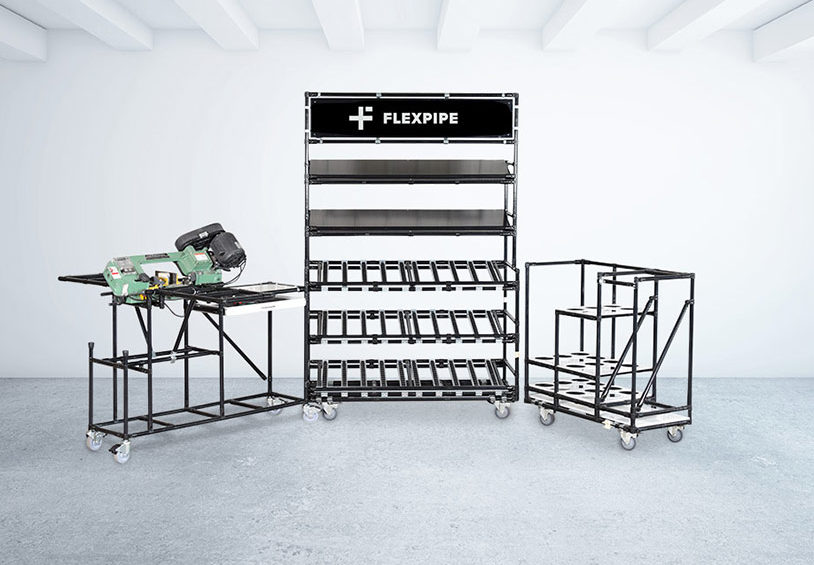
A place for everything and everything in its place is a crucial concept in 5S principles, and the Flexpipe Crib is an accurate reflection of this concept. This structure features three distinct sections: cutting workstation, centrally-located shelf unit, and tube storage cart.

The cutting workstation includes a platform to set up a saw, storage shelves for your tools, and a drawer with foam cutouts to store small tools.

The 5-tier central unit includes two shelves and three conveyor levels for optimal product storage.

The cart includes an 8’ section for tube storage as well as a section designated to manage scraps efficiently.

Each of these components is mounted on wheels making it easier to move each one around for quick configuration changes. Furthermore, you can quickly create a U-shaped cell to reduce movements during the assembly process. One can also choose to close off the Crib when not in use to save space.

The Flexpipe Crib was designed according to the Kanban “two-bin” system to facilitate the inventory of assembly parts at a glance. Two posters displaying all the possibilities of Flexpipe products grouped by category are also included in the Crib’s packaging. Why not do like our customer below and build lateral supports to display the posters clearly!

With these posters clearly visible, no matter who tries to build stuff, they can see what items are available

Michael Dumas - Manufacturing Manager at Barfield Inc.

Too often, structures are assembled directly on the floor or stacked pallets. This is probably the best way to lose parts and increase the risk of work-related accidents.

The Crib is an ergonomic and organized location specifically designed to assemble your modular structures.

Use it to show your team just what Lean Manufacturing standards are all about. In a best-case scenario, each of your facility’s departments should be organized in such a way that they are just as Lean as your Crib.


An excellent self-teaching opportunity
Fill two needs with one deed when learning about the modular system’s various uses
Each Crib comes with pre-cut parts, a detailed, step-by-step assembly plan, and two parts posters. The assembly instructions have been simplified to make the learning process more comfortable, regardless of your skill level.

It took us a while to begin assembling our Crib, but it turned out to be a training session in itself. When we got down to it, we discovered the modular system’s enormous potential. We also realized just how practical some parts were and put them in our structures. We should have taken it out of the box much sooner!

Jamie & Jamie - Maintenance workers at Robinson Innocations

More information:
How modular carts help this logistics company improve its efficiency


It is the most frequently used parts that will go into your Crib’s assembly.
When the time comes to assemble more complex structures, you will have already learned the modular system’s basics. It’s worthwhile to keep in mind that assembling the Crib enables you to understand each component’s usefulness in the overall system.

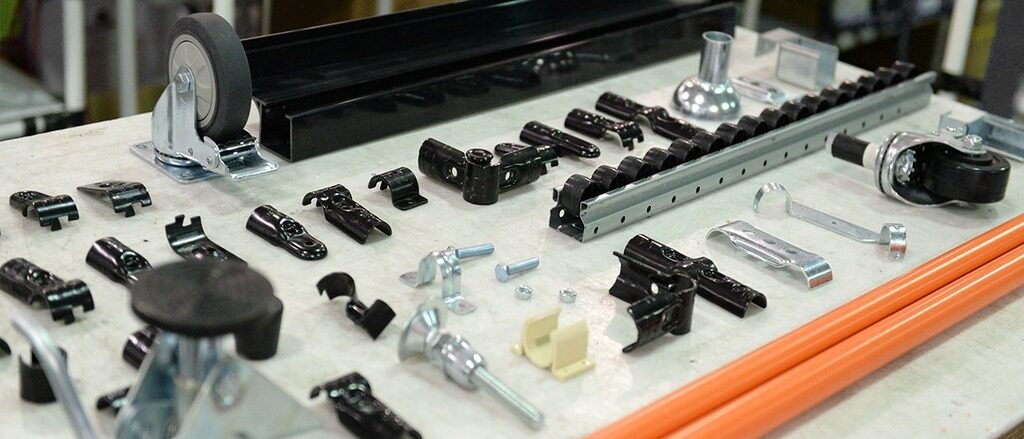
With over 150 different components, you’ll become familiar with certain parts that are often overlooked. Such as accessories (AO-CLIP, AC-STRAP, AI-CORNER, AS-REST), slide brackets (FL-COU), and two types of wheels: stem swivel caster (W-4ESB) and plate swivel casters (W-4PSB).

Here is the list of tools included in your Flexpipe Crib:

T-HANDLE;
T-BIT;
T-CUTTER;
T-REAMER;
T-DEBURR;
T-BCUT;
T-BDEB

Afterward, all you’ll need to do is equip yourself with cutting and assembly tools such as a saw, drill, driver, and measuring tape. Complete your lean manufacturing workstation’s setup with an assembly platform made of Flexpipe tubes! That said, you’ll be able to build it according to the size which meets your needs as well as the available floor space.

To determine which tools are best suited for your situation, please read our articles regarding the best tube and joint system cutting tools and assembly tools to get the job done.


Your mini moonshine shop
Where assembly and creativity go hand in hand
The location you choose to set up your Flexpipe Crib can be more than a mere assembly zone. Make it a place where creativity will fuel continuous improvement initiatives. This area should be accessible to all to encourage as many employees as possible to participate in the creative process.

To set up an efficient and productive moonshine shop, you need a dedicated space at the plant, equipped with basic tools and materials. For example, some companies have a moonshine shop right in the middle of their facility so that employees can see innovative work taking place in real-time.

You can also use your Crib as a storage unit for your 5S tools. Colored labels, floor marking stickers, visual learning tools, or any other 5S project-related items can all be kept in this location for quick and easy use.

As such, the Crib will become a purpose-driven location where 5S principles and Lean Manufacturing principles are highly visible for daily implementation.

More information:
9-step checklist for a Kaizen moonshine shop


Some even use the Crib as a meeting point to discuss essential topics and address urgent problems (Obeya) or for daily morning meetings (DMM).


In a nutshell, the Flexpipe Crib will be a valuable asset when integrating 5S in your facility.
On the one hand, it will help you become familiar with the modular material handling system. On the other hand, it will be an ergonomic and safe place for your continuous improvement projects.

Besides being an area dedicated to assembly and creativity, it can also be a designated gathering-point for Lean-themed meetings.

What is the 60 second visual workflow?

What is the 60 second visual workflow?

In lean manufacturing, the general rule of thumb is that anyone should be able to walk into a workplace and identify the flow of work being done within 60 seconds. One of the easiest and most effective ways to visually accomplish this goal is through the use of 5S floor marking.

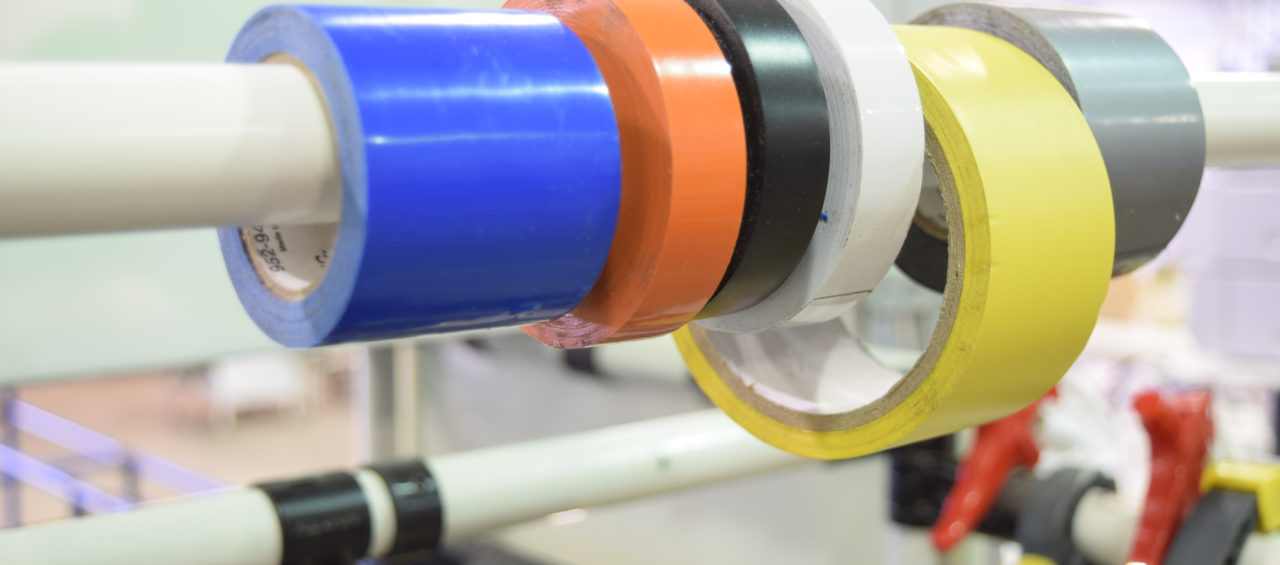
The proper use of floor marking tape helps create order and a flow pattern of work in your facility, which eliminates searching and confusion within a work area. Floor marking also helps to define processes and cells in the value stream clearly.

Every industrial workplace is required by OSHA to mark aisles and passageways to guarantee that pedestrians have a designated walkway to pass safely. Forklift drivers must also be aware of their driving lane’s parameters. But 5S floor marking will do more than that.

In a parking lot, the lines make cars park in a certain way, optimizing the space available. Studies have shown that when a lot is covered in snow, 25% fewer vehicles can park.

The color scheme below complies with the OSHA 1910.144 standard, which purposefully limits the colors included to encourage natural learning and easy recognition of specific areas in the workplace. However, it can also be easily modified to suit the particular operational priorities, processes, and characteristics of individual facilities.

There are many pieces of equipment on wheels (machinery, carts, racks, workstations, boards, etc.), allowing flexibility. However, they can easily be moved, which potentially increases searches and confusion—floor marking with color codes and signage help to reduce this potential problem.
5S Floor Marking Color Scheme (Developed by Brady Corporation)
Yellow
Alleyway, traffic lanes, and work cells.
White
Equipment and fixtures (workstations, carts, floor stand, displays, racks, etc.) not otherwise color-coded.
Blue, green and/or black 
Materials and components, including raw materials, work-in-progress and finished goods.
Orange 
Materials or products held for inspection.
Red 
Defects, scrap, rework, and red tag areas.
Red and white 
Areas to be kept clear for safety/compliance reasons (e.g., areas in front of electrical panels, fire fighting equipment, and safety equipment such as eyewash stations, safety showers, and first aid cabinets).
Black and white 
Areas to be kept clear for operational purposes (not related to safety and compliance).
Black and yellow 
Areas that may expose employees to physical or health hazards (e.g., flammable or combustive material containers); Indicates that extra caution should be exercised when entering and working in the area.

Additional marking codes can be done for recycling, trash, and finished goods but use as few colors as possible. This will make it easier for employees to remember the intended meaning of each color.

Floor marking goes beyond simple line tape:

Arrows to create a flow.

Corner marker for temporary object placement such as pallets.

The footprint for foot traffic.

Dense traffic areas with extra protection.


Supermarket Flowracks and their influence on Manufacturing

Supermarket Flowracks and their influence on Manufacturing

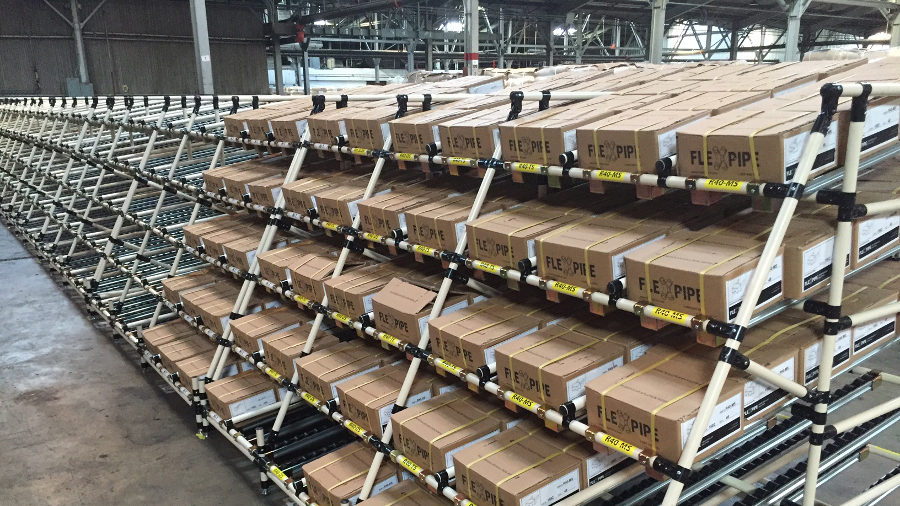
Lean suggests the elimination of large packaging. The use of small lots often requires constant supply. Gravity flow racks help realize this approach with a continuous flow in the factory. Flow racks are usually supplied from behind, and parts are consumed on the other side. Gravity racks can be used on the assembly lines or in the storage areas. The pipe and joint system facilitate the building of these custom roller racks.

The idea is simple: swap the palette of large material containers next to the employee (often representing one or two days of production) for a flow rack, with small boxes representing several hours of production and keeping the presentation neat.

This idea can easily be included in your organization during the design of a lean manufacturing workstation. The flow racks are not new. They were first known for their use in supermarkets for perishable items such as milk. Then in distribution centers with first-in-first-out racking systems (FIFO), but they are now present on assembly lines, services, and even in the health system.

Using small lots and small containers give you the possibility to use parts in a flow mode to transport parts at low cost, to easily follow operation schedules, and adjust to possible changes. This will also allow you to save space on the production line, improve the part presentation, and organize better workstations. An increase in productivity and an increase in production line density (the production volume per unit area) will be quickly achieved.
What are the advantages of this change?
For several years, organizations using FIFO racks have seen the following benefits:

Supplies are more organized

Unlike a standard shelf, a flow rack requires a way to operate: Supplying from behind and consumption in front. This allows two people to accomplish their tasks without interference. Travel is also minimized because all products are found together in one place.

Merchandise is more organized

Some items may be more challenging to store because of their shape. The organization and preparation of components in a flow rack also eliminate wasted time searching for and unpacking parts.

More accessible

To facilitate the work of the operator, the flow rack can be integrated into a workstation. Some travel and unnecessary maneuvers could be eliminated. The ergonomics of the workstation must also be considered in the design of a position.