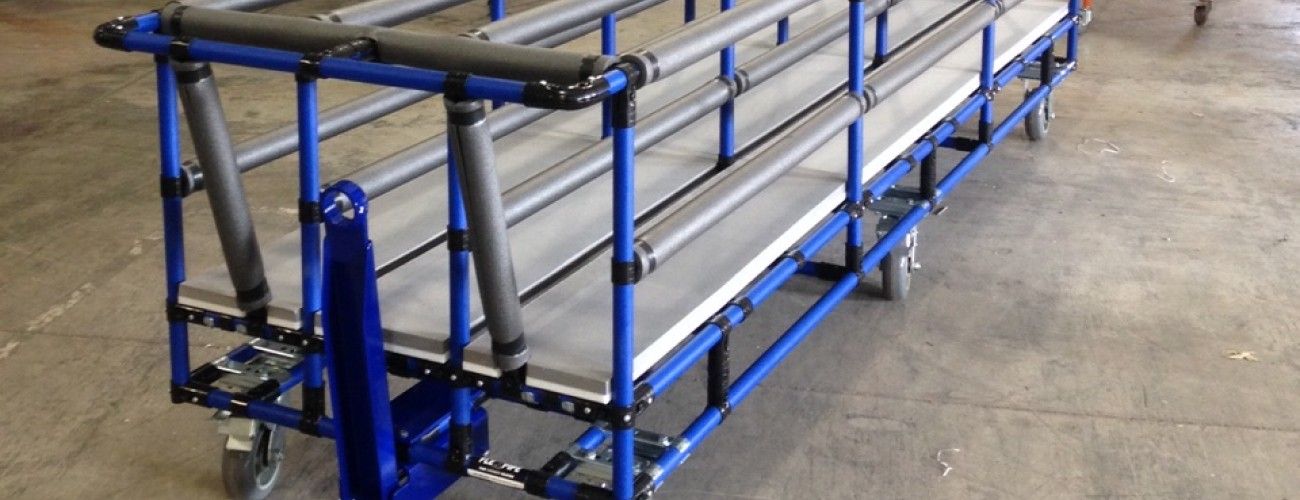
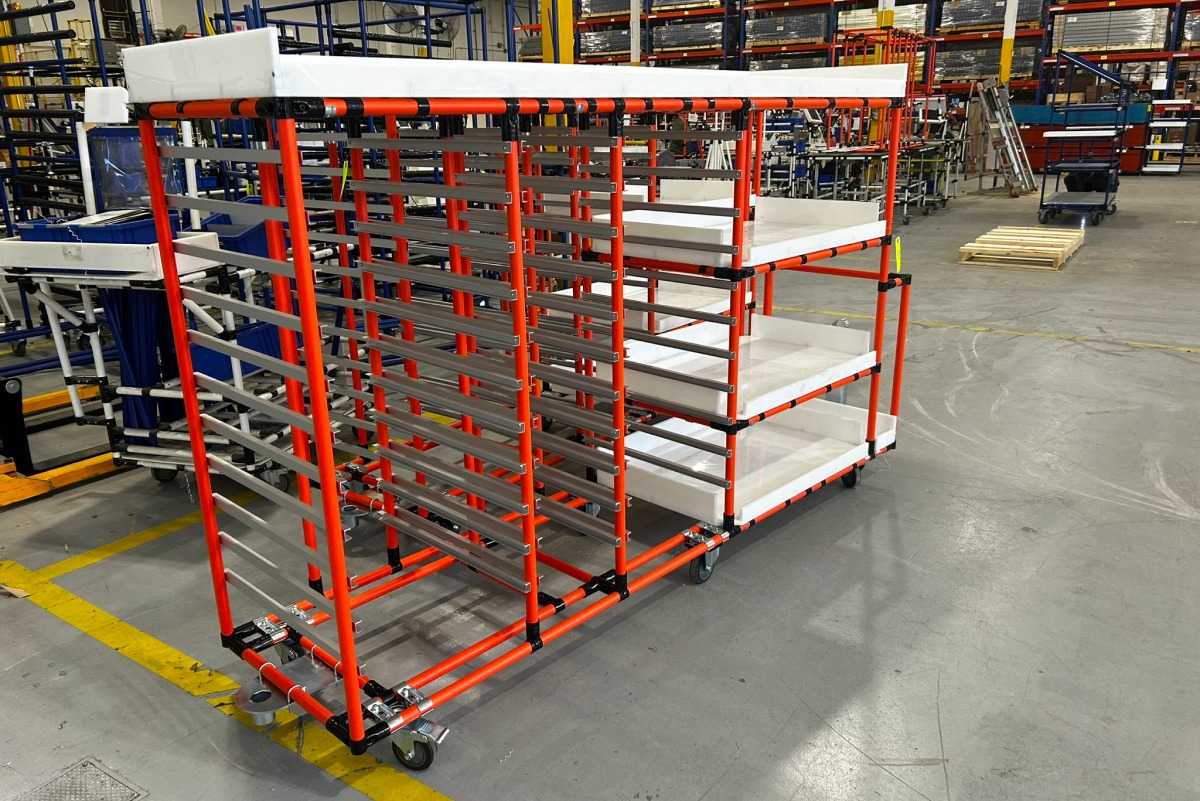

In modern electronics assembly and manufacturing facilities, companies must have workstations that are designed for ESD-sensitive environments. However, just having an ESD-safe workstation isn’t enough. That workstation must be ESD-compliant.
Only after using ESD-ready materials to build the modular workstation can an independent third-party auditing company certify the workstation as ESD-compliant.
Unlike traditional steel-welded workstations and prefabricated benches, modular workstations can be changed, adjusted, and modified without welding and without third-party contractors.
All changes and modifications to the workstations can be made by the production employees themselves.
This makes modular and scalable workstations ideal for lean manufacturing environments where product changes are common and continuous improvement initiatives are essential. Flexpipe Inc. provides the ESD-ready steel tubes and joints alongside numerous accessories like roller tracks, HDPE boards, Kaizen foam, and other ESD-safe components for assembling modular ESD workstations.

An ESD workstation is a workstation that was built and assembled using ESD-safe materials. It is properly grounded and has static-dissipative components, such as ESD work mats, wrist straps, and ankle straps, that work together to dissipate electrostatic charges safely. This then protects assembly technicians, employees, and sensitive electronic parts from electrostatic discharge (ESD) during assembly.
The most important aspect of an ESD workstation is that it is never a stand-alone system. An ESD workstation is part of an entire Electrostatic Protected Area (EPA). An EPA is a designated area of an assembly, manufacturing, or shop floor designed to minimize the risk of ESD damaging electronic components.
It is for this reason that designing and assembling modular ESD workstations with Flexpipe materials requires a complete EPA system approach.
| Component Category | Flexpipe ESD Products |
|---|---|
| Structural Components | – ESD Steel Pipes – Nickel-Plated Steel Joints – Round Joints – Threaded Joints – Clamp Joints – Connectors – Fasteners |
| Work Surfaces | – HDPE Decking Panels – UHMW-ESD Work Surfaces – UHMW-ESD Sheets |
| Material Flow | – Roller Tracks – Bi-Directional Roller Tracks |
| Mobility | – Casters |
| Storage | – Heavy-Duty Drawer Slides |
| Accessories | – ESD L-Shaped Plastic Angles – ESD Accessories |
Whether it’s an electronics assembly facility, battery manufacturer, medical device manufacturer, or an automotive or aerospace manufacturer, workstations in ESD-sensitive areas must be assembled with ESD-safe materials.
Any manufacturer that makes, assembles, or integrates electronic components into a finished good is most often required to have ESD workstations.
To learn about ESD protection, testing, and industry requirements, read our Complete Guide to ESD Protection.
For any manufacturer assembling or integrating electronics, having modular ESD workstations provides extensive benefits. It’s not just about protecting electronic components during assembly. It’s also about how modular ESD workstations lower product failure rates, improve ergonomics, support lean manufacturing and continuous improvement initiatives, and reduce costs.
ESD workstations protect sensitive electronic components during assembly, resulting in fewer immediate electronic failures or latent failures after the product has been delivered to customers.
Fewer electronic failures mean lower failure rates and a higher production yield. Decreasing failure rates increases profitability. Reducing latent failures – those product failures that only occur once the electronic product gets in the hands of customers – means fewer upset customers and less warranty servicing.
An ESD workstation made from Flexpipe steel tubes and joints means creating the perfect-sized workstation for optimal ergonomics. Musculoskeletal injuries are far less likely to occur when everything is perfectly positioned and within reach. Less overreaching means less worker strain.
Not only is reach minimized, but layouts are adjustable. Workers can have the perfect placement and height for work surfaces, while also minimizing eye strain by positioning LED lights and monitors within the ideal range. From soft, perfectly positioned keyboards and work surfaces that reduce carpal tunnel syndrome to reducing injuries and increasing efficiency, modular ESD workstations are worth the investment.

The Flexpipe system addresses all the pillars of a successful lean manufacturing facility. It’s the ultimate 5S tool to improve workstation efficiency. It allows for easy placement of visual information while keeping tools and consumables within easy reach. Right-sized ESD workstations reduce motion waste by keeping technicians working, and the entire steel tube and joint system is perfect for continuous improvement initiatives.

Change is a constant in the electronics industry and any industry relying upon electronic finished goods, integrated assemblies, and subcomponents. From battery manufacturers constantly reducing the size of their batteries to the automotive industry, where vehicle makers are always looking to upgrade electronics, changing products is a must.
As products change, so do the assembly requirements. That means needing a larger or wider ESD work surface or needing to adjust a workstation’s size to accommodate new product dimensions. Whether it’s new parts that need assembly with different material bins or different tools, ESD workstations are rarely static in electronics industries.
Retrofitting and modifying modular ESD workstations is a much simpler, far less expensive, and much faster process compared to steel-welded, prefabricated workstations.

In the end, a Flexpipe modular ESD workstation has much lower costs over its lifetime compared to welded, prefabricated workstations. These costs are reduced even further as modular Flexpipe workstations can be modified numerous times, resulting in a longer service life.
With the ability to reconfigure ESD workstations multiple times coupled with being able to reuse material as needed, the costs of a modular Flexpipe workstation will always be lower than a prefabricated welded workstation.
Before designing any Flexpipe modular ESD workstation, it’s important to be mindful of certain considerations. These include the application for the workstation, the type of production process or work task the workstation will perform, the ergonomics, whether you’ll include special equipment like monitors, the material flow to, within, and from the workstation, and whether you plan to expand the workstation in the future.
| Application Category | Typical Workstation Applications |
|---|---|
| Assembly | – PCB Assembly – Battery Assembly – Battery Module Assembly – Medical Devices |
| Testing & Verification | – Electronics Testing – Calibration – Quality Control |
| Inspection & Service | – Inspection – Repair |
| Research & Controlled Environments | – Laboratories – Cleanrooms |
| Industrial Manufacturing | – Electrical Equipment manufacturing |
After you’ve identified what the workstation will be used for, the space you have available, the importance of ergonomics, and whether you have sufficient space for expanding the workstation in the future, the next step is choosing the features that help you build that ESD workstation.
There are two primary considerations. The first is the work surface itself where electronics will be assembled or worked on, and the second is the surfaces found throughout the modular ESD workstation.
Flexpipe offers UHMW-ESD work surfaces which can be cut to size depending on the overall dimensions and thickness requirements of your workstation’s work surface. Next, HDPE decking panels from Flexpipe can be used for upper shelves, containers, side panels, pull-out drawers, and shadow boards.
Build your workstation around the operator by embracing ergonomics. This means determining the height of the work surface, shelves, and how far the reach zones should be. If using keyboards, ensure there is sufficient space for the keyboard without interfering with the assembly area.
If monitors are needed, ensure they are placed so that eye strain is minimized. Lighting should sufficiently illuminate the work surface without too much glare, and there should be sufficient foot space for the operator when standing or sitting.
The next step is to ensure that tools are properly organized, and the workstation operator has easy access to tools and materials. The focus is on reducing strain.
Focus on point-of-use storage so that the operator can easily reach parts, tools, and consumables. Shelves below the work surface should be used to store larger material bins, while those above the work surface should be high enough not to interfere with work tasks.
Bins should be easily accessed, and pull-out drawers should provide protection for special tools and sensitive items.
From roller tracks, shadow boards, and tool boards to tool-placement and cut-out Kaizen foam for 5S and tablet, document holders, and grounding accessories, Flexpipe ensures you have everything needed to create modular ESD workstations.
| Flexpipe Product | Description |
|---|---|

| Roller Tracks : Upgrade material flow by improving how parts, bins, and assemblies move efficiently within the workstation View the product |

| HDPE Peg Board Sheet : Provides dedicated locations for tools to support 5S initiatives, and quick visual identification of missing tools View the product |

| Kaizen Foam : Create custom cut-outs that securely hold tools for 5S organization that helps to immediately identify missing tools and items View the product |

| ESD Black Sheet : Perfect for work surfaces and for paneling throughout the modular ESD workstation View the product |

| Document Holders : Keep work instructions, drawings, and quality document visible and protected from damage without occupying valuable work surface space View the product |

| LED Lights : Illuminate work surfaces and work areas so that employees don’t experience eye strain and can easily retrieve tools and consumables as needed View the product |

| Monitor Mount : Allow for easy placement of monitors and screens to help technicians identify work order requirements and data entries View the product |
Keeping your modular ESD workstation functional and operational ultimately comes down to some simple approaches. First, schedule periodic inspections of the workstation itself. This isn’t just about ensuring that the technician has adhered to 5S and proper organization, but ultimately about ensuring that the workstation is sturdy and well-maintained.
Second, inspect more than just the work surface. How are the casters? Does the piping look OK, or is it damaged in any way? What about the connectors? Are there sections of the workstation where levels are sloping? Focus on inspecting the entire workstation and be ready to fix what needs fixing.
Third, make sure all work surfaces and accessories are properly taken care of and maintained. Don’t let work surfaces become damaged by poor maintenance.
Download Flexpipe’s free ESD Protection Guide to learn how to design compliant ESD workstations, select the right materials, test for ESD safety, and avoid common implementation mistakes.

In every measurable way, modular ESD workstations made with Flexpipe always beat steel-welded, prefabricated, generic workstations. Flexpipe workstations are adjustable and can be changed by production employees. They can be expanded at any time, are easy to repair, require no welding, have a lower lifetime cost, and use materials that can be reused.
The result is a lower lifetime cost and longer overall useful life.
| Modular Flexpipe | Traditional Welded |
|---|---|
| ✓ Adjustable | – Fixed |
| ✓ Expandable | – Replace entire bench |
| ✓ Easy to repair | – Welding required |
| ✓ Reusable | – Not reusable |
| ✓ Lower lifetime cost | – Higher modification costs |
The most common misconception about ESD workstations relates to whether the materials used mean the workstation itself is ESD-compliant.
So, does using ESD-ready materials automatically make a workstation ESD-compliant?
No. It does not.
Using ESD-ready materials is the all-important first step. However, for a workstation to be ESD-compliant means it must be properly grounded, have the correct work surfaces, adhere to specific ESD governance, be tested, and, most importantly, be inspected by a third-party auditor.
In the electronics industry, it’s a third-party laboratory or industry auditor that comes on-site at your manufacturing facility and certifies that your ESD workstation is compliant.
A company can design and assemble a modular ESD workstation with Flexpipe steel tubes, joints, and accessories, ground the workstation, and test it, but still needs a third party to certify it as ESD-compliant.
Building a modular ESD workstation doesn’t require sourcing from multiple suppliers. Flexpipe provides the complete set of ESD-ready materials in one place:
Start with a free plan, adjust it in the Flexpipe Creator, and order the parts directly. If your team is short on time, our assembly service can deliver the structure ready to use.
An ESD workstation is a workbench made from electrostatic discharge-safe materials and components that prevent static electricity from damaging sensitive electronic parts during assembly, testing, and repair.
Any industry where electronics are integrated, manufactured, assembled, or combined and tested as part of a finished product will need ESD workstations for its employees. Most common applications include the electronics industry, automotive, and aerospace industries.
An ESD workstation has been specifically built with ESD-ready materials, has been properly grounded, and is certified ESD-compliant. A regular workstation would not be grounded and would not be used for electronics assembly.
ESD-ready materials are those materials that were designed to dissipate static electricity, thereby protecting electronic components from electrostatic discharge. These materials are used to make modular ESD workstations.
No. Using ESD-ready materials is critical to building an ESD workstation, but ESD compliance requires proper grounding, testing, and third-party compliance with ESD standards.
Yes, an existing workstation can be upgraded with ESD-ready components provided the workstation is eventually grounded properly.
Because it can be modified or changed by production employees without welding, has a longer service life and lower costs than a steel-welded workstation, and the material can be reused as needed.
Yes, ESD workstations can be made to have shelves, drawers, and tool boards provided ESD-ready materials are used.
Yes. Mobile ESD workstations are possible. They simply use static-safe materials with locking casters. Casters allow the mobile ESD workstation to be moved from one work area to the next.