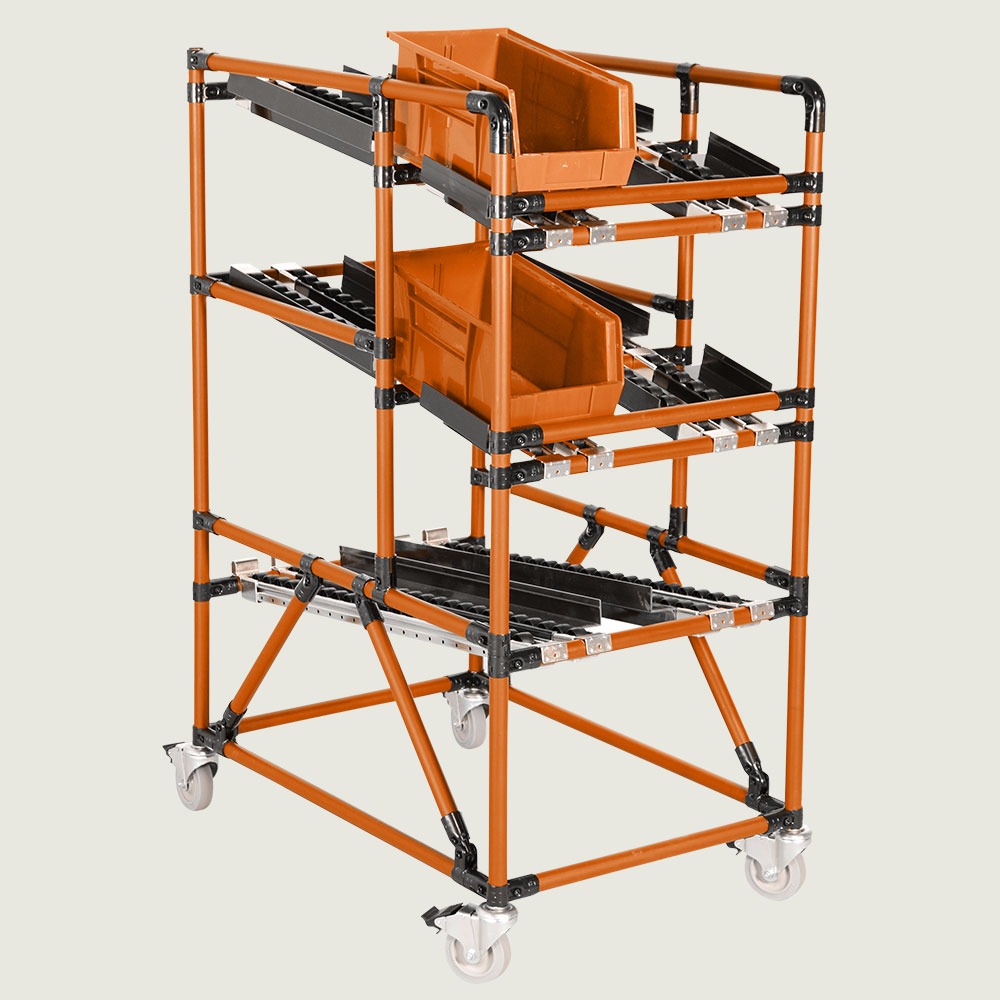
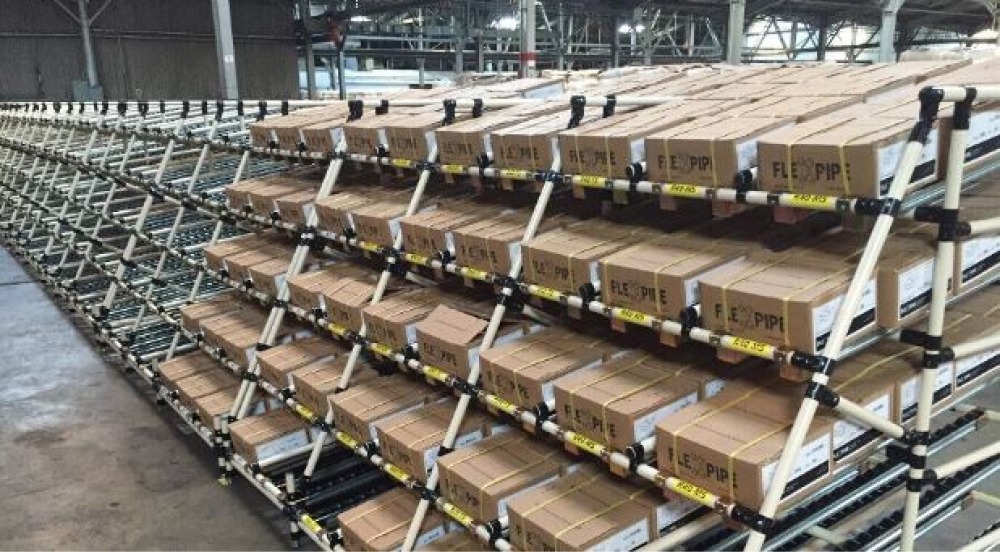
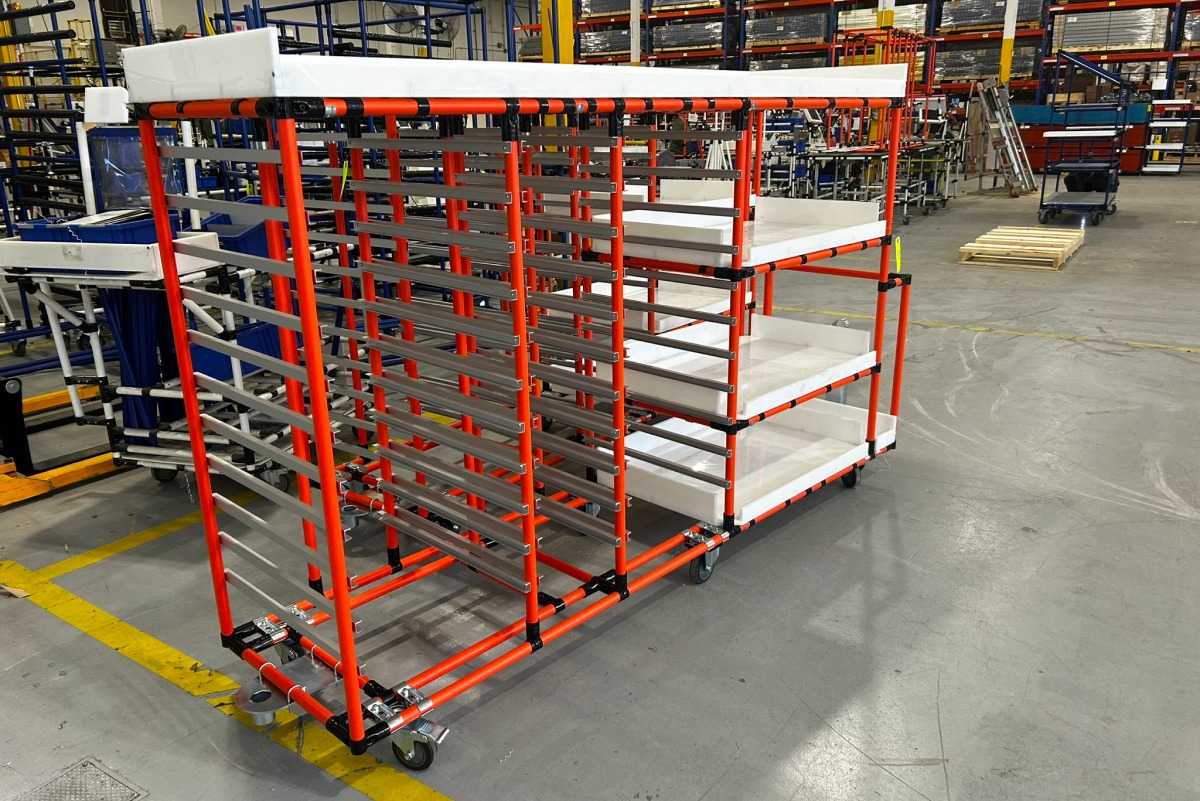

In manufacturing, optimizing floor space is essential to reducing the extremely high costs associated with expanding, leasing, or renting additional production space. However, optimization is about improving efficiency—not simply cramming more equipment into the same area.
To maximize available floor space, manufacturers need material handling solutions that adapt to the production environment, not the other way around. While equipment is largely considered fixed-in-place, modular material handling structures can be designed to fit around machinery, workstations, and production cells.
This is where Flexpipe’s modular steel tubes and joints provide the ultimate in flexibility.
Whereas prefabricated welded structures are fixed, Flexpipe’s modular steel tubes and joints allow manufacturers to create custom structures that easily adapt to the available space. This ensures better use of available space while improving material flow, ergonomics, and efficiency.
L-shaped flow racks are a great example of this flexibility. These structures maximize corner space while keeping parts within easy reach. L-shaped flow racks provide efficient gravity-fed material flow for technicians in U-cells, assembly stations, and line-side replenishment areas.
Like all Flexpipe solutions, L-shaped flow racks can be assembled, modified, and expanded as production needs change, giving manufacturers a practical way to optimize both space and workflow.
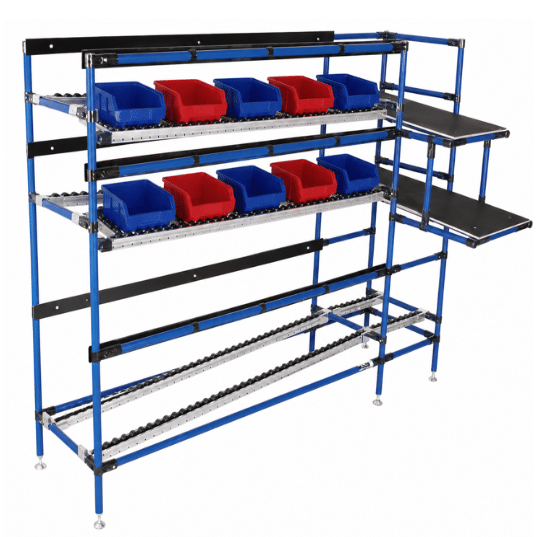
An L-shaped flow rack is a material-handling structure configured in an L-shape that gravity-feeds material to a lean workstation, work cell, or production station. The L-shape maximizes the available corner floor space by ensuring two adjacent sides can provide materials as needed.
Workstation operators and work cell technicians have easy access to materials from multiple angles. The benefit is that the operators or technicians never have to leave their workstations to retrieve critical materials to finish work orders. This is one of the more ideal examples of a modular structure being designed to fit the available shop floor space.
In lean manufacturing, floor space is limited. However, production flexibility is critical, and L-shaped flow racks built from Flexpipe’s steel tubes and joints are an extremely cost-effective solution that is exceptionally strong, durable, and ideal for corner locations requiring line-side replenishment.
For U-cell lean work cell layouts, workstations in corner spaces or tight corridors benefit from the L-shaped flow rack, which ensures a steady supply of materials without taking up valuable space.
Like all Flexpipe structures, a modular L-shaped flow rack requires no welding and no outside contractors to assemble or reconfigure. Everything from assembly, adjustments, modifications, and slight changes can be done by production teams themselves.
With any material handling structure, it’s essential that access is easy. If the L-shaped flow rack requires material bins to be stored from behind – as in a FIFO (First-In, First-Out) flow rack – then there should be enough space to allow employees to store the bins from behind the structure.
There are several benefits to using modular, Flexpipe L-Shaped flow racks on your shop floor. These include maximizing corner spaces and reducing technician and operator movement (keeping them inside their workstation). Additional benefits include improving material flow for U-cell lean layouts and line-side replenishment, being a modular and reconfigurable solution that can be changed or adjusted, and ensuring FIFO compliance.
Generic rectangular flow racks leave large portions of corner spaces unused. This has a cascading effect as other adjacent structures must accommodate that unused space. However, Flexpipe modular L-shaped flow racks can be designed to fit these corners perfectly. Production teams can design and assemble right-sized L-shaped flow racks that perfectly hug corner spaces.
Every time an operator in a lean work cell or workstation must leave to retrieve materials or tools is time wasted. When this happens multiple times a shift, the costs quickly add up. An L-shaped flow rack reduces that operator movement. By having a structure that wraps around two sides of a work cell, operators have a much easier time. Materials are always within reach. That reduces motion waste and increases the operator’s efficiency.
It’s not just about reducing operator motion waste. It’s also about providing a simple, ergonomic solution where material flow is optimized. That’s what you get when you use Flexpipe to make modular, L-shaped flow racks. Materials can be retrieved as needed, and the L-shape perfectly encapsulates and mirrors the work cell and available space.
Every steel tube, joint, fastener, and roller used to make a Flexpipe modular L-shaped flow rack can be reused as needed. Regardless of whether you want to enlarge your structure, increase its height or length, reduce or increase the angle of the racking, or want to increase the number of racking levels, everything can be modified as needed. This simply is not possible with welded or prefabricated structures.
For manufacturers that rely on FIFO inventory management, a modular Flexpipe L-shaped flow rack can be configured so that material bins are loaded from the back of the rack. Each level is then configured with level stoppers to keep bins in place. Operators at the workstation can easily retrieve materials as needed, ensuring that inventory is used quickly. Faster inventory turnover means less material obsolescence and damage.

When it comes to designing and building a corner flow rack, there are some essential considerations to be aware of. It’s not just about properly measuring the corner space. It’s not just about ensuring your structure can handle the load. Equally important is making sure that you have the right angle on the roller tracks so that material bins can easily slide into place after one is removed.
Here is some insight into each critical step.
Carefully Plan the Corner
Make sure to properly take all the required dimensions for the corner. Next, ensure that the two segments that connect at the corner are structurally sound. That means using cross-bracing, using the correct joints and connectors, and using support tubing to ensure a solid, rigid corner assembly.
To properly design and model the corner junction before even cutting a single steel tube, use the Flexpipe Creator Extension.
Optimize Roller Track Angles
The purpose of a FIFO flow rack is to ensure that the material bins are gravity-fed to the lean workstation or work cell. Every time an operator removes a bin, a replacement must easily slide down to take its place. That requires an incline that is typically 3 to 5 degrees. However, this is largely based on the weight of the material bins.
Level stoppers are essential to keep bins in place and avoid them falling off the level. However, be sure to plan accordingly; lighter bins will require a steeper slope to ensure they can replace the next bin, while heavier bins will require a less steep slope.

Both Arms Do Not Have to Be Uniform
No rule says both arms of your L-shaped flow rack must be the same height or length. Decide according to the space you have available. Design around that space, and your arms will have the correct height and number of levels. Identify where material bins are easiest to retrieve and ensure you have designed each level and spacing according to the bin’s dimensions.
Mobile or Stationary?
If you want the ultimate flexibility with your L-shaped flow rack, then design it with industrial casters. Flexpipe offers numerous casters with foot brakes to keep your L-shaped flow rack in place. A mobile rack can then be moved to different locations as needed. However, if you are sure you want to keep the rack in place, then foot anchors will provide the perfect fixed location and increase stability.
Don’t Build Until You’ve Validated Load Capacity
Every Flexpipe structure’s success depends entirely upon the structure’s ability to support the weight of the material it’s holding. This means using the Flexpipe loading capacity calculator to ensure that you are using the right pipe size, span, and dimensions for every inch of your structure. Determining load capacity for your structure is essential before assembling it.
To ensure your structure can support the weight, visit the Flexpipe Loading Capacity Calculator.
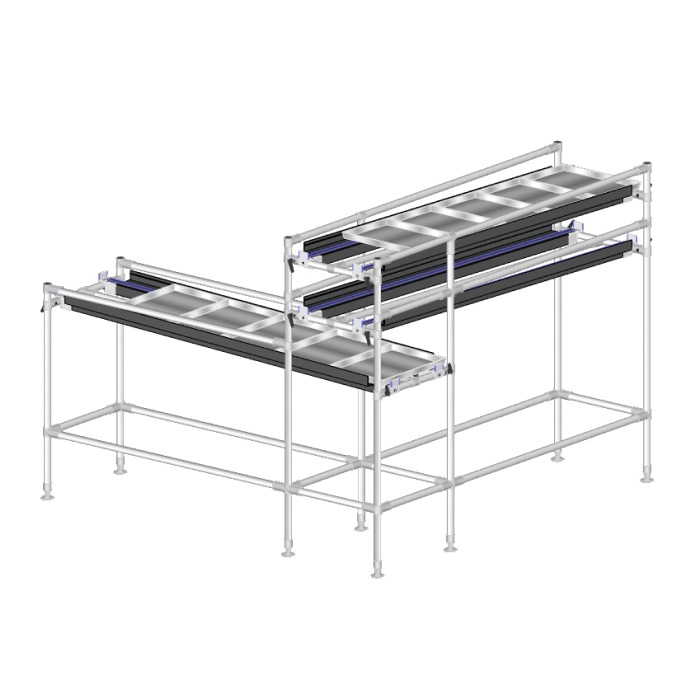
Download this free Flexpipe plan with dimensions, a complete parts list, 3D files, and step-by-step assembly instructions. Use it as a starting point and customize the design to fit your space, bins, and material flow requirements.
While there are some variations from time to time, for the most part, every L-shaped flow rack made with Flexpipe has some or all of the components listed below.

As is the case with any Flexpipe structure, a modular Flexpipe L-shaped flow rack requires the same preventative maintenance. A simple end-of-shift inspection should cover the following points.
These end-of-shift inspections need not be elaborate. Technicians and employees who regularly work in the work cell or workstation that uses the L-shaped flow rack are perfectly positioned to identify issues beforehand.
An L-shaped flow rack is a material handling structure where two segments set at a 90-degree angle gravity-feed material to a work cell or workstation. An L-shaped flow rack allows material bins to be presented on two sides of a workstation lean U-cell simultaneously while also helping manufacturers maximize corner space.
While a standard flow rack presents material bins from one location, an L-shaped flow rack adds a second location at 90 degrees so that material bins can be accessible from two locations. This makes an L-shaped flow rack particularly effective for lean U-cell layouts and corners of a shop floor where floor space is limited.
Yes, an L-shaped flow rack can be made to support first-in, first-out (FIFO) inventory management. Each level can be made to hold angled roller tracks that allow gravity to naturally present material bins for use. Both sections of the L-shaped flow rack can support FIFO material presentation, which makes an L-shaped flow rack ideal for line-side replenishment.
Yes. While work is required, assembling a custom-sized and tailor-made L-shaped flow rack using Flexpipe’s modular tube and joint system requires no welding whatsoever. The solution involves assembling steel pipes, joints, roller tracks, and accessories with an Allen key. All designs using the Flexpipe Creator extension will generate a bill of materials and layout to make assembly easier.
The loading capacity of any Flexpipe structure depends entirely on the wall thickness and length of the steel pipes. Flexpipe has made calculating the load easier via its loading capacity calculator. In addition, because of the relatively low cost of the material, adding small section supports helps to both increase loading capacity and ensure a sturdier structure.
Yes. If you are interested in making your L-shaped flow rack mobile, Flexpipe offers numerous casters and caster designs. These casters allow the structure to be moved across the shop floor as needs change. Plate-mount casters or casters with foot brakes are recommended for heavier configurations to ensure stability and safe movement.
Any industry that has embraced lean manufacturing and continuous improvement can likely use an L-shaped flow rack. This is why it’s so commonly adopted by manufacturers in the automotive, aerospace, electronics, and medical device industries. L-shaped flow racks can also be used as a picking solution in warehousing or as a packing station in distribution centers.
An L-shaped flow rack has three primary uses. Companies rely on them to maximize corners of their shop floor, position them within U-cell layouts, or rely on them for line-side presentation. A supermarket rack is a multi-level rack with one material bin presentation side. It is a straight FIFO racking solution where material bins are stored from behind.