
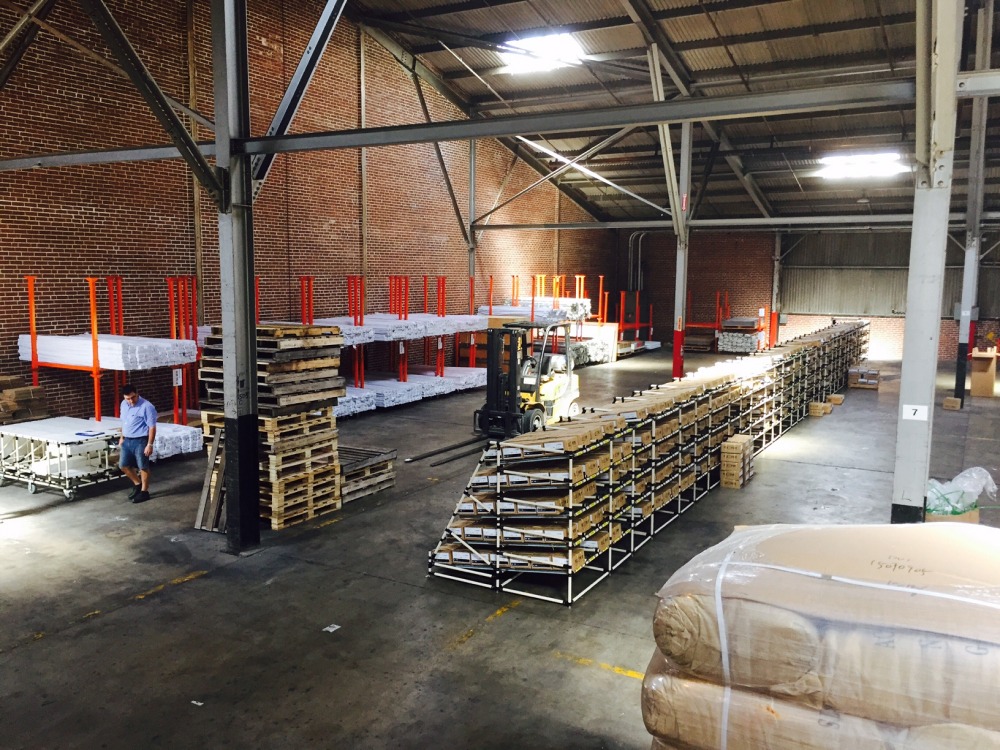

Picking carts are used in order fulfillment centers by warehouse employees who pick products from shelves to complete customer orders. With today’s constantly changing markets and the need to react to ever-changing customer preferences, a modular, scalable, and easily modified picking cart is best – one that can quickly adjust to changing order sizes, volumes, and requirements.
Efficient order fulfillment with a picking cart is a question of flexibility, availability, and cost control. Fixed or welded picking carts are expensive ($700 to $900). Modifying or changing the structure of a welded picking cart involves sending welded picking carts to the manufacturer or a third-party contractor for refurbishment, waiting days or weeks, and incurring significant rework costs that are often higher than the cart’s original sticker price.

This is why today’s lean order fulfillment environments have embraced the modularity and scalability of steel tube and joint picking carts and material handling structures. Far less expensive upfront ($250 to $300), steel tube and joint picking carts can easily be modified or adjusted onsite within the warehouse – sometimes within mere minutes – saving warehouse operations considerable time, resources, and money while ensuring optimal material handling efficiency.
An all-too-common mistake is assuming that all mobile carts are the same and serve the same purpose. They don’t. Kitting carts transport a “kit” or “package” of materials, parts, and components to production so employees can assemble a product. WIP “work-in-process” carts transport semi-finished products to different production workstations. Truck carts hold finished products for packaging or storage, and tugger carts move packaged goods, materials, and finished products to different warehouse locations.
A picking cart serves none of these purposes. Picking carts simplifies order fulfillment. Steel tubes and joint picking carts can be assembled within the warehouse. They can be made to include multiple levels and numerous customized bin locations. A modular, scalable picking cart made of steel tubes and joints means warehouse and order fulfillment centers can easily modify their picking carts to account for new products and changing customer orders.
Warehouse employees use picking carts to pick various products and accessories from warehouse shelves. By identifying specific bin locations via a pick list or order fulfillment sheet, warehouse employees can move from one stock, storage, and racking area of the warehouse to the next, picking various products and accessories and placing them on the picking cart until an order is complete.
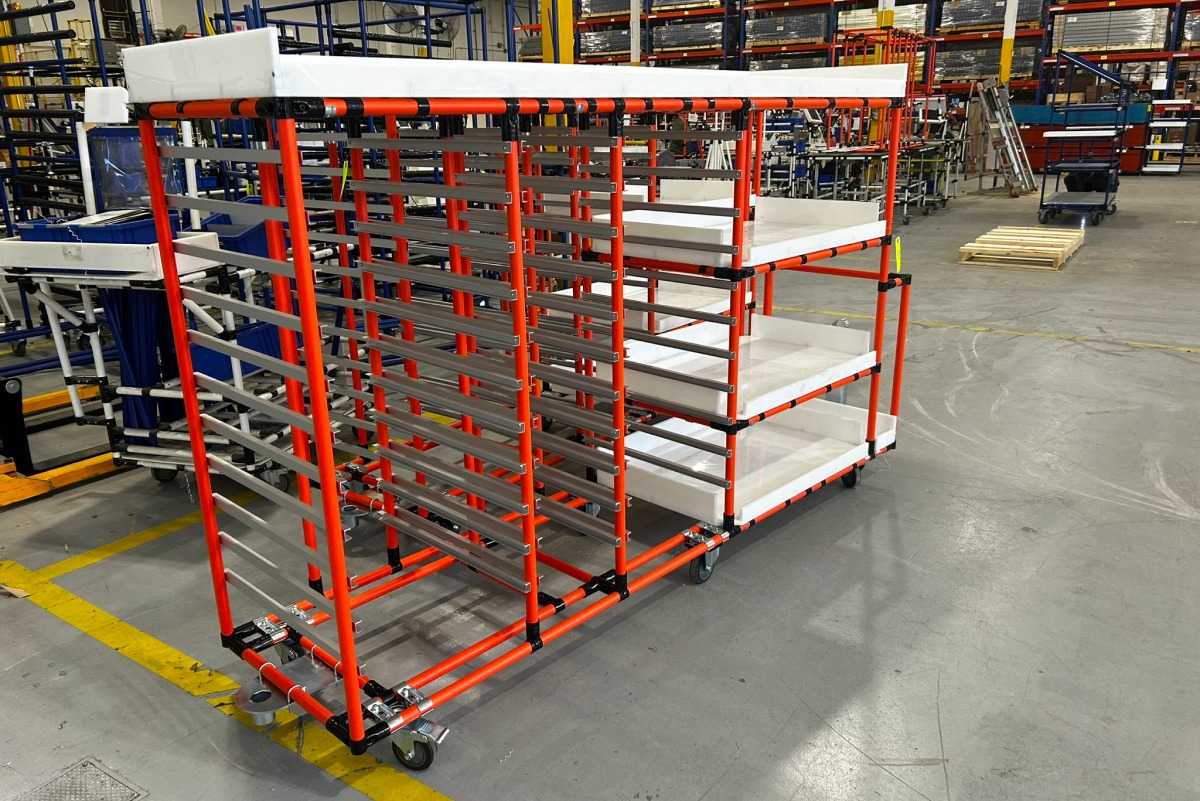
The above image is a perfect example of the customization that can be accomplished with steel tubes and joint picking carts. This warehouse picking cart has casters at the bottom with foot brakes, ensuring that warehouse employees can apply the brake to keep the picking cart stationary. The customized configuration includes two columns with eleven placement areas for sheet placements along with three customized bin locations on the far right and a flat-level storage area at the top.
Modular and scalable steel tube and joint picking carts are the ultimate in warehouse order fulfillment efficiency. They can be configured to act as a fail-safe, Poka-Yoke solution that dramatically reduces picking errors by ensuring only the right-sized products, accessories and add-ons fit into bins. They can be configured alongside Warehouse Management Systems (WMS) to include RFID barcode scanners to improve inventory counting and accuracy.
Modular and scalable steel tubes and joint picking carts can be assembled to maximize available space between adjacent storage, shelving, and industrial racking structures. This provides warehouse employees with sufficient space on either side of the picking cart, allowing them to pick various items without interference or having to constantly walk around the picking cart.
An all-too-common occurrence for warehouses with fixed industrial storage racking is to purchase a welded picking cart whose dimensions are too wide, making picking various items for order fulfillment time-consuming, dangerous, and cumbersome.
With steel tubes and joint picking carts, the emphasis is on modularity and scalability, creating a tailor-made picking cart whose dimensions and bin storage areas are customized to your needs.
Warehouses can also customize their steel tube and joint picking carts for single-pass order fulfillment, helping to reduce multiple trips to and from storage, packaging, and shipping.
With conventional welded picking carts, there is an inherent limitation in how many products can be picked and placed onto the cart. That means wasted time spent picking parts and transporting them to packaging and shipping on multiple passes. Multiple trips due to storage limitations of welded carts have a direct impact on warehouse costs and efficiency.
With steel tubes and joint picking carts, all that movement waste is eliminated. Assembling a cart that allows for single-pass order fulfillment increases efficiencies and reduces costs.
With steel tubes and joint picking carts, flexibility, cost, ergonomics, safety, and functionality are always front and center.
With expensive conventional welded picking carts, there is no flexibility. These fixed, welded picking carts cannot be changed or modified without incurring significant rework costs and downtime. Welded carts are not customized to a warehouse’s specific bin sizes or product dimensions. Having a “customized” welded cart serves no purpose as these always include high non-recurring engineering (NRE) design and assembly costs.
Most often, welded picking carts have a maximum of two to three levels with no spacing on any level to account for different warehouse bins, boxes, products, or part sizes. Welded carts are generalized stand-alone designs. They’re manufactured as standard product offerings, forcing warehouses to change their material handling, picking, and order fulfillment processes to accommodate the limited functionality of the welded carts.
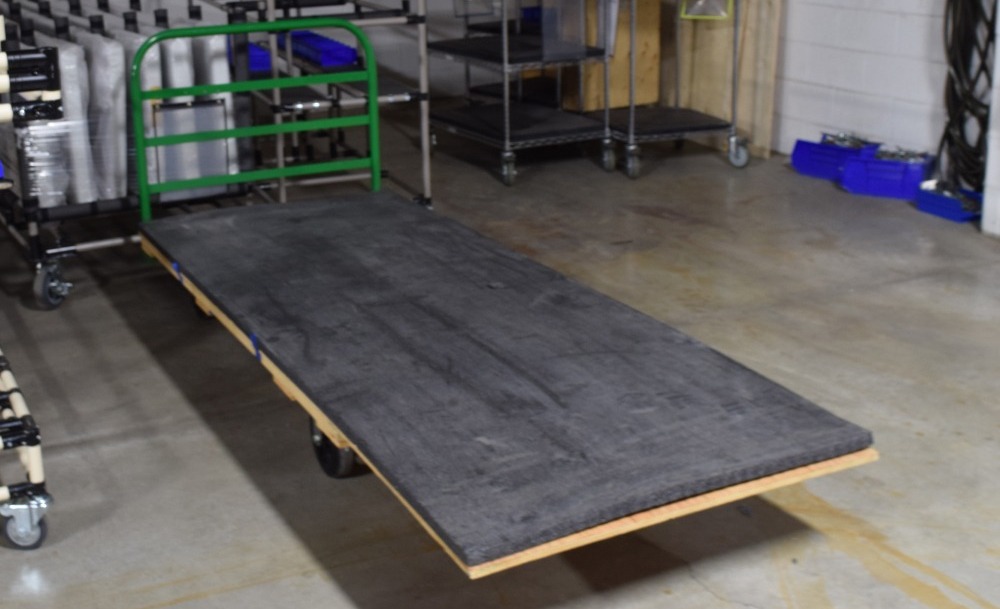
Additional issues with welded carts include a lack of warehouse employee ergonomics and safety. In terms of order fulfillment, products are allowed to move freely on welded carts, often falling off and causing accidents, trips, slips, falls, or extensive product damage. In the worst cases, a flatbed cart with no means of safely securing finished goods means the warehouse employees moving the cart and anyone around are susceptible to accidents and injuries.
With their limited functionality and flexibility, incredibly high costs, ergonomic and safety issues coupled with the constant potential for increased product damage and order fulfillment errors, welded carts should be avoided entirely.
The first and most important part of designing any modular, scalable steel tube and joint picking cart for order fulfillment is to account for the picking cart’s loading capacity. This ensures the picking cart can sufficiently support whatever weight it holds while ensuring warehouse employees can easily maneuver the picking cart without over-exerting or injuring themselves.
While safety and ergonomics should always be a priority, another is ensuring you’ve designed a steel tube and joint picking cart that is customized for your product’s dimensions and bin sizes. Simple solutions like kaizen foam can protect fragile finished products from damage. Incorporating ergonomic solutions like casters with foot brakes helps to keep picking carts stationary, helping to avoid roll-back accidents.

Creating structural reinforcements with extra steel tubes and durable steel corner, 4-way, 3-way, and angled cross joints to support each level of the picking cart is another important design element. Given the low cost per foot of steel tubes, adding a single three-foot steel support angle with two joints typically costs less than $10 – making reinforcements affordable, simple, and quick.
Finally, using heavy-duty, high-strength 1 & 9/16′ square steel tubes for the base of picking carts creates a solid foundation for the entire structure where weight distribution is always optimized for safety.
With modular and scalable steel tube and joint picking carts, warehouses can future-proof their order fulfillment processes by ensuring their picking carts can easily be adjusted or modified. Few material handling systems can match steel tubes and joints in terms of low cost, flexibility, functionality, durability, strength, safety, ergonomics, and order fulfillment efficiency.

This image is a perfect example of how a steel tube and joint picking cart can be designed, assembled, and optimized for single-pass order fulfillment. Instead of using a standard welded cart where products would be allowed to move freely and become damaged, this cart above has specific bin locations along with casters with brakes to allow warehouse employees to keep the picking cart stationary.
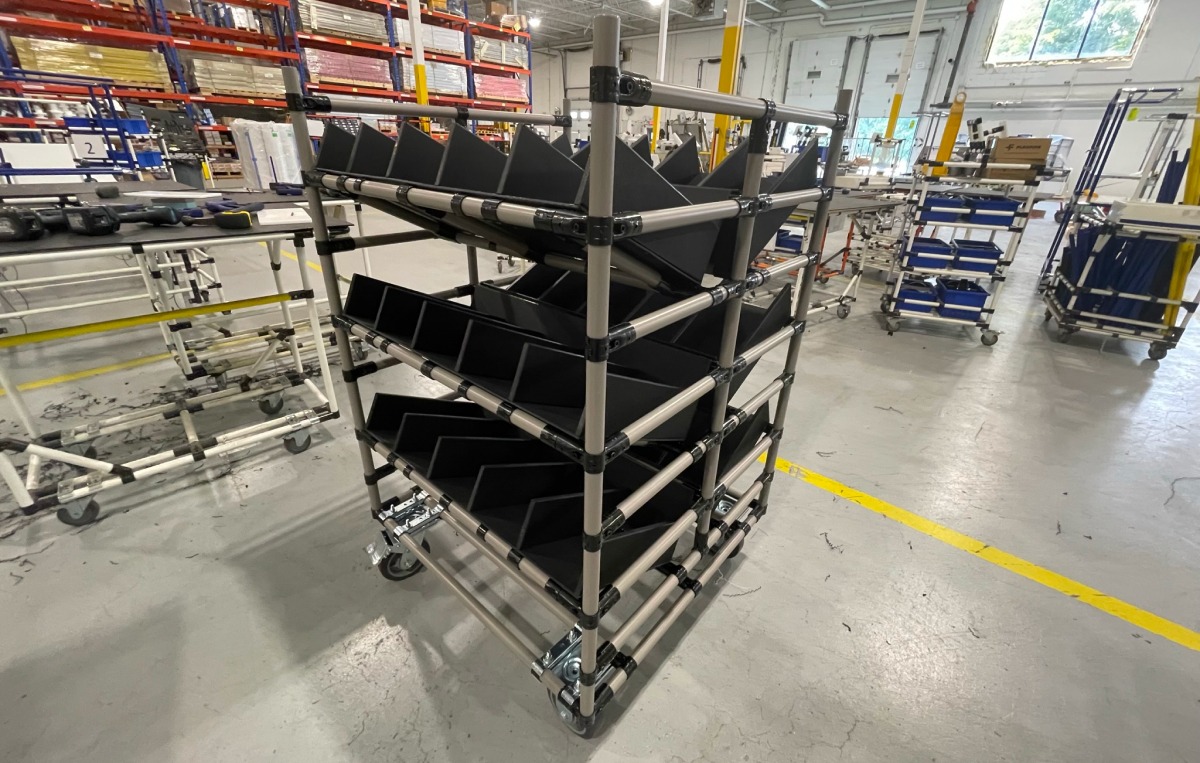
This warehouse picking cart is a perfect example of how warehouses can customize their picking cart designs to match their product dimensions or bin sizes. In this example, a warehouse created a picking cart for order fulfillment where they created customized slots on two levels to accommodate multiple combined rolls of tape.
By customizing the picking cart, the warehouse employees will be able to safely secure the parts for the order and do one complete single-pass order fulfillment run.

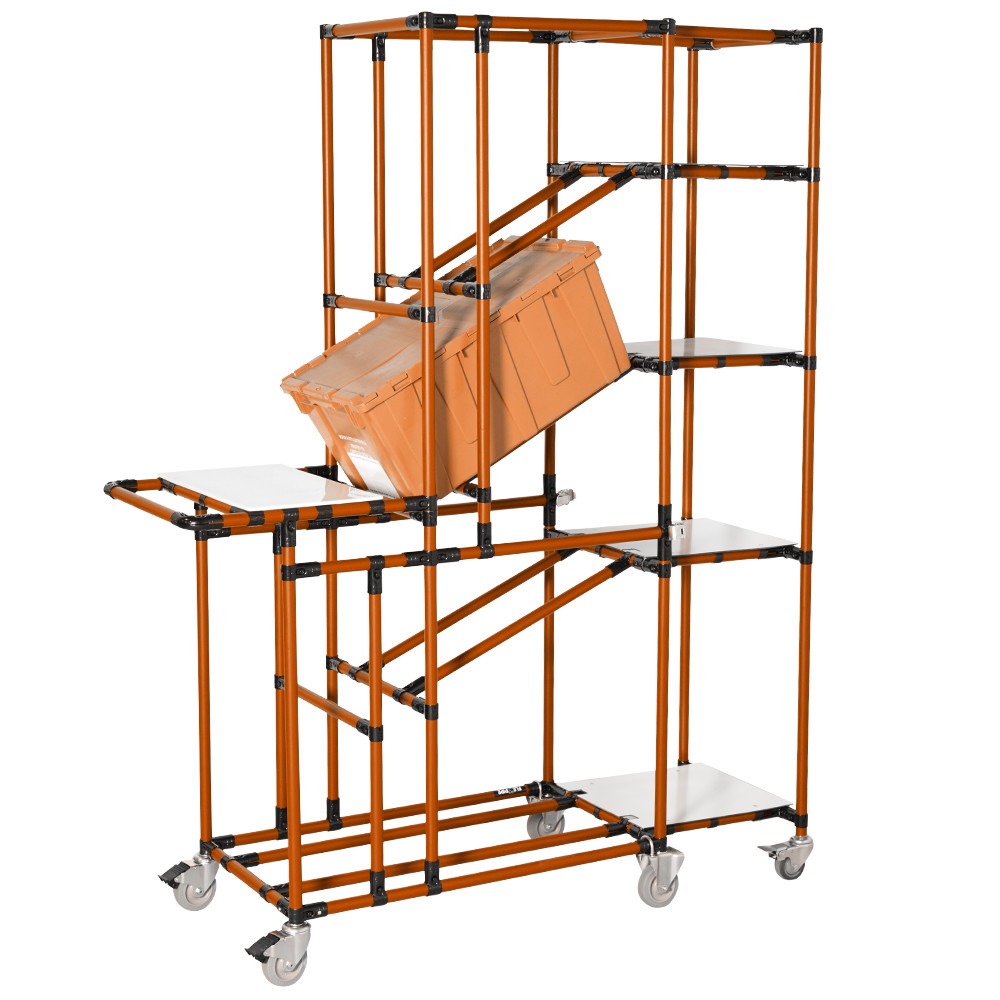
This picking cart was specifically designed as a narrow-aisle picking cart for a warehouse with tight spacing between its existing industrial racking and shelving. Instead of buying an expensive welded pushcart that would be too wide to work with – this warehouse chose to make multiple customized, narrow-aisle steel tube and joint picking carts that have the perfect dimensions to fit between the warehouse’s industrial racking.
The benefit of the steel tube and joint system is that if the warehouse ever expands or increases the space between their industrial racking, they can easily modify or change their order fulfillment picking carts in a fraction of the time and costs compared to changing welded picking carts.
All steel tube and joint picking carts for order fulfillment will of course always include the steel pipes and joints to connect the pipes. These steel pipes are cold-drawn steel which means they have undergone temperature treatment to increase their impact resistance, durability, and strength.
While it is very possible to make a warehouse order fulfillment picking cart with just steel pipes and joints, most warehouses choose to increase flexibility with additional accessories. For instance, kaizen foam can be used to cut out the outline of a given product to ensure it is properly protected against damage. Rollers can be used on multilevel picking carts to store multiple orders and have them easily removed when ready.
Decking materials can be used to make pull-out drawers or containment levels and separations for different-sized bins. Ultimately, there are endless possibilities in design to account for everything required in order fulfillment. From creating separate bin locations, product holders, packaging tools, tape, and consumables to ensuring that the cart has foot brakes that can be applied to keep the cart stationary, everything you envision your picking cart becoming can be done with the steel tube and joint system.

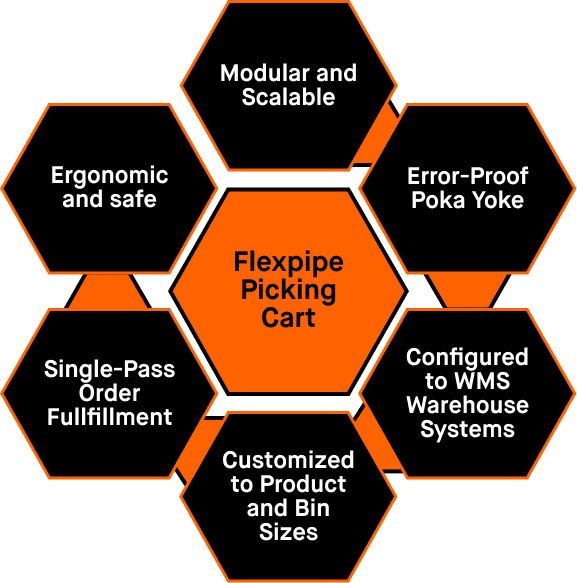
Flexpipe is the ultimate modular and scalable material handling solution, putting the power of customization right in your hands. From easy-to-use picking carts that store large volume orders and allow order fulfillment to be completed in a single pass to manufacturing facilities that want to adopt lean manufacturing best practices – Flexpipe is the best available solution.
If you would like to learn more about the many different types of companies that have used Flexpipe, please visit Case Studies.
To learn about how Flexpipe helps those in third-party logistics, warehouse, and order fulfillment, please visit Warehousing.
To reach out to us and speak to someone or get additional information on Flexpipe in terms of samples, starter kits, and pricing, contact us now.

Flexpipe provides a free online loading capacity tool where you input the pipe length and wall thickness of each structural span, and the tool calculates the maximum safe load that pipe can support. For a multi-level picking cart, calculate each level independently using the longest unsupported pipe span on that level as the input. If a given level falls short of your target load, adding a mid-span support pipe and two joints — typically costing under $10 in materials — increases capacity significantly. Always calculate before ordering to ensure the finished cart safely supports the combined weight of all picked orders at peak capacity. Access the tool at the Flexpipe loading capacity page.
Flexpipe picking carts can be configured to support all three strategies used in U.S. order fulfillment centers. For batch picking, a large multi-level cart with many individual bin locations lets one associate collect multiple orders simultaneously in a single pass. For zone picking, narrower single-zone carts sized to fit the aisle width and bin profile of each specific storage zone reduce congestion and travel time. For wave picking, carts can be built with color-coded or labeled lanes that correspond to each wave release, making sorting at the packing station faster and reducing mis-picks. Because the cart dimensions and bin layout are fully adjustable, the same components can be rebuilt into whichever configuration a new WMS rollout or peak season requires.
Repetitive bending, reaching, and lifting are among the leading causes of musculoskeletal disorders in U.S. warehouse workers, and OSHA’s ergonomics guidelines under 29 CFR 1910 specifically target these risk factors. Flexpipe picking carts address this in several ways: shelf heights are fully adjustable so the most frequently picked items sit between knuckle and elbow height, eliminating floor-level bending; bin angles can be tilted toward the picker to reduce reach depth; and caster-mounted carts eliminate carrying loads compared to handheld baskets or totes. Foot-operated caster brakes keep the cart stationary during picking, preventing rollback injuries.
For narrow-aisle warehouses, smaller wheel diameters — typically 3 or 4 inches — keep the cart’s overall footprint compact and reduce the turning radius needed to navigate tight rack openings. Swivel casters on all four corners give maximum maneuverability in confined spaces. Non-marking thermoplastic rubber (TPR) wheels are recommended for smooth concrete or epoxy floors common in U.S. fulfillment centers, as they roll quietly and do not mark the floor surface. At least two casters should include a foot-operated brake so the picker can lock the cart in place while picking from both sides. For heavier multi-level carts carrying full batch loads, step up to 5 inch swivel casters to keep push force within NIOSH manual handling guidelines.
Yes. Flexpipe’s Creator extension for SketchUp is a free 3D design tool that lets you lay out your picking cart visually using the actual Flexpipe component library and automatically generates a bill of materials and cut list when you are done. Most warehouse teams report designing a standard picking cart in under an hour. Assembly of a typical multi-level cart takes one person one to two hours using only a pipe cutter, deburring tool, and Allen key — no welding or power tools required. Flexpipe also offers a pre-cut pipe service so components arrive ready to assemble, reducing floor preparation time further.
Yes. Flexpipe maintains a gallery of over 300 free downloadable 3D plans including multiple picking cart configurations — narrow-aisle carts, multi-level batch picking carts, single-pass order fulfillment carts, and more. Each plan includes a bill of materials so you can estimate costs and order components directly. These plans are especially useful for U.S. warehouse managers who want a proven starting point before customizing dimensions to their specific aisle widths, bin sizes, and order profiles. Browse all available plans at the Flexpipe free plans gallery.