

Choosing the right industrial work surface affects safety, productivity, and long-term costs. This guide breaks down the most common surface materials used in lean manufacturing—HDPE, UHMW-ESD, honeycomb, aluminum composite, and foam—so you can confidently select the right option for your workstations, racks, and modular structures.
With so many industrial work surface options available for manufacturing applications, it’s normal to feel overwhelmed. From ESD-compliant UHMW panels with surface resistances ranging from 10⁶ to 10⁹ ohms, to durable High-Density Polyethylene (HDPE) sheets and lightweight, impact-resistant honeycomb boards, each material is designed to address a specific need on the shop floor.
Additional options such as white aluminum composite panels, highly versatile pegboards, crosslink foams, and 13-layer Kaizen foam further expand the possibilities for workstation surfaces, tool organization, and part protection in lean environments.
Each material comes with its own strengths and limitations. Some are essential for ESD compliance and meeting Occupational Safety and Health Administration (OSHA) requirements. Others are cost-effective solutions that help reduce expenses, while certain materials are must-haves for workbench tops and flow rack decking.

To simplify the decision-making process, Flexpipe has standardized its industrial work surface offering in this easy-to-follow guide—helping you make better, more informed choices.
Whether you’re comparing HDPE vs UHMW vs honeycomb, selecting a manufacturing workbench surface for multiple workstations, or looking for a reliable static-control material, this guide will help you identify the right solution for your modular workstations.
By the end, you’ll know exactly which work surface best fits your application.
There are several risks with selecting the wrong workbench top material. The wrong material can significantly increase your costs. Others pose a potential safety risk to employees, while still others can cause ergonomic problems.
From an industrial work surface that easily warps and buckles over time, a material that experiences premature wear and tear, to selecting a material that is not ESD-compliant, the wrong industrial work surfaces for manufacturing applications can increase safety risks, drive up costs, and lead to high defect rates.
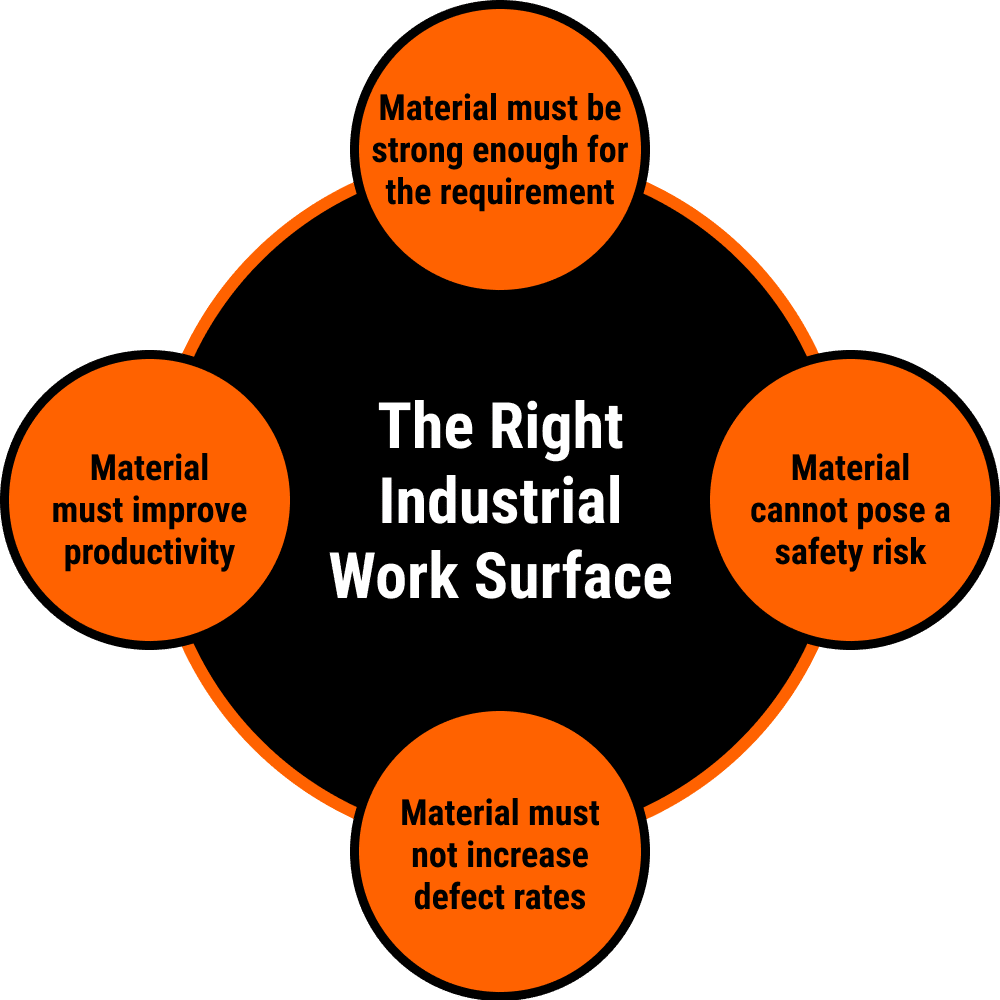
Choosing a non-ESD HDPE surface material can severely damage sensitive electronics during assembly. The wrong material for tool storage can result in lost tools and consumables, leading to extended downtime and lost production capacity. Choosing the right material comes down to accounting for the following variables. First, the material must improve productivity and efficiency. Second, the material must be durable and strong enough for the required task. Third, the chosen workbench top material must never pose a safety risk. Finally, your manufacturing workbench surface must not increase product defect rates.
Flexpipe offers an extensive range of industrial work surfaces for manufacturing applications. Each one is designed to meet the strictest of manufacturing requirements while adhering to well-established lean manufacturing principles of reduced costs, less rework and downtime, and lower scrap rates.
When choosing industrial work surfaces for manufacturing applications, identify the type of material handling structure first. Focus on whether the surface will be used for work assembly or is meant only as an accessory.
An accessory might include a pegboard to store tools within a workstation, a honeycomb board for the back of racks, or wire mesh for guard rails around machinery. Work assembly surfaces should be matched to the type of assembly tasks. This means electronic assembly must have UHMW, ESD-compliant work surfaces, whereas general assembly can use HDPE.

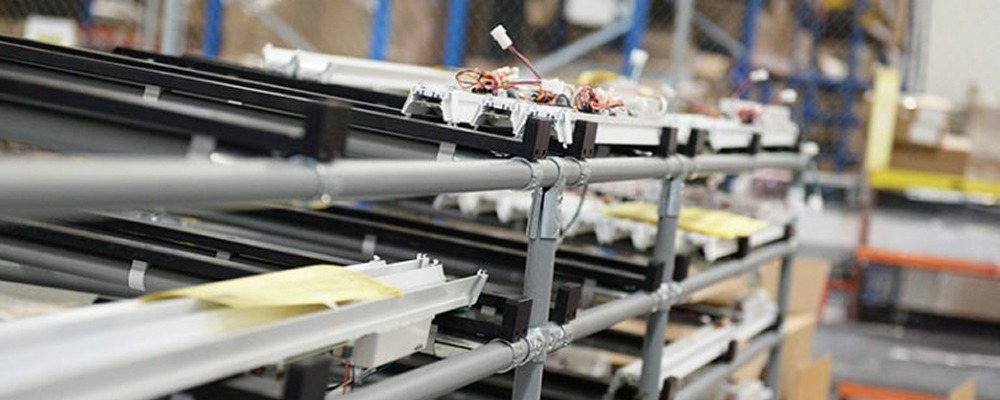
From flow rack decking material and honeycomb board for the back end of material handling carts to shock-absorbent foam, there are plenty of Flexpipe industrial work surfaces for manufacturing applications to choose from.
The White HDPE Sheet (½” thick × 48″ × 98″) offered by Flexpipe is an extremely versatile work surface with excellent impact resistance and chemical resistance. It is a low-friction surface that ensures semi-finished parts and assemblies easily slide or move across the surface without generating any wear or micro-scratches on part surfaces.

HDPE (High-Density Polyethylene) is a lightweight, impact-resistant plastic known for its strength, chemical resistance, and low-friction surface. It’s commonly used for industrial work surfaces, carts, flow racks, and material handling structures because it’s durable, corrosion-proof, easy to machine, and maintains a long service life even in demanding environments.
Flexpipe offers several ESD-compliant solutions geared towards static protection. One of them includes the UHMW-ESD Black Sheet (1/4″ thick x 48” x 96”), which offers high electrical resistance protection from 10⁶–10⁹ ohms.
Offering excellent electrostatic dissipation that protects every stage of the electronics assembly process, the UHMW-ESD Black Sheet has excellent impact, chemical, and solvent resistance. Much like the White HDPE Sheet, the UHMW-ESD Black Sheet provides a solid low low-friction surface that won’t catch or drag subcomponents during assembly.

UHMW-ESD is a self-lubricating, moisture-resistant plastic that won’t swell or warp like wood. It maintains stable electrostatic-dissipative properties even in humid environments, while offering excellent durability and smooth part movement. Easy to cut and long-lasting, UHMW-ESD is an ideal low-maintenance workbench surface for electronics and static-sensitive assembly.
Possessing a great strength-to-weight ratio while being incredibly lightweight and exceptionally budget-friendly, the Flexpipe Honeycomb Board (5/16″ thick x 48″ x 96″) is the ideal solution when needing to create barriers or walls on framing. Not designed as a work surface for assembling parts or assemblies, these honeycomb boards are more of an accessory that helps to finish off material handling structures.
You’ll find the Flexpipe Honeycomb Board as a finishing solution for the side walls of mobile carts, trolleys, and flow racks. Large trolleys with individual vertical slots for transporting semi-finished parts typically use the Flexpipe Honeycomb Board for its walls, as it’s sturdy enough to keep the parts in place without being too expensive.
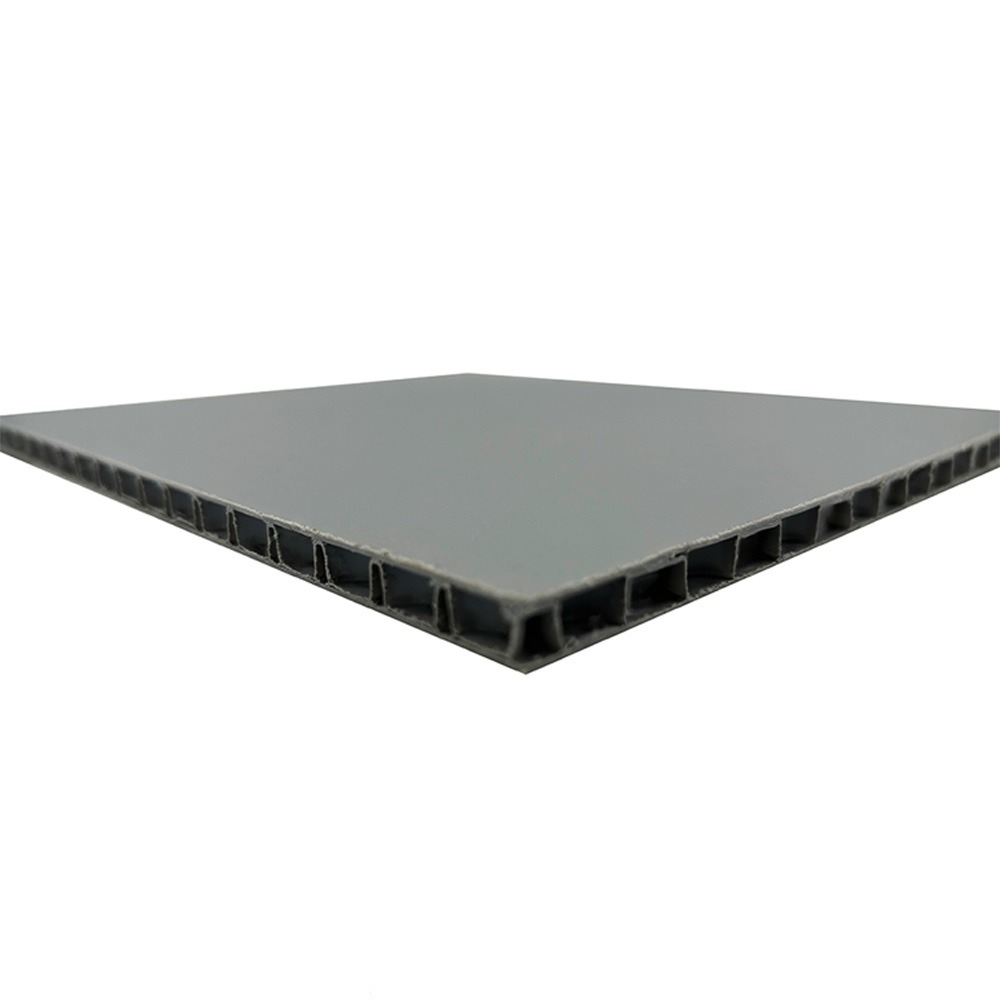
An extremely inexpensive material, honeycomb board is a lightweight, multi-function material with good moisture resistance that does not succumb to corrosion. Extremely easy to cut and available in large sheets, the Flexpipe Honeycomb Board is one of the most important industrial work surfaces for manufacturing applications available.
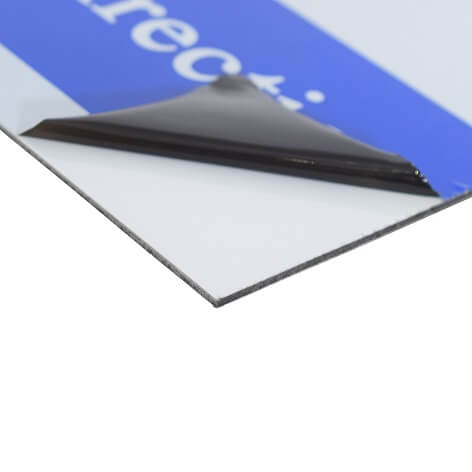
The White Aluminum Composite Panel (1/8” x 48” x 96”) from Flexpipe is a two-sided aluminum sheet with polyethylene in between. A cheaper alternative to HDPE, the White Aluminum Composite Panel is yet another solution from Flexpipe that can be used for side walls and non-load-bearing surfaces.
Like all the work surface panels offered through Flexpipe, the White Aluminum Composite Panel is easy to cut, very durable, and long-lasting while also being lightweight. It also has excellent chemical resistance while having superior impact strength. Much like the White HDPE Sheet, the White Aluminum Composite Panel is a cost-effective, low-friction, and self-lubricating surface.
This is a good surface when needing a solution with good moisture resistance that won’t require consistent maintenance or replacement. Its non-toxic properties make it a great solution across the production shop floor.
When it comes to adhering to 5S (Sort, Set in Order, Shine, Standardize, and Sustain), the Pegboard (1/4”x 48” x 96”) offered through Flexpipe is the ideal workstation organization solution. Lightweight, durable, and low-cost, Pegboard is easy to cut, requires minimal maintenance, and has a long shelf life.

The ideal solution for the back walls of ergonomic workstations, a pegboard allows operators and technicians to quickly retrieve critical tools and consumables, while ensuring they are always readily available and easily identified. Compatible with standard hooks and simple add-on accessories, manufacturing employees benefit from a work surface that maximizes arm-reach zones while reducing wasted time.
From improving tool organization and tool placement to reducing workstation clutter, the pegboard is a solution that possesses good load-bearing strength when properly mounted. Cut as needed, and this simple material will immediately improve workstation organization.
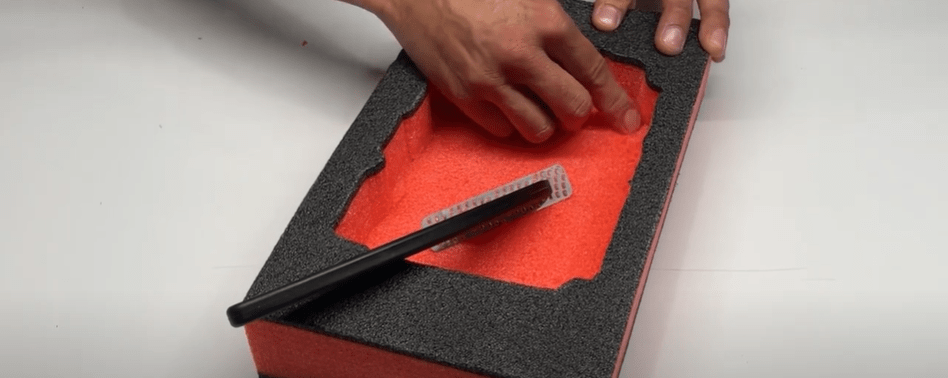
The 13-layer, 5s Kaizen Foam (2.4” x 20” x 40”) offered by Flexpipe is a multi-layer polyethylene, high-density foam that is easy to cut and allows for quick and seamless outline cutting of critical tools and consumables. With high shock-absorbing properties, manufacturing employees can do right-sized cutouts within the Kaizen foam so that only properly sized tools can be placed.
A very lightweight material, 5S Kaizen Foam can neatly be stored within drawers, carts, and toolboxes. Its non-abrasive surface ensures that tool metals, plastics, composites, and steels won’t encounter any scratches or damage. The material doesn’t generate much dust or particles when being cut compared to other types of foams.
Highly compressible yet stable, manufacturing employees will find it easy to trace their tools, cut out the shape, and easily place their tools safely and securely. In the end, this is a closed-cell, high-density polyethylene rigid foam that has excellent chemical resistance and moisture resistance, ensuring steel tools don’t rust or corrode.
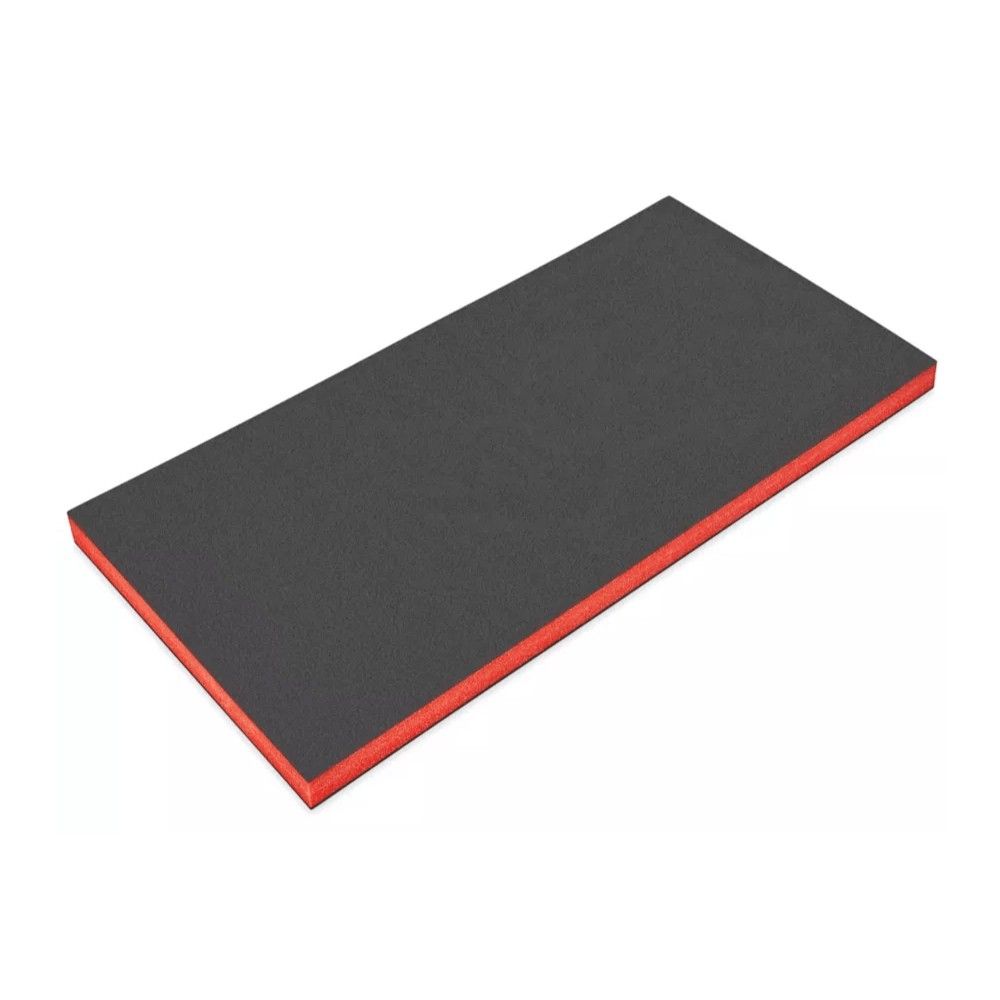
Kaizen foam is named after the Japanese concept of “Kaizen,” meaning continuous improvement. The foam’s layered structure allows tools to be organized, trimmed, and arranged with precision, supporting lean manufacturing practices. Its purpose is to make workstations more efficient, visual, and consistent, which reflects the core Kaizen principle of reducing waste and improving workflow.
Selecting the wrong industrial work surface can lead to that surface warping, cracking, absorbing too much moisture, and eventually rotting. In extreme cases, that industrial work surface may not be able to support the required weight. Ultimately, the wrong choice can increase costs, lead to multiple replacements, damage parts and components, and lead to extended downtime.
Start by identifying whether you need the industrial work surface for a heavy-duty application, like a manufacturing workbench surface or flow rack decking. If so, then HDPE is needed.
If you’re working with electronics or assembling electronics, then you will need the static-sensitive and ESD-compliant UHMW-ESD Black Sheet. Finally, lightweight applications where the surface or wall won’t support too much weight are ideal for Honeycomb or Pegboard.
UHMW-ESD panels maintain surface resistance between 10⁶–10⁹ ohms, ensuring controlled static discharge. When working with electronics or assembling electronics, always use the UHMW-ESD panels as an ESD-safe workbench top.
Honeycomb polypropylene panels and pegboard are the lightest and offer an excellent strength-to-weight ratio.
Yes. Order the Panel Sample Chain Kit to compare surface materials side by side.


