Kitting Carts: An Essential Lean Manufacturing Tool

In lean manufacturing environments, Flexpipe kitting carts ensure production employees have the necessary tools, consumables, bill-of-materials (BOM), work-order instructions, and work-in-process (WIP) parts needed to complete a work order or work task. Mobile Flexpipe kitting carts are critical to ensure that workflow remains uninterrupted and that production employee wait times are minimized.
Manufacturers with welded or fixed-structure kitting carts cannot modify them without significant costs and incurring long refurbishing lead times. Given the constantly changing requirements in lean manufacturing – where continuous improvements and never-ending changes thrive – a low-cost, modular, and scalable Flexpipe kitting cart can quickly be adjusted or modified as needed.
So, why are Flexpipe kitting carts a difference maker in lean manufacturing environments?
Understanding Flexpipe Kitting Carts:
A common misconception is that kitting carts are the same as material handling carts. Yes, both transport materials. However, a modular and scalable Flexpipe kitting cart is specifically designed to carry work-order-specific materials and consumables, and a material handling cart or trolley is meant for transporting general production materials or finished goods.
While somewhat like lean manufacturing carts or material handling carts, Flexpipe kitting carts are designed for production employees because they provide the cut-to-length materials, ready-to-assemble parts, the tools, and the instructions needed to complete a specific production work order or work task. Flexpipe kitting carts can be specifically designed, assembled, and disassembled to adjust to the constantly changing requirements in lean manufacturing.
The best way to think about lean manufacturing carts and material handling carts is to think about how they move materials throughout a company’s manufacturing facility. They can move finished goods or raw materials. A kitting cart contains materials and parts specifically “kitted” so that the production employee within the workstation can complete his or her work task.
The kitting cart might include the raw materials, a special Allen key for assembly, work order instructions, fastener packs, subcomponent parts, and anything else needed for the production employee in their workstation.
Benefits of Using Flexpipe Kitting Carts
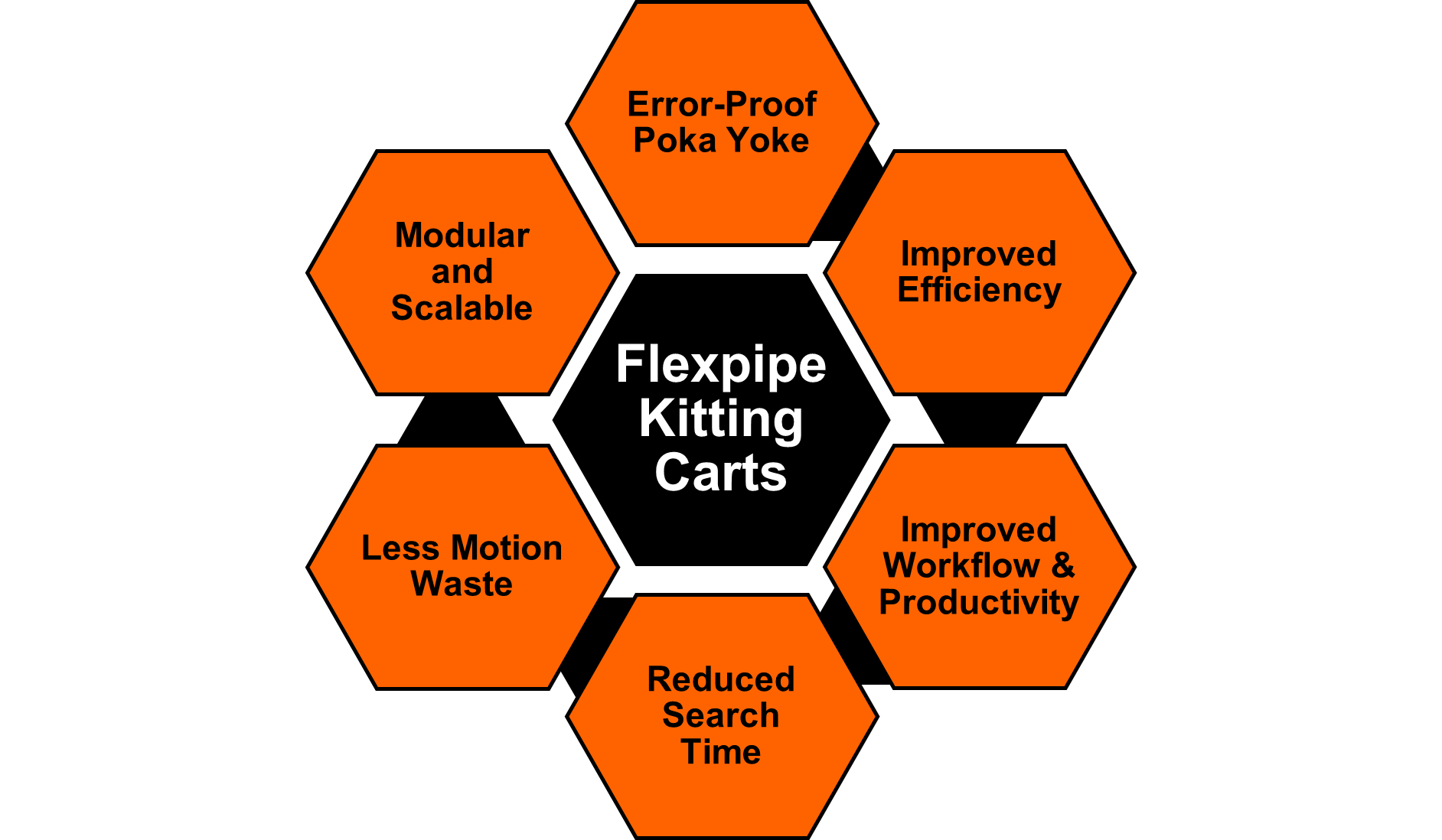
A Flexpipe kitting cart can act as an error-proofing, Poka-Yoke solution for production employees. If any raw materials, consumables, fasteners, or other critical parts needed to complete the work task or work order are missing, then the production employee can’t finish their work order. In the most advanced lean manufacturing environments, a production employee will often check to make sure the kitting cart has the proper allotment of materials and parts to finish the work order.
Flexpipe kitting carts can be configured with simple solutions like Kaizen foam inserts to ensure the proper placement of tools. They can be customized with ESD-compliant materials and decking materials so that only the right-sized parts, materials, and consumables can be placed inside the kitting cart.
Flexpipe kitting carts are all about efficiency. They ensure that production employees in lean manufacturing workstations never have to leave to get parts, raw materials, tools, or much-needed instructions. Everything they need to complete the work order should be included in the kitting cart.
Flexpipe kitting carts enhance workflow and dramatically improve productivity. They ensure an uninterrupted flow of work by allowing production employees to focus on their work tasks. No time is wasted searching aimlessly for instructions, fasteners, work orders, raw materials, consumables, or parts. Everything is included in the kitting cart to reduce search times and limit motion waste.
An often-overlooked benefit is how kitting carts ensure a clean, well-maintained workstation. Instead of having materials, consumables, instructions, work order information, and fasteners strewn about the workstation, they’re all properly placed within the Flexpipe kitting cart. They ensure that production employees properly adhere to essential 5S principles of workspace organization.
Ultimately, a Flexpipe kitting cart is a customizable solution that can be tailored, quickly modified, or changed to meet the constant demands of continuous improvement processes in lean manufacturing. This allows manufacturers to quickly scale up or down the size of their carts to meet whatever changes they make to their production floor.
Given the importance of flexibility and scalability in lean manufacturing, a Flexpipe kitting cart is the perfect solution for continuous improvement environments.
Drawbacks of Welded, Fixed Kitting Carts
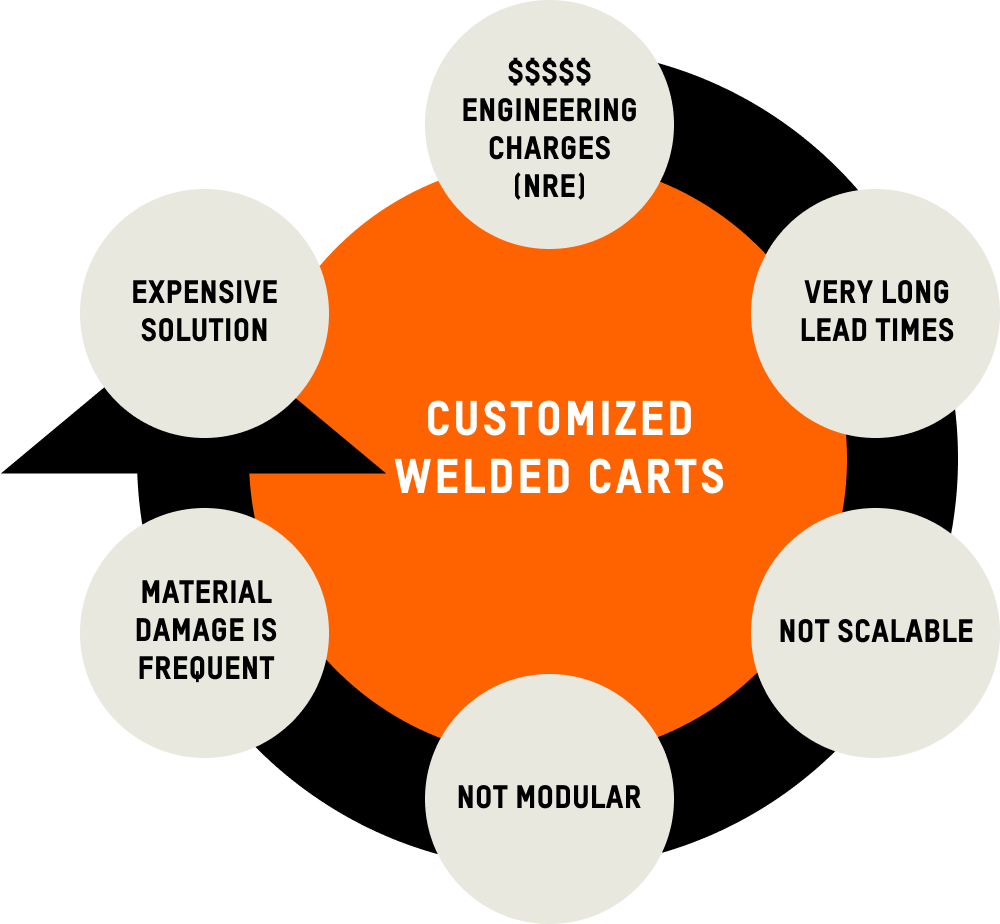
There are several drawbacks to purchasing welded, fixed kitting carts. First, asking for a customized welded kitting cart is extremely expensive. Welded kitting cart manufacturers prefer to stick to me-too, standard-sized welded carts. It allows them to mass-produce welded carts at lower costs. A customized welded cart would include non-recurring engineering design charges (NRE).
Second, the lead time for a customized welded kitting cart makes this option untenable. It can take weeks or even months before you receive your customized welded kitting cart. Third, welded kitting carts aren’t scalable or modular. They cannot be changed without incurring substantial costs for modifications.
Fourth, welded kitting carts don’t do a good job of protecting raw materials, parts, bins, tools, or consumables. These items are often haphazardly laid on the top of the welded cart. They’re allowed to move freely and damage is frequent. Finally, welded kitting carts are incredibly expensive, cumbersome, and difficult to maneuver.
Flexpipe Kitting Cart Design Principles
The first rule of designing any Flexpipe kitting cart is to ensure you’ve properly accounted for safety. Designing an ergonomic Flexpipe kitting cart with no protruding steel pipes, Flexpipe fasteners, or joints ensures that no production employees are accidentally injured.
Second, incorporating simple solutions like Flexpipe’s Kaizen foam ensures that all tools and critical items fit neatly and securely in their proper place. This is but another, simple Poke Yoke/failsafe solution.
Finally, you can easily add steel supports to your Flexpipe kitting cart to reinforce certain areas. Adding a simple 3-foot section of support pipe to a portion of your Flexpipe kitting cart to ensure its durability, typically costs no more than $10 when the Flexpipe joints are added.
Free Flexpipe Kitting Cart Plans
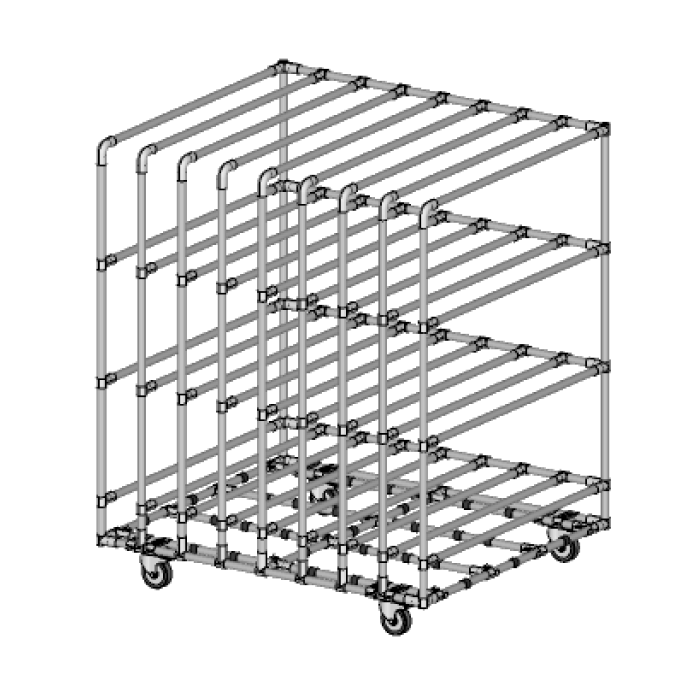
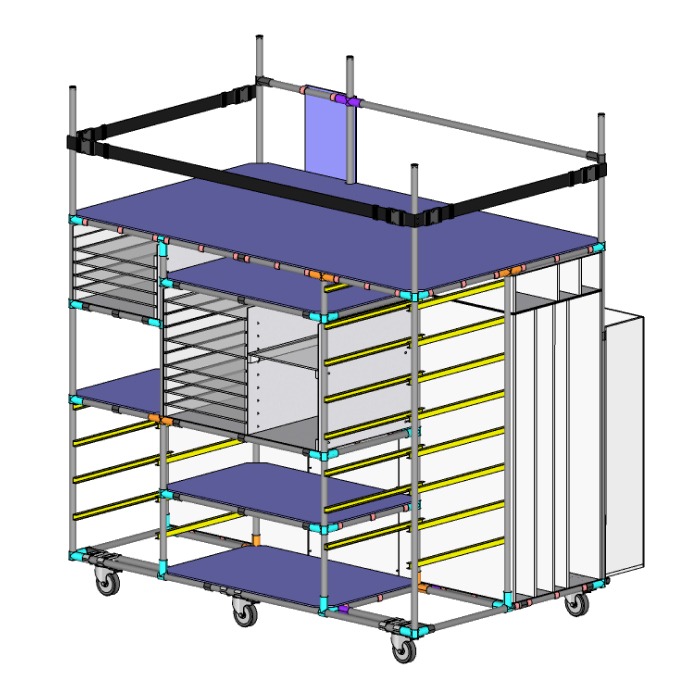
Flexpipe customers have designed and assembled countless kitting carts – each of them customized to their own needs and requirements. Customers typically use Flexpipe’s Creator Extension – a Sketchup Plugin that simplifies design and material orders.
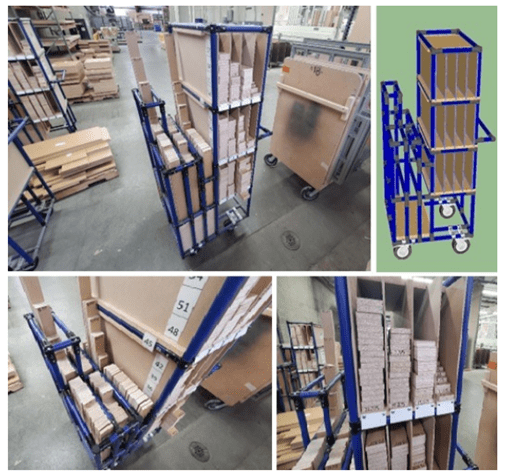
Here is but a small sample of some of the free Flexpipe kitting cart plans available.
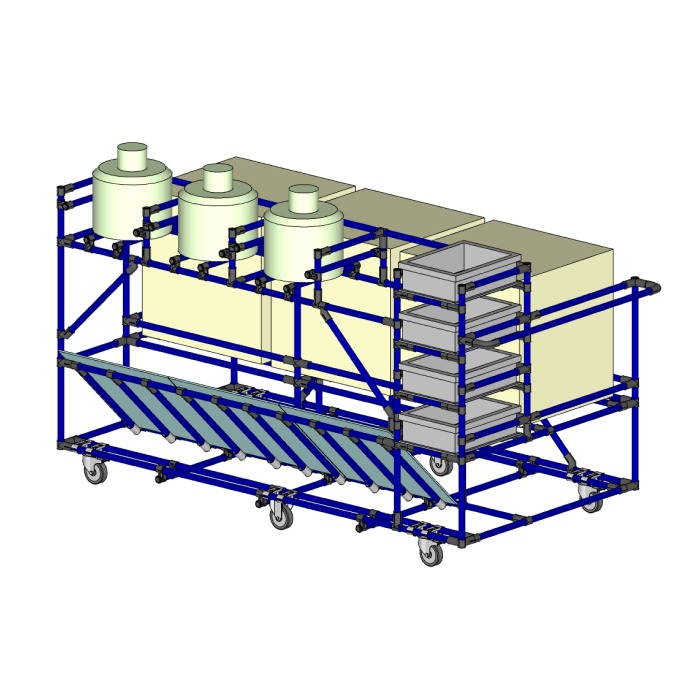
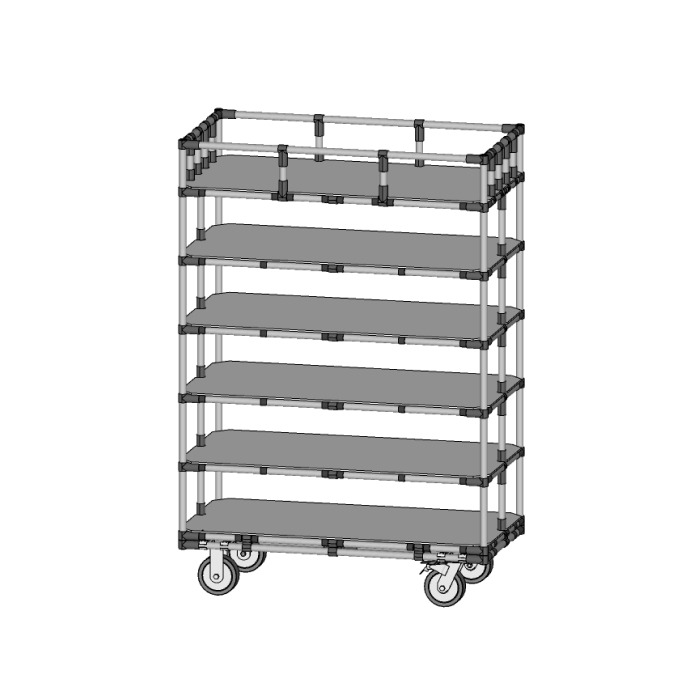
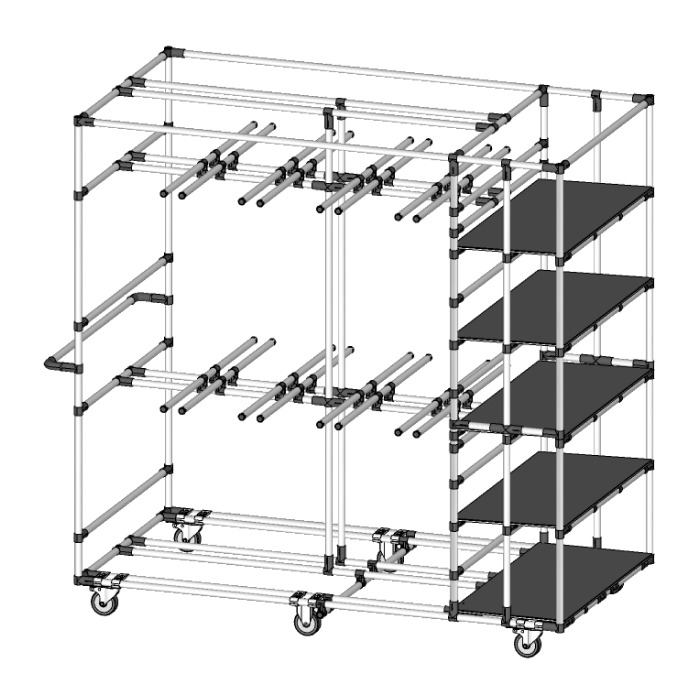
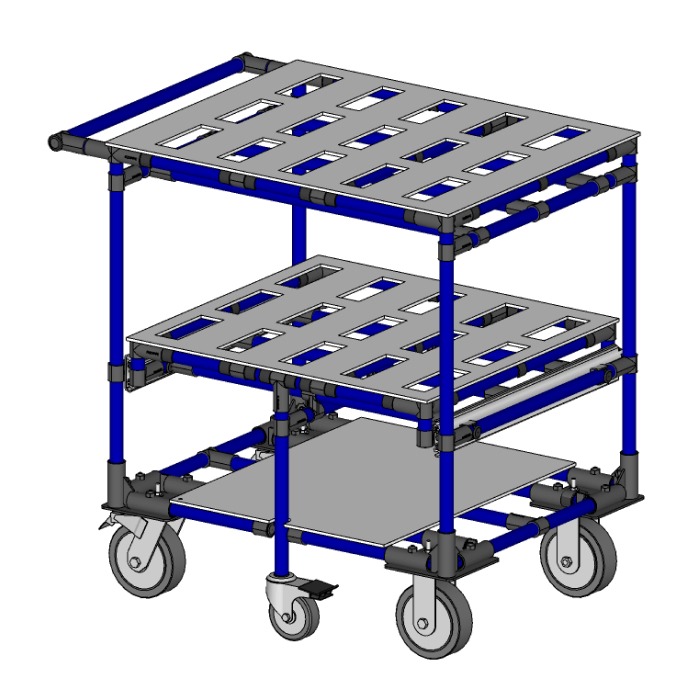
Examples of Flexpipe Kitting Carts in Action
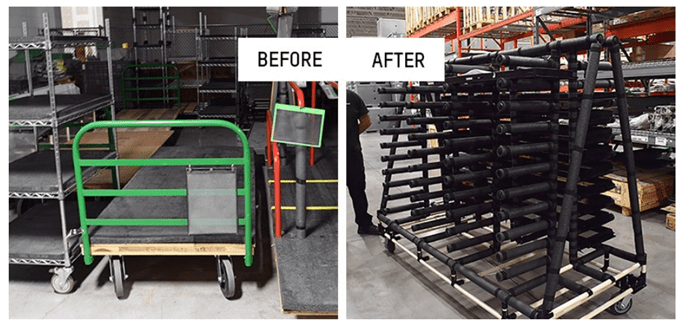
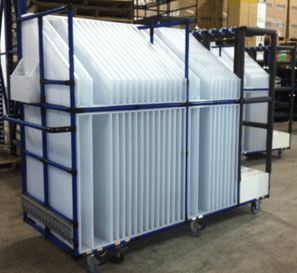
Before: Unstable wooden trolley where parts, tools, consumables, and different-sized raw materials were simply laid onto the wooden trolley. This was dangerous for employees as large sheets of raw materials and boards often hung on the side. These sheets often fell off while being transported as did other parts as nothing was securing them in place. Other issues were missing materials.
After: A customized Flexipe kitting cart with foam was constructed. This customized kitting cart had specific locations for different sheets of material and ensured that only the right-sized dimensions would fit. It properly secured the material in place, was much safer for operators and employees, and was easier to maneuver.
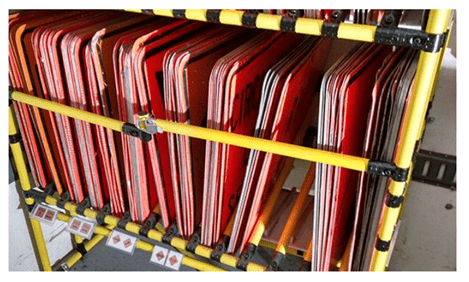
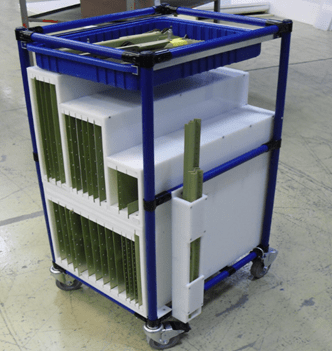
What to Include in Your Flexpipe Kitting Cart:
Given that a Flexpipe kitting cart is for providing critical components, materials, parts, and tools required for a given lean manufacturing workstation or workspace, ensuring your kitting cart includes locations for all these requirements is essential. Here are some tips on what to include in your Flexpipe kitting cart.
- Material Requirements: Define the material requirements that your kitting department will be including in the kitting cart. Define the amount of material required and its dimensions. Lean manufacturers often have a Bill of Materials (BOM). That’s the best place to start. You want to ensure that all the materials can be neatly contained and held in place within your Flexpipe kitting cart.
- Work Order Requirements: Manufacturers typically use work orders when releasing requirements to the production floor. These work orders provide a sequential breakdown of the work that must be completed to manufacture or assemble a finished good. Given that most manufacturing environments can be dirty, it’s a good idea to have a location on your kitting cart where the work order and assembly instructions are protected. They can be placed in plastic bags or removable containers.
- Tools: In manufacturing environments that have adopted 5S principles, workstations, and workspaces should always have a location for the tools they use throughout the day. However, if your work orders sometimes call out specific tools like Allen keys or small wrenches, then it’s best to ensure your kitting cart has a location for those.
- Flexpipe Kaizen Foam and Foam Inserts: Both are great solutions for protecting fragile material and subcomponent parts or for quick and immediate storage of smaller tools and consumables.
FAQs:
What is the loading capacity of a Flexpipe kitting cart?
Flexpipe is a modular, scalable, and easily modified steel tube and joint material handling system. There is no universal weight that all Flexpipe kitting carts can hold. The loading capacity of each Flexpipe kitting cart depends upon its design and assembly. Its customization drives its loading capacity.
The first – and most important step – in designing any Flexpipe structure is to calculate the structure’s loading capacity. This is done with the Flexpipe Load Capacity Calculator.
Flexpipe customers use this loading capacity calculator to determine how much a given Flexpipe structure can support. Given the variances in kitting cart designs and the many different types of structures that can be built with Flexpipe, the loading capacity calculator must be used at the outset of any new design.
Is it easy to change or modify a Flexpipe kitting cart?
The simple answer is yes, it is relatively easy to change or modify a Flexpipe kitting cart compared to any welded cart, wood cart, or aluminum cart. The Flexpipe solution is the ultimate cut-to-length-and-assemble solution. It is modular, scalable, and can be changed as needed far faster than any other material handling solution.
The amount of time needed to change a Flexpipe structure is often measured in minutes. Depending upon what needs changing – and how many changes need to be made – it’s a good rule of thumb to plan your changes in ½-hour to 1-hour increments. A Flexpipe cart can be changed within an afternoon as opposed to several weeks for a fixed or welded cart.
Is there any maintenance needed with a Flexpipe kitting cart?
Like any critical manufacturing machinery, equipment, or tool, a Flexpipe kitting cart should be considered an investment. Flexpipe structures are incredibly durable and made with high-strength, cold-rolled / cold-drawn carbon-steel pipes (SPCC).
These steel pipes are coated with scratch-resistant polyethylene (PE). Flexpipe steel pipes have undergone heat treatment to increase their strength and impact resistance. Ultimately, when you use Flexpipe’s steel to create a kitting cart – or any other type of structure – you’re using a high-strength, industrial-use steel with high tensile strength.
The Flexpipe solution is an ideal solution for the toughest and dirtiest of manufacturing environments. However, like any tool or piece of equipment, preventative maintenance is always best. Overloading or exceeding the capacity of your Flexpipe structure is never a good idea. A preventative maintenance schedule helps to ensure your Flexpipe kitting cart or other material handling structure lasts for years to come. Periodically inspecting your Flexpipe cart or structure is a simple way to ensure everything is working as it should.
What industries use the Flexpipe steel tube and joint system?
The Flexpipe steel tube and join system originates from the Toyota Production System (TPS). This solution has been in use – in one form or another – for the past 70 years. As such, it is heavily relied upon by automotive manufacturers as well as aerospace companies.
Ultimately, any manufacturer looking to adopt lean manufacturing, Kaizen principles will benefit from using the Flexpipe steel tube and joint system.
Flexpipe: The Ultimate Kitting Cart Solution
The Flexpipe steel tube and joint system can be used for any material handling requirement your company may have. Whether it’s creating kitting carts, material handling carts, trolleys, flow racks, mobile Takt boards, customized workbenches, or any other type of production-specific structure, Flexpipe steel tubes and joints are often the must-have solutions.
If you would like to see some of the other types of structures Flexpipe customers have designed – and download those plans for free – please visit our Custom-Made Structures Page.
If you are interested in some of the types of Flexpipe parts, consumables, tools, pipes, joints, and other solutions our customers use for their Flexpipe structures, please visit our product category page.