How Skipper Groupe Boosted Picking Efficiency by 3x Using Flexpipe's Modular Solutions

Skipper Groupe – a third-party logistics company providing essential warehousing in Europe and the United States for numerous international business-to-business (B2B), e-commerce, industrial, and commercial enterprises – turned to Flexpipe’s steel tube and joint material handling system to reduce warehouse management costs and improve efficiencies. Camille Jouvet – General Manager at Skipper Groupe – assembled several customized Flexpipe material handling structures that simplified incoming reception, stocking, picking, packaging, and shipping processes.
Skipper Groupe
With 13 different warehouse locations and countless global customers, Skipper Groupe is viewed by its customers as a critical third-party warehouse and international partner. The company’s warehouses provide vital access to new markets for companies that would otherwise not have access. By providing an essential warehouse along with real-time inventory tracking and shipping, Skipper Groupe quickly becomes an integral part of its customers’ supply chains, ensuring on-time deliveries while providing essential tracking.
The company’s innovative Baliseo App lets customers track inventory counts at all 13 Skipper Groupe warehouse locations, set alerts, and monitor in-transit customer orders from any mobile device or terminal with a Wi-Fi connection.
Learn more about how Camille Jouvet and his team used Flexpipe’s easy-to-assemble steel tube and joint material handling system across all 13 Skipper Groupe warehouse locations.
Skipper Groupe Responsibilities
Skipper Groupe manages 13 separate warehouse locations. Nine of these are in the south of France, two in Paris, and two others in Georgia, USA. The company warehouses everything from soap to electronics, linens, and houseware. They also warehouse an impressive selection of industrial consumables such as high-strength fasteners, brackets, nuts, and washers, in addition to extremely fragile items such as China and crystal.
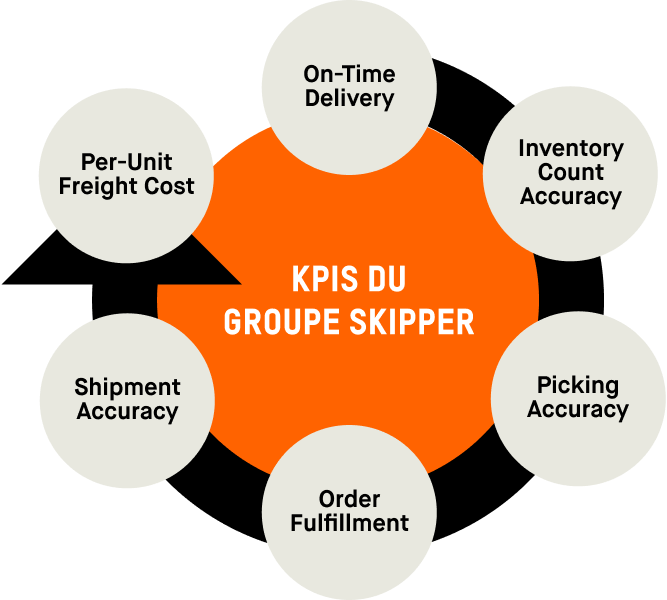
Like any third-party warehouse and logistics company, Skipper Groupe’s customers measure them on multiple time-critical key performance indicators (KPIs), the most important of which is on-time delivery. Other KPIs include inventory count accuracy, picking accuracy, order fulfillment, shipment accuracy, and the per-unit freight cost for each product shipped. Every product warehoused by Skipper Groupe requires unique material handling and inventory stocking processes. Each requires a different incoming receiving, inspection, unpacking, and storage process. For order fulfillment, all products have specific instructions for picking, packaging, and shipping.
Largely Dependent Upon Manual Processes
None of the 13 Skipper Groupe warehouses are fully automated, and for good reason. Given the sheer volume and variety of products each Skipper Groupe warehouse manages – and with all their different material handling processes required for each customer product – a mixed approach of automation and manual processes provides the optimal solution. While some warehouses utilize automation for high-volume customers, many operations maintain manual processes where they are more economically efficient.
Skipper Groupe’s contracts typically range from one to five years, but with modern technology becoming increasingly flexible and adaptable, the company is strategically investing in automation. For instance, their first goods-to-person solution is planned for Q2 2025, aimed at improving outbound capacity, picking accuracy, and storage optimization. This investment will support customer growth, enhance competitiveness in the web industry, and position the company for future expansion.
A flexible material handling solution is essential for the manual processes that remain integral to operations. The solution needs to be modular and scalable, allowing warehouse teams to create their own material handling structures to accommodate the needs of the many different products in their respective warehouses. This is where solutions like Flexpipe complement both automated and manual processes, offering flexibility and efficiency at a low cost.
“With up to 34 different customer products in our Lawrenceville Georgia warehouse, and with each product requiring a different picking, packaging, and shipping process, our warehouse needed a simple material handling solution where structures could be easily changed or modified by our warehouse team to optimize storage space and maximize warehouse efficiencies. For us, Flexpipe’s steel tube and joint system checks all the boxes.” – Camille Jouvet, General Manager Skipper Groupe.
Picking Table Station | Structure Showcase
Skipper Groupe – A Focus on Continuous Improvement and Service Quality
A big reason for Skipper Groupe’s success is the company’s unrelenting commitment to continuous improvement. Every one of its 13 warehouse locations has a continuous improvement engineer on-site. Within the company itself, there are three separate quality-driven departments. Each is focused on ensuring the highest quality service and warehouse management practices for all the company’s customers.
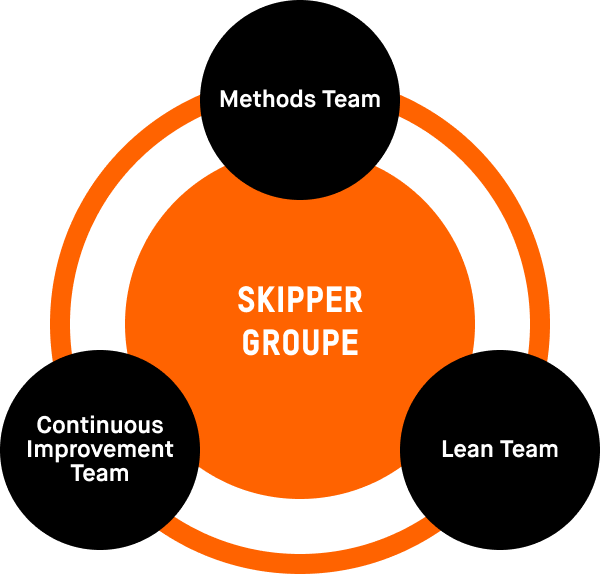
These three internal departments include :
- 1 – Methods Team
- 2 – Continuous Improvement Team
- 3 – Lean Department Team
Methods Team: This customer-facing team defines all the material handling, inventory, and stocking requirements for each new customer’s product line. Once a customer has agreed to have their parts inventoried within Skipper Groupe’s warehouses, it’s the Methods Team that conceptualizes how a customer’s products are received, how they’re handled, how they’re unpacked, stored on shelves, and eventually how they’re picked, packaged, and shipped.
Working directly with the customer, Skipper Groupe’s Methods Team is ultimately responsible for how order fulfillment works. They define the criteria for success and ensure the customer’s product line is properly handled and managed.
Continuous Improvement Team: The Continuous Improvement Team is responsible for optimizing how the customer’s products are received, handled, stored, counted, picked, packaged, and shipped within Skipper Groupe warehouses. While the Methods Team provides a framework and guideline on how a given customer’s products should be inventoried and handled, it’s up to the Continuous Improvement team to optimize these processes.
The Continuous Improvement Team will analyze how a customer’s products are initially picked, packaged, and shipped. From there, they will start making small incremental improvements to ensure that the warehouse’s internal material handling, packaging, and shipping processes are optimized.
The Lean Team: The Lean Team is a Skipper Groupe-centric team. Their job is to optimize all internal processes within Skipper Groupe by adopting multiple lean methodologies. Whereas the first two teams are customer-centric, this third team is company-driven and is focused on how certain lean methodologies can help improve company-wide processes.
The Lawrenceville Georgia Location – Wagon Preparation
For Camile Jouvet and his team, manual picking, packaging, and shipping are commonplace across all 13 warehouse locations. For most items, these manual processes are more than efficient. Individual items are picked, data is entered into a pick list, information is transferred internally, and the parts are easily transported to the shipping area.
However, their “wagon preparation” orders at their Lawrenceville, Georgia warehouse required 30 large ticket items with multiple separate parts. Unfortunately, the manual material handling processes were becoming too labor-intensive, and wasteful, while occupying too many internal resources and valuable equipment.
Skipper Groupe team would pick a single part and then transport that part to the packaging station using a forklift. Up to 30 separate trips needed to be made each time before an order could be packaged and shipped. That means 30 separate picking tasks and 30 separate one-way trips with the warehouse’s forklift.
Each picking process involved a warehouse employee going to a specific bin location, picking that single item, and then transporting that item to the packaging area with the forklift. Given that the wagon preparation requires 30 or more separate parts, the process of picking and moving one item at a time with a forklift was extremely time-consuming, labor-intensive, and costly.
Additional problems were encountered in the packaging area, where it wasn’t uncommon for these 30 parts to pile up waiting to be shipped. For Camille Jouvet and his team, this was an excessive amount of warehouse waste that needed to be addressed.
Picking cart with pocket shelves | Structure Showcase
The Flexpipe Solution
Skipper Groupe team used the Flexpipe steel tube and joint system to assemble a mobile kitting cart that would allow them to perform all their picking and transport tasks in a single trip. This meant using the mobile picking cart at each bin location within the warehouse, picking all 30 parts, placing them on the mobile kitting cart at one time, and then transporting all 30 parts at the same time to the packaging station.
This mobile kitting cart eliminated the need to make multiple single trips while also eliminating the build-up of parts in the shipping area. Instead, this new mobile kitting cart would be used to transport all 30 parts at once, saving valuable time and resources.
To increase the functionality of this new mobile kitting cart, Skipper Groupe added a leveled platform. This platform allows the team to take notes and capture all the data for their pick-list documents. Then, once the mobile cart arrives in the packaging area, the packaging employees remove all the parts from the kitting cart and begin to package the order.

“With our new Flexpipe kitting cart, we can prepare 30 different boxes at a single time and transport all of them in one single pass. This was a huge savings in time and meant our forklift could be used elsewhere as needed.” – Camille Jouvet – General Manager Skipper Groupe.
This new mobile kitting cart has multiple vertical placement locations as well as an angled section for bin location. The team also added two fork slots at the bottom of the structure for the forklift’s forks, allowing them to transport the entire cart to the packaging station in one trip.
To further increase efficiency, Skipper Groupe warehouse team made several of these carts. Once a full, kitted cart arrived at the packaging station for shipping, an empty kitting cart was returned by the forklift operator to the warehouse picking team for the next order.
The packaging station was also redesigned using Flexpipe’s steel tube and joints. This allowed Skipper Groupe to make a custom-fit packaging station adjacent to all their conveyors, making packaging a much simpler process.
“We customized this new packaging station to serve our specific customers in the better way. What I like most about Flexpipe is that today this packaging station works for some customers. However, if tomorrow a new customer needs a different setup, we can adjust this Flexpipe station ourselves. With Flexpipe it’s the ultimate in flexibility!” – Camille Jouvet, General Manager Skipper Groupe.

Both the mobile kitting cart and the new packaging station were customized and assembled by Skipper Groupe team using Flexpipe’s steel tubes, joints, and casters. They alone cut and connected the cart in the warehouse.
For the Skipper Groupe team, the Flexpipe steel tube and joint system was the perfect solution. Even if they cut a section of pipe a little too short, they knew they would just use that pipe for another structure.
Optimize Your Warehouse Packing Station for Efficient Logistics
Duplicating Efforts
When it comes to improving warehouse efficiencies and processes, success is largely dependent on a team’s ability to duplicate efforts. What works for one product line should work for a similar product line. This is exactly what the Skipper Groupe team did.
Realizing how much time had been saved with the new mobile kitting cart, the team duplicated the design on a smaller scale. Assembling the cart all by themselves, the Skipper Groupe team created a smaller version of the kitting cart, one that could hold 20 separate parts and one that did not require the use of a forklift.

Adopting a similar concept, this smaller mobile kitting and picking cart incorporated the same platform, allowing warehouse employees to enter critical pick list data on a level surface. With multiple 20-part and 30-part kitting carts, Skipper Group had successfully revamped its entire picking, packaging, and shipping process. The new cart design is more flexible and lighter, making it easier to move manually. During peak activity periods, instead of ordering more forklifts, the Skipper team uses these smaller picking carts. They also help prevent congestion at the packing step by allowing workers to transport smaller quantities of boxes to the conveyor more frequently.
Customized Flexpipe Cherry Picker Boom Lift Platform
Looking to further improve warehouse processes, Skipper Groupe reviewed their picking processes for the highest portions of their warehouse. To reach 22 feet up, Skipper Groupe warehouse team in Lawrenceville, Georgia relied upon a Cherry Picker Boom Lift.
In the past, items picked would simply be laid on the top of the Cherry Picker Boom Lift platform which was less than ideal as it constricted movement for warehouse employees, and picked parts could fall, potentially injuring employees below.
To resolve this issue, the team assembled a custom Flexpipe picking storage platform and affixed it to a pallet using Flexpipe high-strength fasteners. This new storage platform would be lifted onto the Cherry Picker Boom Lift with a forklift whose forks would slide underneath the pallet. Each level of the newly assembled Flexpipe platform would then secure whatever items were picked.
This new Flexpipe custom platform saved space, allowed more items to be picked at a single time, and ensured that no parts ever fell.

Customized Warehouse Material Handling Structures from Flexpipe
Flexpipe Inc. is a modular and scalable system that allows any warehouse to design, assemble, change, modify, or adjust any material handling structure. From mobile picking and kitting carts, trolleys, and trolley carts to stationary flow racks, shelving units, TAKT boards, and customer-specific shipping and transport carts, anything you can envision for your warehouse can be made with the Flexpipe solution.
To learn more about the different types of Flexpipe structures that you can assemble, or design please visit our custom-made structures page.
To better understand how the Flexpipe team can provide your warehouse team with training, insight, and guidance, please visit our learning section.
If you have any questions about what you can make with Flexpipe or are interested in reaching out to us directly, contact us now.