

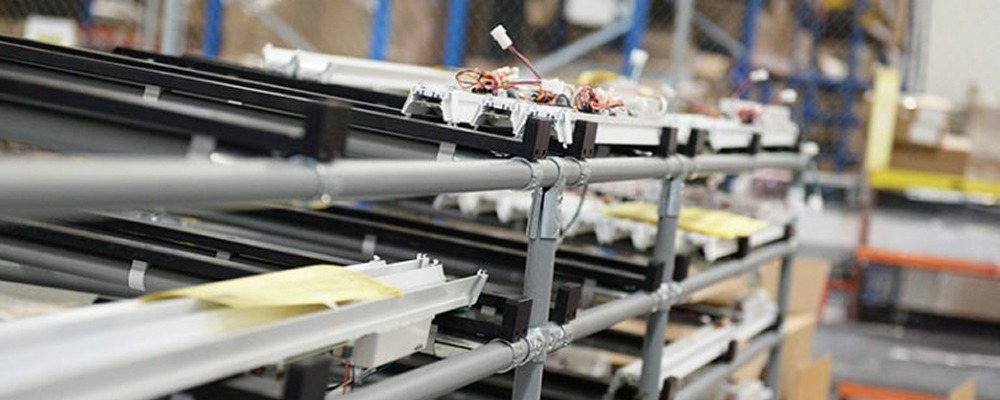


A Flexpipe roller track is an essential component for lean gravity-fed FIFO (First-In, First-Out) flow racks. They are used in material-handling systems, such as picking and kitting carts and racks, and line-side replenishment, where material storage and retrieval must be seamless.
A roller track consists of low-friction rollers securely mounted within a steel frame. Accessories like level stoppers ensure material bins stay in place. When properly used, Flexpipe roller tracks are ideal for storing material bins and totes, allowing for easy loading and unloading as needed.
In lean manufacturing, roller tracks ensure line-side production technicians can easily retrieve materials and consumables from shelving units. A roller track leverages gravity, requires no power, and has low-friction rollers for seamless material flow. They are durable, come in different widths and configurations, and can be cut to whatever length is needed.
Flexpipe roller tracks :
A Flexpipe roller track is a gravity-fed solution used in material flow racks to control the storage, movement, and retrieval of material bins. Material is stored from the back of the flow rack and retrieved from the front.
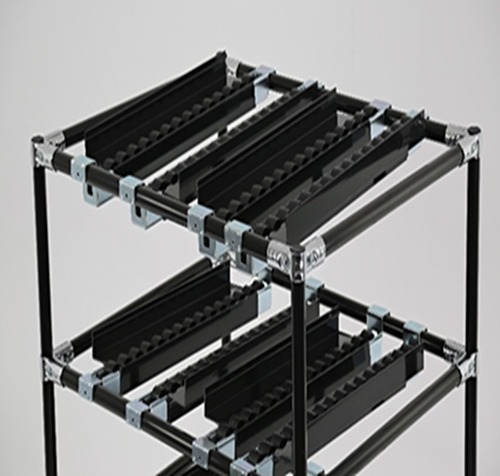
A roller track is a critical component of any lean manufacturing FIFO flow rack. Each Flexpipe roller track is installed at a 5-degree downward angle. A tab stop at the end of each level stops material bins from falling over.
The 5-degree decline ensures the bins slide down from the loading side (back of the rack) to the picking side (front of the rack). By providing line-side access to material bins, a roller track reduces motion waste as operators don’t have to travel outside their workstation for material.
Benefits of Roller Tracks
Choosing the right gravity roller track is critical to ensuring your material bins move easily from the back of your FIFO flow rack to the front without getting stuck. That means choosing a roller track matched to the types of bins your company uses. The following flow rack roller track guide outlines the most common Flexpipe options available and when to use them.
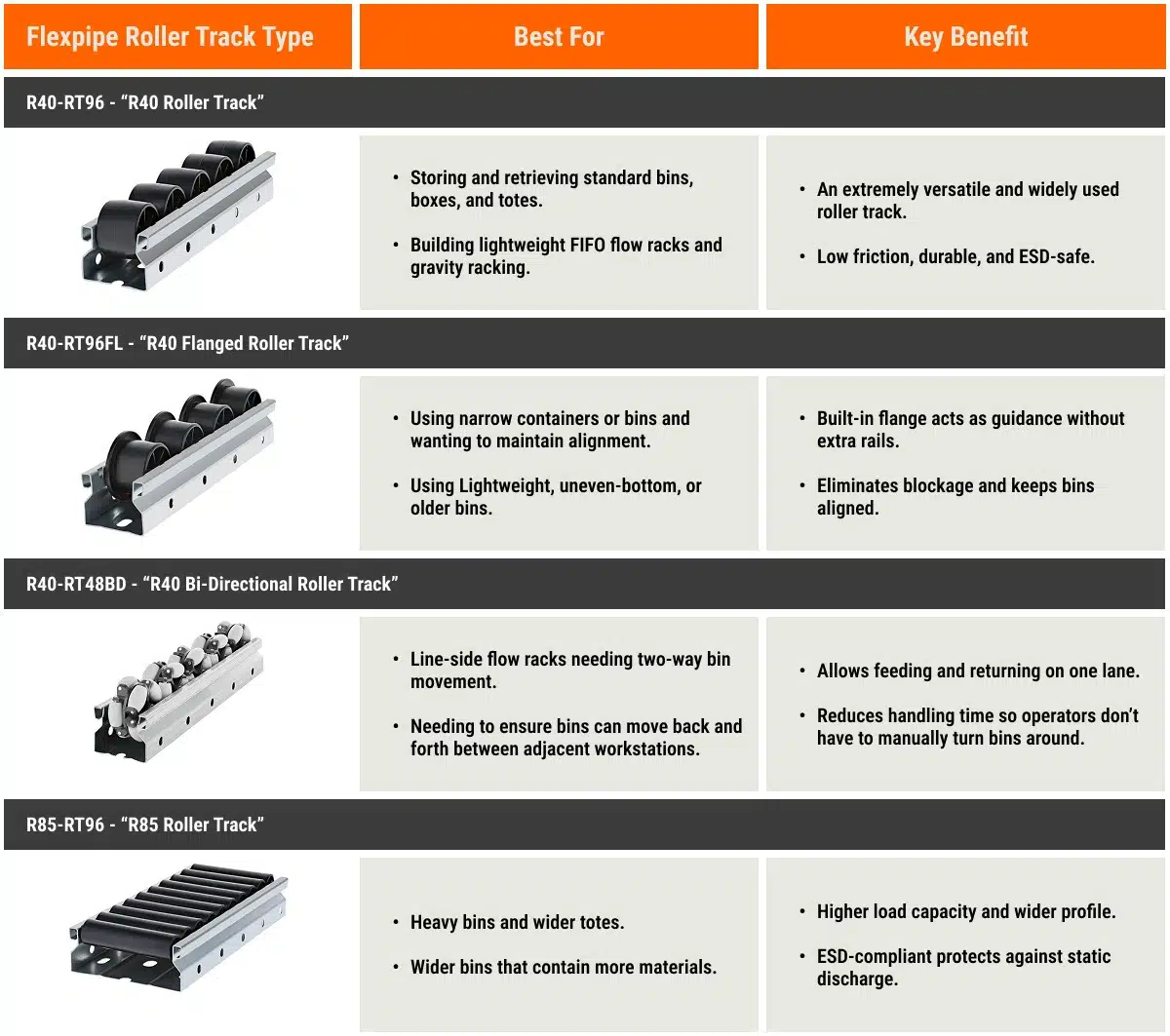

The R40-RT96 is the standard Flexpipe roller track for any electrostatic discharge (ESD) requirement. The wheels are polyethylene (PE) and are mounted within a galvanized steel enclosure. They work with standard-sized material bins, generate low friction, and are exceptionally durable and quiet.
Each wheel can support 20 lbs and about 507 lbs over 1 meter (3.28 feet). This Flexpipe roller track is modular and scalable, ensuring easy access to gravity-fed material bins, minimizing handling, and improving efficiency.
Use the R40 Roller Track when…
Next up is the R40-RT96FL – R40 Flanged Roller – another ESD-compatible flow rack roller track with polyethylene (PE) wheels. The R40 Flanged Roller supports the same overall weight per wheel and meter while improving material flow by providing low rolling resistance.
The R40 Flanged Roller has flanges that act as a built-in guiding tool, keeping material bins aligned while reducing blockage.
Use the R40 Flanged Roller Track when…

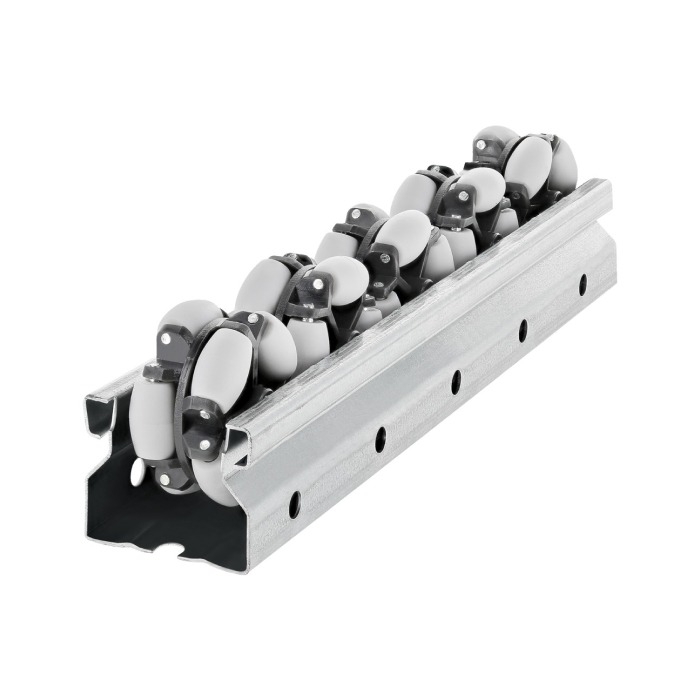
Providing the same great low-friction operation, the R40 Bi-Directional Roller Track allows for movement in both directions, making it an extremely flexible solution.
This low-resistance roller track provides exceptionally smooth rolling performance, and its compact design allows for easy integration within any standing rack. The R40 Bi-Directional Roller Track also reduces handling time as operators don’t have to manually turn bins around.
Use R40 Bi-Directional Roller Track when…
The R85 Roller Track is 85 mm wide, which makes it perfect for supporting heavier bins. This ESD-compliant flow rack roller track is best used with sensitive electronic components needing protection against static discharge.
The frame is made of heavy-duty galvanized steel, making this FIFO roller track incredibly durable. Like all Flexpipe roller tracks, the R85 Roller Track is a low-friction, incredibly smooth roller track that can be integrated into any line-side FIFO flow rack.
Use R85 Roller Track when…

In most applications, lean manufacturers start with the standard R40 roller track. As their requirements and needs change, they often start using the other roller tracks.
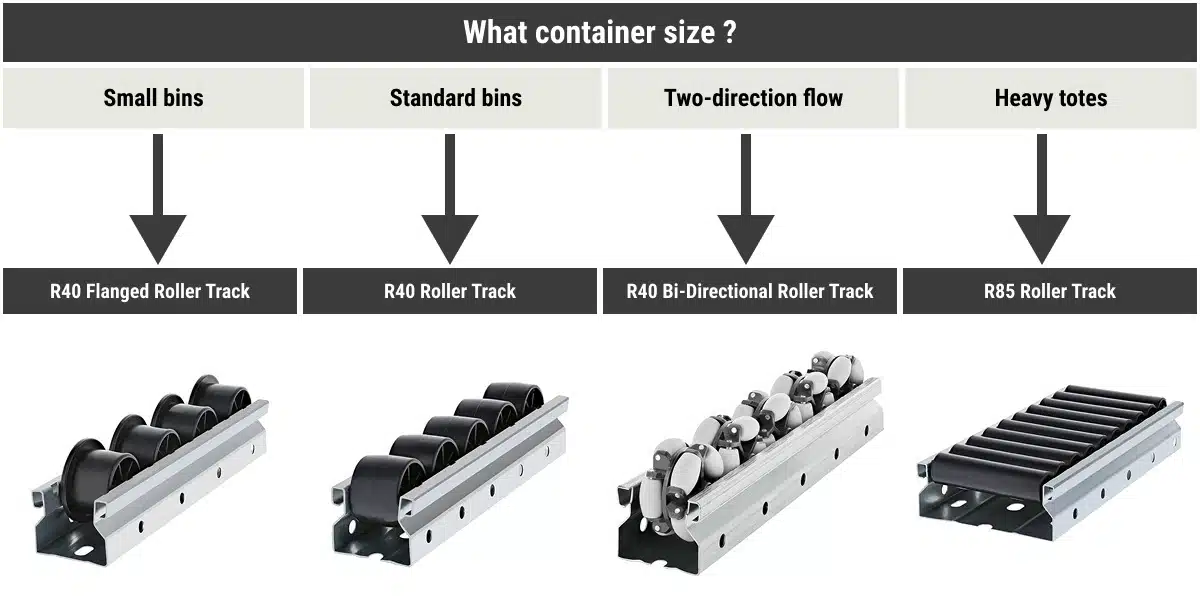
Ultimately, a flanged roller track guides material bins and keeps them perfectly aligned. The bidirectional roller tracks support two-way material flow, while the R85 roller tracks are used with wider and heavier bins.
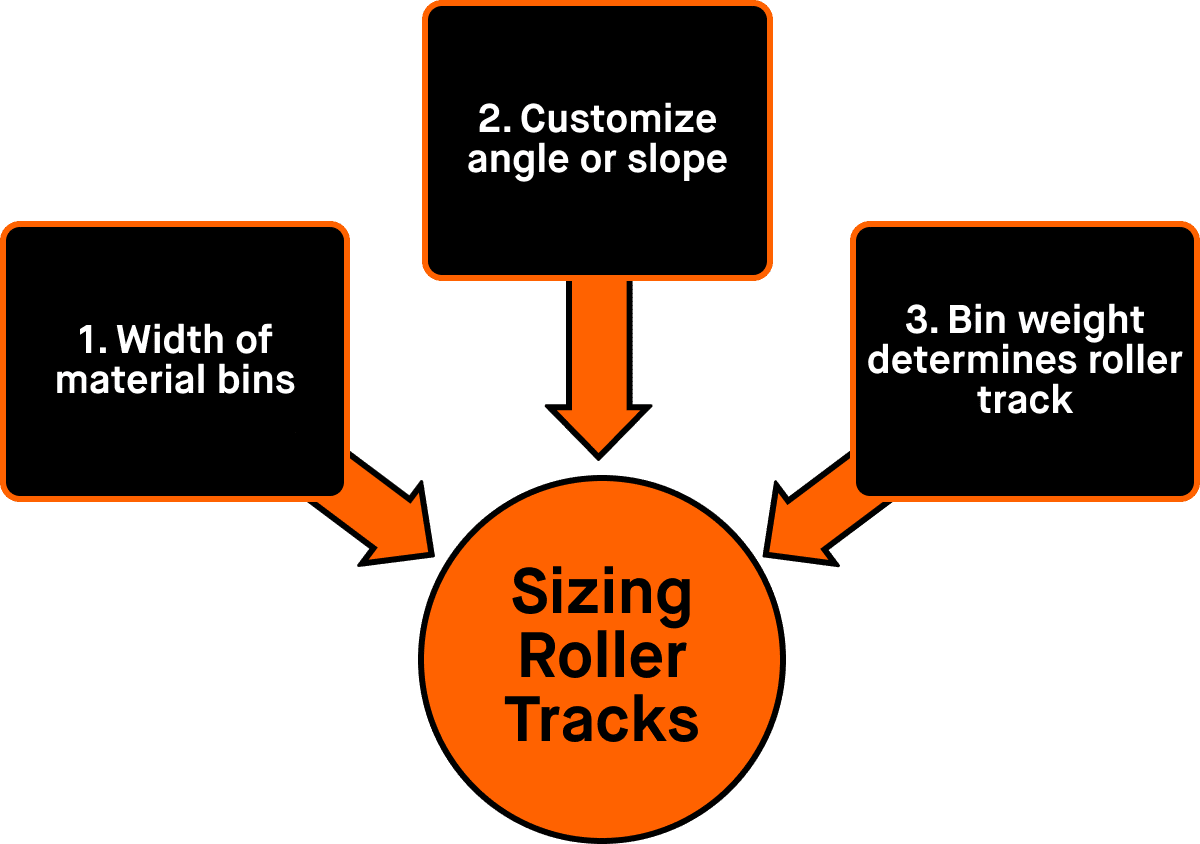
Several important criteria should be considered when sizing a roller track lane. First, always consider the width of your material bins. That width determines the spacing between the roller tracks. Material bins holding lightweight materials will require shorter spacing compared to material bins holding heavier materials.
Second, start with a 5-degree angle for the slope of the roller track. However, be willing to adjust this angle slightly up or down depending upon the weight of the materials within your bins. A 3- or 4-degree angle is sufficient for heavier material bins, as the extra weight ensures the bin slide downward. However, lighter bins may require more slope.
Finally, the weight of the material bins is also essential to choosing the type of roller track. Remember, the standard Flexpipe R40 roller track’s wheels support 20 lbs and over 507 lbs over 1 meter (3.28 feet). Anything heavier than that would typically require R85 roller tracks.
Flexpipe provides lean manufacturers with a comprehensive list of roller track accessories that help to secure bins in place while improving material flow. A breakdown of these accessories, along with a description of each, is provided in the table below.

The most common applications for Flexpipe roller tracks are FIFO flow racks. However, they are also found in supermarket racks, kitting and picking carts, and racks, in addition to any requirement for line-side replenishment or warehouse replenishment.
In lean manufacturing environments, it’s common to have mobile FIFO flow racks positioned immediately outside a given lean manufacturing workstation or lean work cell. Inventory personnel will store material bins from the back of the rack. The front of the rack faces the operator.
This simple configuration ensures the operator never has to leave their workstation or lean work cell to get critical materials or consumables. Everything is stored for them. They simply remove a material bin as needed, and a replacement takes its place while inventory personnel store the bin from the back of the rack.
An all-too-common mistake is trying to use skate wheel tracks in place of roller tracks. First, it’s important to understand that these two products serve different functions. They are not interchangeable.
Roller tracks are predominantly found in lean manufacturing FIFO flow racks, picking and kitting carts, and line-side material handling structures that support production with critical materials and consumables. They are essential to providing operators in lean workstations and lean work cells with the critical materials needed during assembly.
Skate wheel tracks are most often found in packaging and shipping. They are heavily relied upon for order fulfillment, allowing warehouse personnel to move parcels down the track to shipping. While they may be found in production, they are not used on FIFO flow racks or material handling structures that provide production employees in workstations with critical materials.
Roller Tracks
Skate Wheel Tracks
The most common mistakes in designing include using the wrong roller track. It’s common for companies to forget to account for the material bins’ width. They simply install the roller tracks only to find out there isn’t sufficient space between the tracks to allow for easy movement.
Another mistake is not adjusting the flow rack angle. Heavier material bins don’t require as steep a slope, whereas lighter material bins require a steeper slope. This leads to another common mistake, not using Flexpipe roller track decelerators (R40-SLOW) for heavier bins.
Overloading racks is another common mistake, and consequently, overloading the roller tracks. Always be aware of the total weight of each material bin relative to what the roller track can support.
While each of these mistakes is common, perhaps the biggest mistake is when lean manufacturers buy fixed, steel-welded flow racks. These fixed FIFO flow racks do not allow for customization. In most instances, they don’t match a manufacturer’s bin dimensions, and if those bin dimensions change, there is no way to adjust the structure.
A roller track is used in gravity flow racks. Bins, totes, or cartons are stored at the back of a rack, and gravity moves them to the front, supporting FIFO racking systems and improving production efficiency.
The Flexpipe R40 roller track is the most common choice for flow racks because it works well with standard bins in lean manufacturing and warehouse environments.
R40 tracks are designed for standard, lightweight bins, while R85 roller tracks have a wider profile, allowing them to support larger, heavier bins.
Flanged roller tracks should be used when you want to properly guide bins to ensure they don’t drift off the roller track. The integrated flanges help guide bins and maintain alignment.
Yes. Flexpipe roller tracks are used in FIFO flow racks because they allow containers to move smoothly from the loading (bask) side to the picking (front) side using gravity.
The Flexpipe system is the ultimate solution for customizing FIFO flow racks and other material handling systems. This cut-to-size-and-assemble system is exceptionally durable while being a low-cost alternative to fixed-in-place, steel-welded material handling structures.
A Flexpipe FIFO flow rack, workstation, kitting cart, picking cart, lean work cell, or tugger cart can be customized, assembled, modified, and adjusted on-site at your facility.
To learn what’s possible with the Flexpipe system, please visit our Design Guide.
To see existing solutions that can help you reduce your costs of material handling, visit our Free Plans.
To speak to someone directly or inquire about our design services, contact us now.


