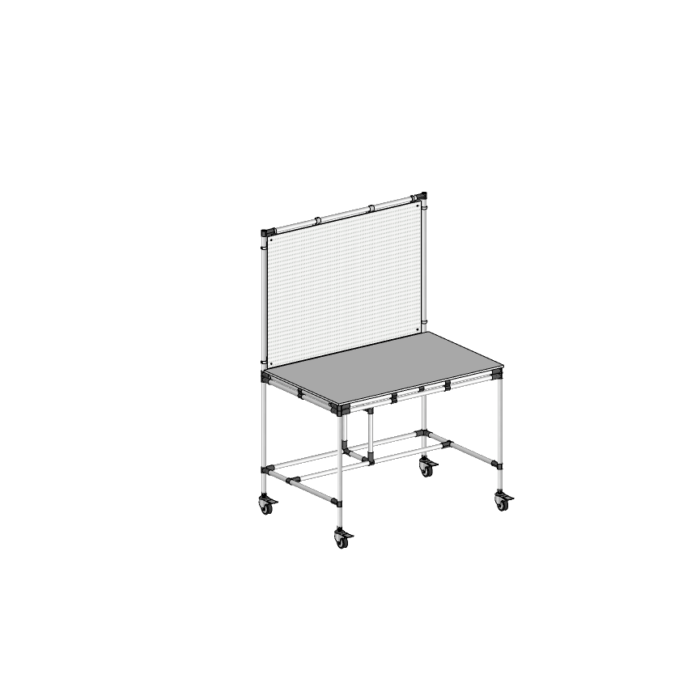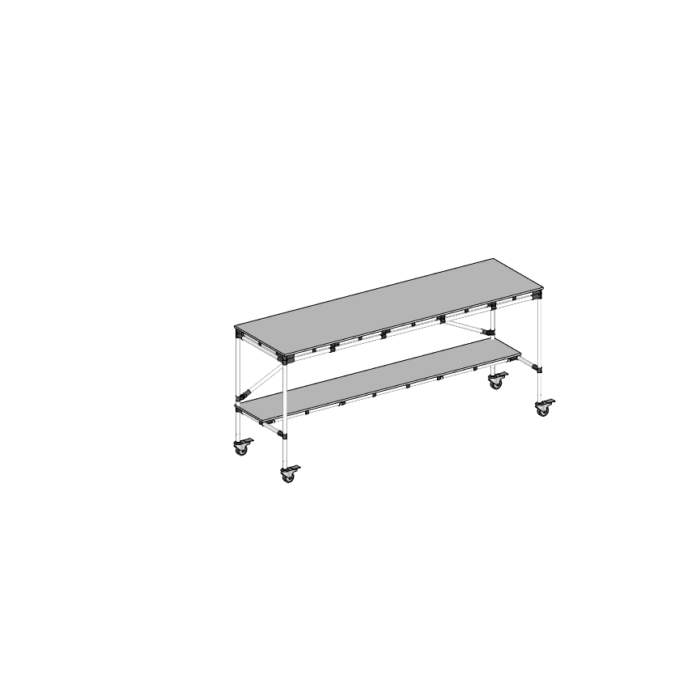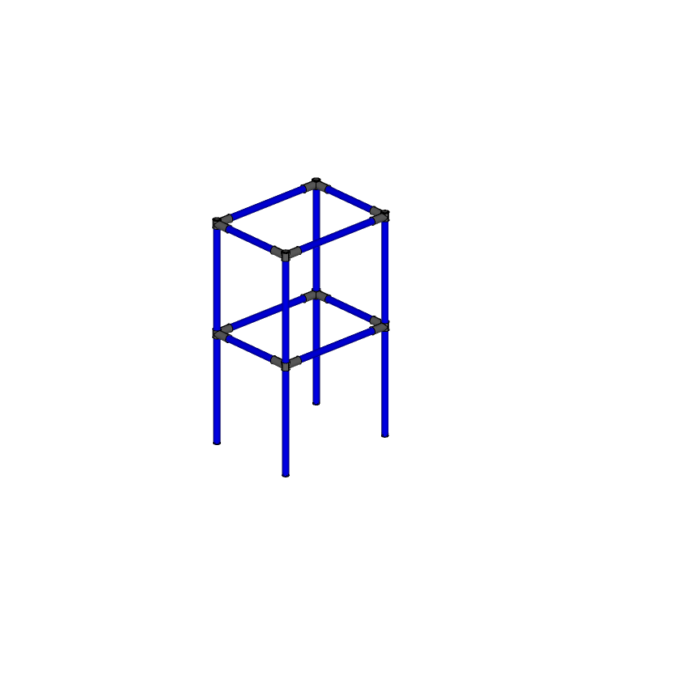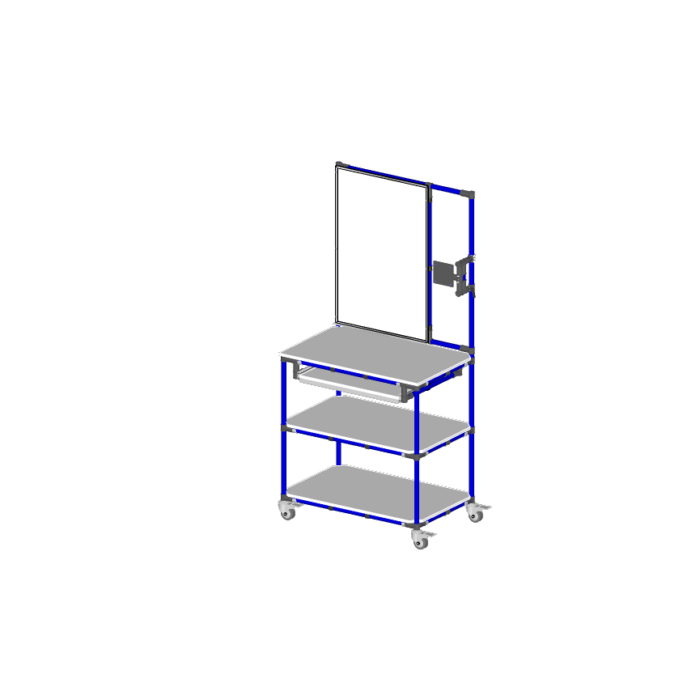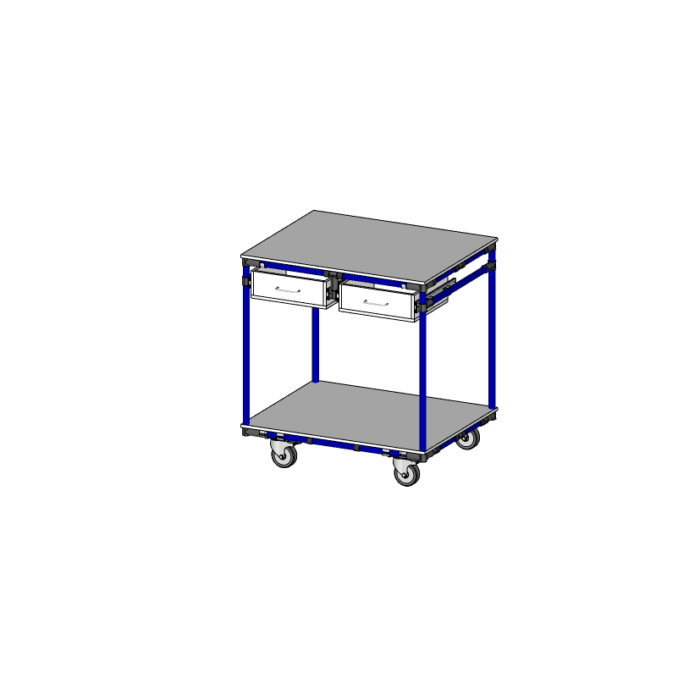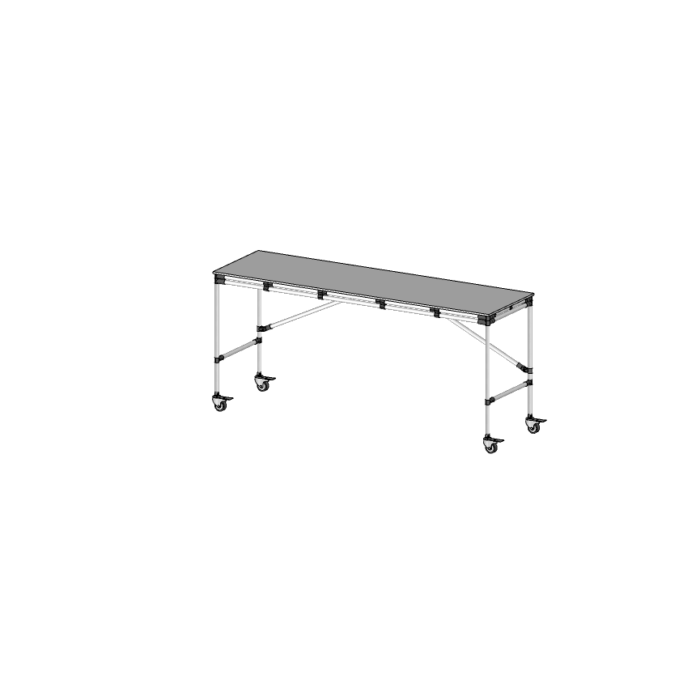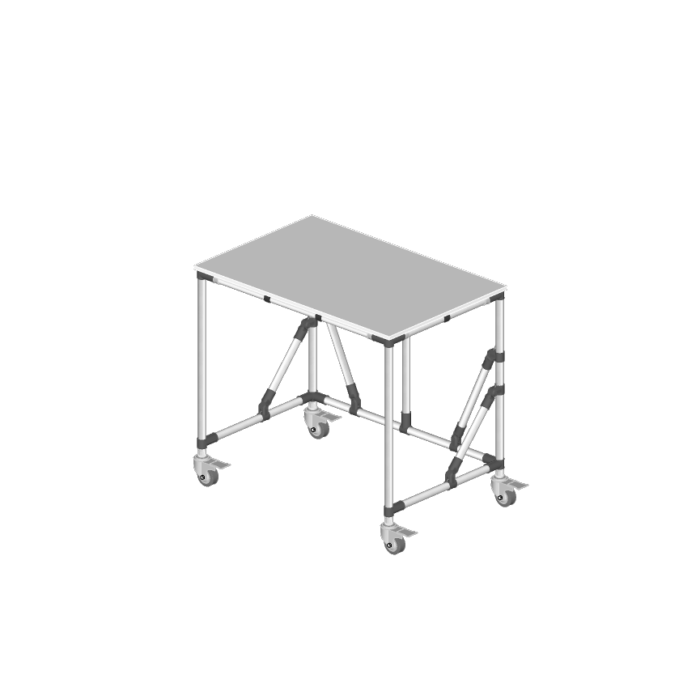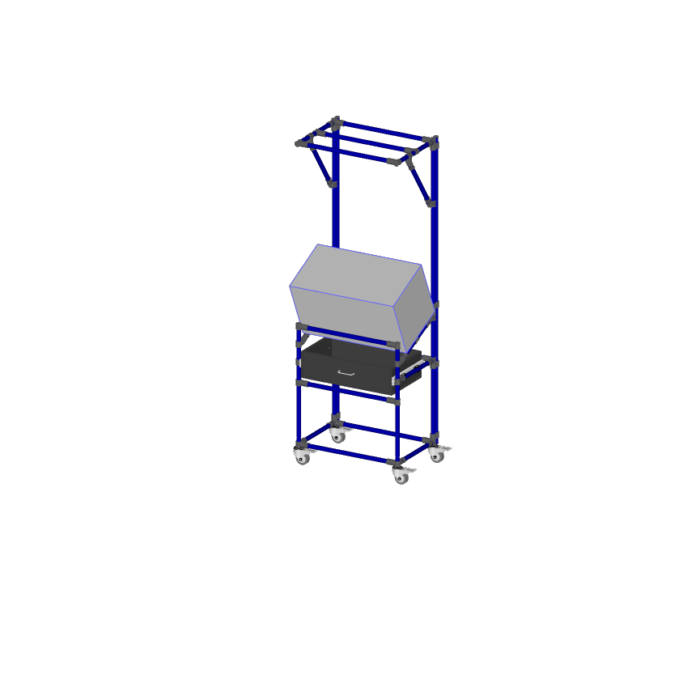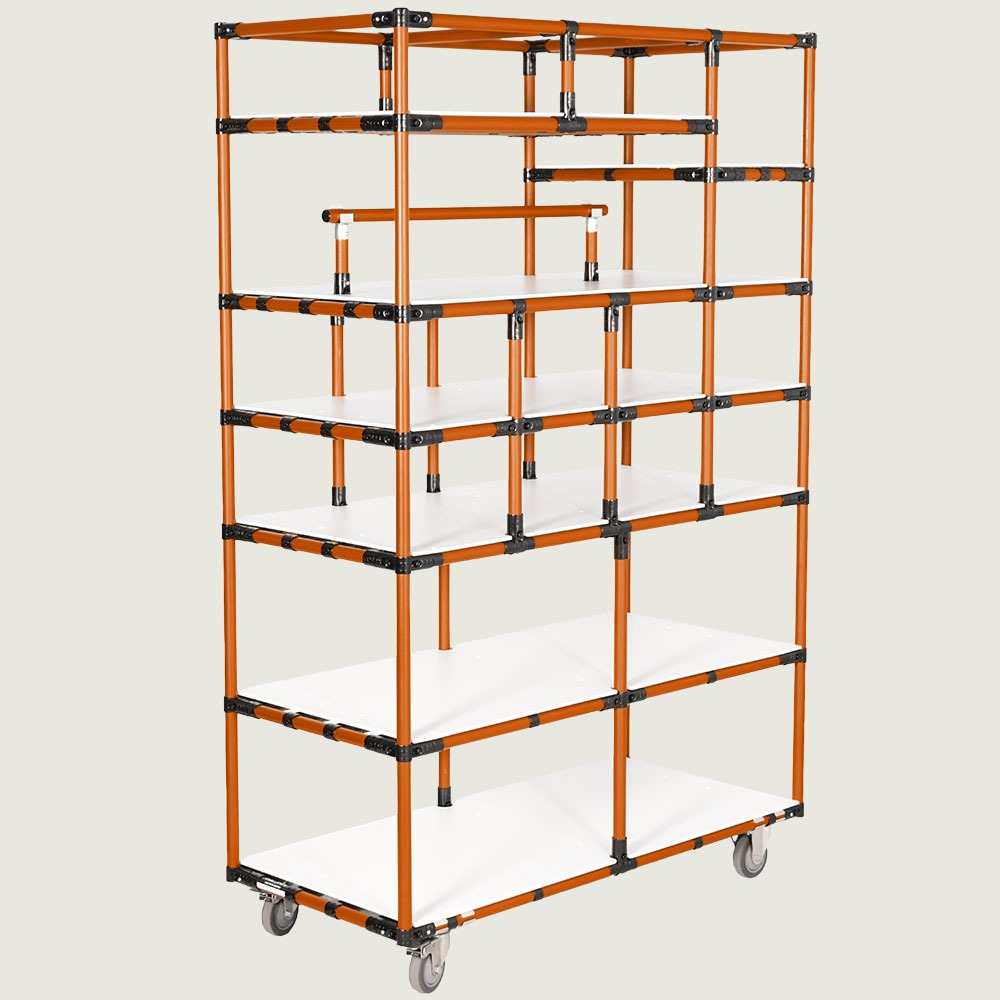
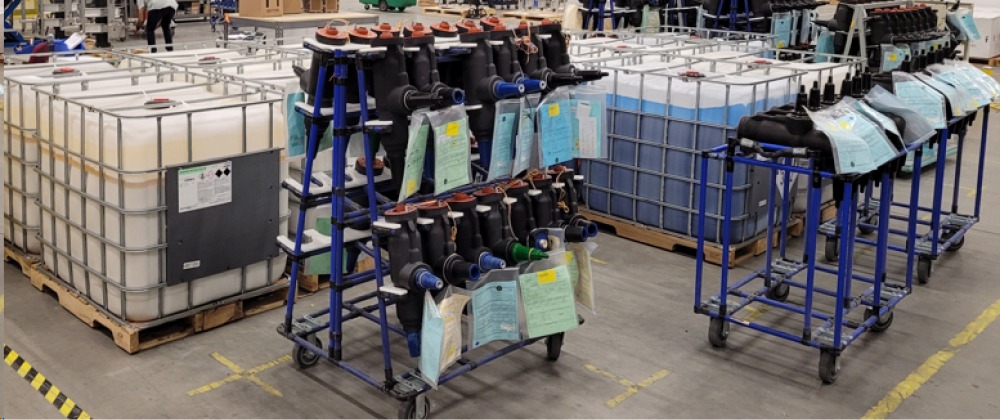
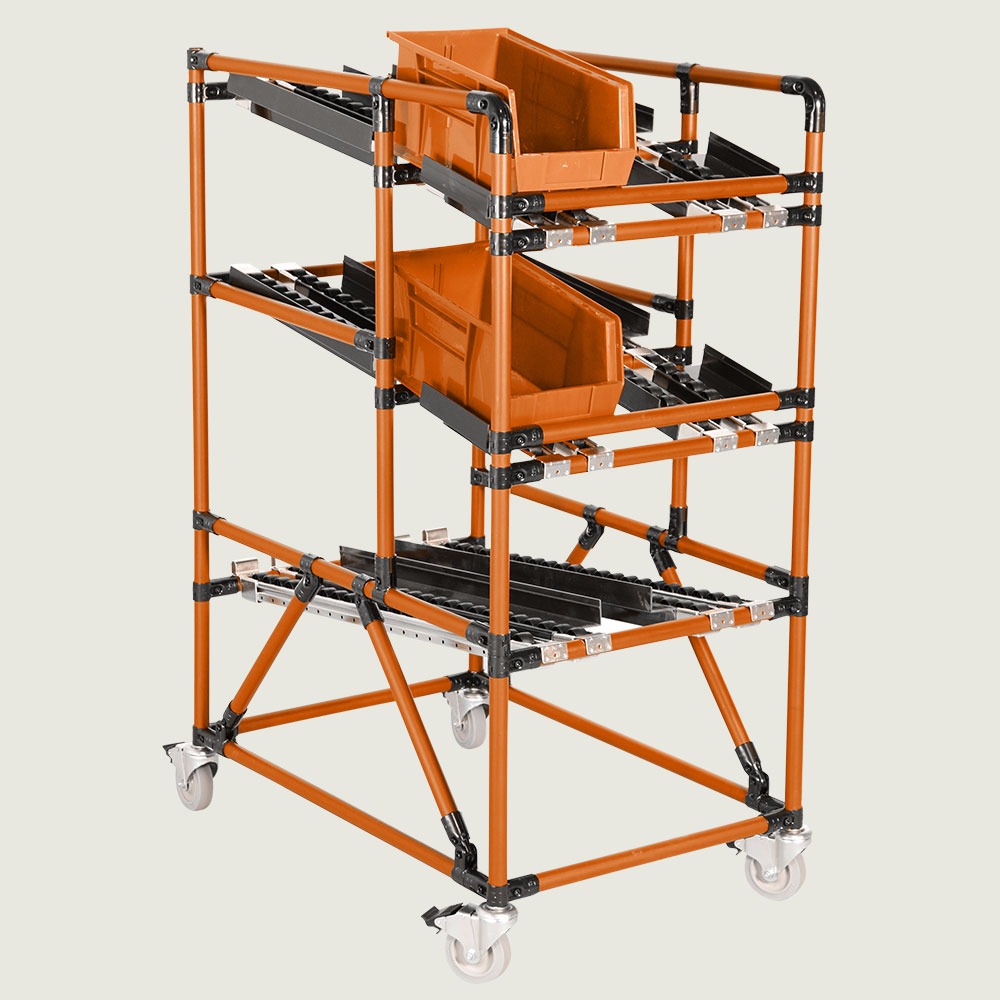
Working cells and workstations are critical to production floor operations. It is therefore important that your workstations regularly be improved upon and personalized to fit workers’ needs. From their work tables, workers can best identify which adjustments could enhance their overall efficiency as they’re the ones who use them, day in day out. When using modular workstations, such changes can be made in no time at all.
Read on for the description of the five most common types of industrial workstations used by our customers—and Flexpipe employees!
A modular workstation is a work station built from interchangeable components, such as pipe‑and‑joint systems, that can be configured and reconfigured to suit specific tasks. These workstations are effective because they allow you to limit the workspace surface to exactly what is needed, which often improves productivity by reducing clutter, minimizing tool search time, and easing 5S audits. Excess surface area can slow workers down rather than helping.
Involving end users, people who work at the stations daily, s key. Solicit feedback on height, reach zones, tool layout, and storage. Use mock‑ups or prototypes to test layouts. When workers help design their workstation, efficiency tends to increase, accident rates drop, and adoption of changes is smoother because workers feel ownership.
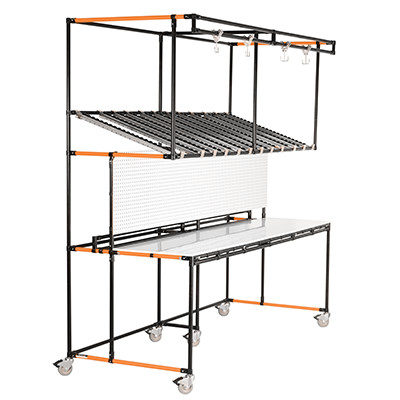
A U-cell workstation is a customizable modular workstation layout designed for manufacturing environments seeking efficiency and space savings. The U-shaped layout enables operators to handle sequential tasks with minimal motion. These industrial workstations are ideal for lean setups that prioritize ergonomics, productivity, and workflow optimization.
Compared to linear layouts, U-cell configurations boost productivity by reducing waste, shortening reach distances, and allowing easier cross-training. When combined with adjustable work surfaces and modular accessories like shadow boards, these heavy-duty workstations support fast, efficient production with fewer errors and less fatigue.
U-cell designs are particularly valuable in factory and warehouse settings that demand safe, ergonomic workstations with durability and adaptability. Case studies have shown U-cells reducing lead times by up to 50%, though exact results vary by use case. Always validate improvements during pilot programs.
Use Flexpipe’s pipe and joint modular design system to:
Flexpipe’s modular tubing lets you adapt and reconfigure layouts as production demands shift, supporting continuous improvement and lean practices.
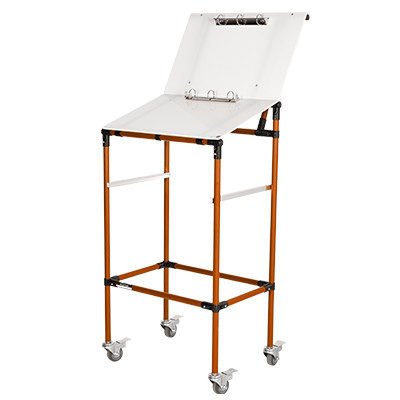
Ergonomic modular workstations are increasingly essential in modern manufacturing environments where operator comfort, adjustable height, and productivity directly affect output quality. These stand-up industrial workstations are built to reduce physical strain, support efficient workflow, and adapt to individual needs. These structures are widely used in manufacturing industries and are now becoming more popular in offices.
An ergonomic workstation is a height-adjustable industrial bench designed to improve worker posture and reduce fatigue during assembly operations. Flexpipe’s modular workstation system allows customization of work surfaces, upright frames, and accessories to match ergonomic principles for each operator.
Standing workstations improve operator efficiency by enabling faster transitions between tasks, reducing musculoskeletal stress, and enhancing situational awareness during assembly. When combined with anti-fatigue mats, adjustable shelving, and ergonomic accessories, they contribute to a safer, more productive workplace environment.
Studies and research confirm that sit-stand configurations can reduce discomfort and improve perceived energy levels. However, success depends on proper workstation configuration, posture training, and supportive features such as footrests or lighting systems.
Flexpipe’s system enables creation of heavy-duty ergonomic workstations that can evolve as tasks and worker needs change. The modular nature supports both standing and seated operations, helping manufacturers improve safety, satisfaction, and throughput.
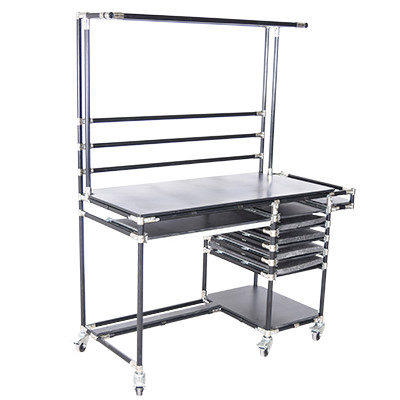
Work centers are essential components of an efficient modular workstation system, especially in industrial and manufacturing environments. These upright workstation modules provide quick access to key documents, visuals, and tools, supporting productivity, workflow accuracy, and reduced downtime across assembly lines.
A work center is a modular workstation structure that integrates KPI displays, work instructions, and visual management tools directly into the production area. Instead of traveling across the shop floor, operators access real-time information—within arm’s reach—while performing assembly or packaging tasks. This supports lean principles and boosts efficiency.
Placing work centers as close as possible to the task area reduces motion waste, supports 5S methodology, and improves real-time responsiveness. They enable faster decision-making and fewer errors. Studies in lean facilities show that moving instructions to the point of use can reduce wasted time depending on layout and line complexity.
Flexpipe’s industrial workstation components allow manufacturers to build custom work centers that adapt to shifting production needs. You can add or reposition accessories, labels, or electronic displays as your workflow evolves—ensuring long-term adaptability in high-change environments.
A personalized modular workstation is a configurable assembly bench that integrates adjustable height, storage options, and modular accessories tailored to specific tasks. Using Flexpipe’s pipe and joint system, work surfaces, upright storage units, and tool access points can be customized and reconfigured as workflow needs change.
When operators contribute to workstation design, studies in industrial assembly environments show that ergonomic redesigns of workstations—including improved layout, height adjustability, and better tool/accessory placement—can reduce cycle times by ~10‑15% (for example, a 12.3% decrease in cycle time in one study), while also significantly reducing ergonomic risk (posture, manual handling).
This approach also supports lean manufacturing objectives like 5S, one-piece flow, and quick changeovers. Limiting unnecessary space and standardizing tool placement on modular benches reduces motion waste and improves throughput.
Flexpipe enables the creation of durable, adaptable workstation setups that support lean initiatives and workforce comfort. Operators can easily adapt their work areas to evolving production lines, enhancing both productivity and morale.
An ESD workstation is an ergonomic industrial workbench or modular workstation designed to prevent electrostatic discharge. This is achieved by using ESD-rated materials such as nickel-plated joints, conductive work surfaces, and anti-static casters.
ESD damage is a leading cause of failure in electronic manufacturing. According to the ESD Association, ESD remains a significant contributor to yield losses, product reliability issues, and manufacturing cost escalation in electronics production. These failures often go undetected until later stages, resulting in rework, warranty claims, or field failures. Implementing a properly grounded, fully compliant ESD workstation reduces these risks significantly.
To configure a safe and compliant ESD workstation using Flexpipe’s modular design system:
Flexpipe’s ESD-compliant modular workstations provide a reliable solution that balances electrical safety, durability, and layout flexibility. They are especially valuable in high-mix, high-sensitivity production environments where customizable modular accessories and grounded work surfaces are essential for safe, repeatable assembly.
Working on ESD stations? Get our complete guide and learn how to protect your people and components from electrostatic discharge.
From U-cell layouts that streamline material flow to ESD-compliant workbenches that protect sensitive components, modular workstations allow manufacturers to optimize production environments for efficiency, safety, and adaptability. With Flexpipe’s pipe and joint system, you can design, build, and reconfigure custom industrial workstations that match your assembly operations, layout constraints, and ergonomic requirements.
Whether you’re seeking adjustable-height benches, heavy-duty assembly tables, or lean production line configurations, modular workstations offer long-term value and scalability. Operators work better in environments tailored to their tasks—and businesses benefit from reduced waste, improved cycle times, and enhanced reliability.
Modular industrial workstations are widely used in electronics manufacturing, aerospace, automotive, medical devices, and logistics. These environments require adaptable, durable, and ergonomic setups that can evolve with production needs. Modular benches are especially valuable where layout flexibility and space optimization are critical.
A well-maintained modular workstation built with steel pipes and reinforced joints can last 10 to 15 years in standard industrial environments. Components like casters or shelves may require periodic replacement, but the core structure is designed for long-term durability and reusability.
Yes. Flexpipe’s modular structure is fully compatible with roller conveyors and flow racks, as well as point-of-use carts. Many companies integrate workbenches with adjacent material handling systems to support lean pull strategies and reduce transport time.
Basic hand tools are usually sufficient — primarily a pipe cutter, a hex key set, and a rubber mallet. Some setups may benefit from cordless drills or angle gauges. Flexpipe also provides instructional build guides and CAD files to speed up planning and prototyping.
Yes. Workstations can be anchored to the floor using mounting plates or kept mobile with ESD-safe casters. Hybrid configurations are also common — such as anchoring the base but using adjustable shelves or rolling side tables.
Most standard workstations can be assembled in 2 to 4 hours using basic hand tools. More complex U-cell or multi-station layouts may take a full day. Because Flexpipe uses a pipe-and-joint clamping system with no welding, your own team can handle the build without outside contractors or specialized equipment.
Flexpipe workstations accept a wide range of bolt-on accessories at any time, including tool holders, label holders, drawer slides, keyboard trays, lighting fixtures, and shadow boards made from Kaizen foam. Because every accessory clamps onto the standard 28 mm pipe, you can add, move, or remove components in minutes without modifying the frame. Browse the full catalog on the downloads and tools page.
During a Kaizen event, teams can disassemble, reconfigure, and rebuild a Flexpipe workstation within hours using only an Allen key. This allows operators and engineers to test layout changes, validate ergonomic improvements, and measure cycle time impacts in real time — all without ordering new equipment or waiting for outside fabrication.
Yes. The Flexpipe Creator extension for SketchUp lets you model your workstation in full 3D, experiment with different layouts, and automatically generate a bill of materials and cut list. This helps you validate the design with your team and get accurate cost estimates before ordering a single component.
Flexpipe’s pipe-and-joint system is approximately 30% less expensive than T-slot aluminum extrusions and significantly cheaper than custom-welded steel fabrication. The real savings come over time — every component is reusable, so when your process changes you reconfigure rather than replace, dramatically lowering total cost of ownership.
Yes. Flexpipe offers a library of free 3D workstation plans that include step-by-step assembly instructions, cut lists, and downloadable SketchUp files. You can use them as-is or modify them to fit your specific layout and production requirements.