Flexpipe Blog

Learn more about the Flexpipe system and its applications with our inspirational articles on continuous improvement, Kaizen Blitz, Lean Six Sigma, 5S and corporate social involvement.


How to Select the Best Industrial Work Surface for Workstations and Modular Structures

How to Select the Best Industrial Work Surface for Workstations and Modular Structures

Choosing the right industrial work surface affects safety, productivity, and long-term costs. This guide breaks down the most common surface materials used in lean manufacturing—HDPE, UHMW-ESD, honeycomb, aluminum composite, and foam—so you can confidently select the right option for your workstations, racks, and modular structures.

The Importance of Selecting the Right Industrial Work Surface

With so many industrial work surface options available for manufacturing applications, it’s normal to feel overwhelmed. From ESD-compliant UHMW panels with surface resistances ranging from 10⁶ to 10⁹ ohms, to durable High-Density Polyethylene (HDPE) sheets and lightweight, impact-resistant honeycomb boards, each material is designed to address a specific need on the shop floor.

Additional options such as white aluminum composite panels, highly versatile pegboards, crosslink foams, and 13-layer Kaizen foam further expand the possibilities for workstation surfaces, tool organization, and part protection in lean environments.

Each material comes with its own strengths and limitations. Some are essential for ESD compliance and meeting Occupational Safety and Health Administration (OSHA) requirements. Others are cost-effective solutions that help reduce expenses, while certain materials are must-haves for workbench tops and flow rack decking.

To simplify the decision-making process, Flexpipe has standardized its industrial work surface offering in this easy-to-follow guide—helping you make better, more informed choices.

Whether you’re comparing HDPE vs UHMW vs honeycomb, selecting a manufacturing workbench surface for multiple workstations, or looking for a reliable static-control material, this guide will help you identify the right solution for your modular workstations.

By the end, you’ll know exactly which work surface best fits your application.

What Happens If You Choose the Wrong Surface Material for Your Modular Structure?

There are several risks with selecting the wrong workbench top material. The wrong material can significantly increase your costs. Others pose a potential safety risk to employees, while still others can cause ergonomic problems.

From an industrial work surface that easily warps and buckles over time, a material that experiences premature wear and tear, to selecting a material that is not ESD-compliant, the wrong industrial work surfaces for manufacturing applications can increase safety risks, drive up costs, and lead to high defect rates.

Warping

Static damage to parts

Premature wear of the work surface

Loss of precision when assembling parts

Ergonomic issues

Increased costs

Downtime

Choosing a non-ESD HDPE surface material can severely damage sensitive electronics during assembly. The wrong material for tool storage can result in lost tools and consumables, leading to extended downtime and lost production capacity. Choosing the right material comes down to accounting for the following variables. First, the material must improve productivity and efficiency. Second, the material must be durable and strong enough for the required task. Third, the chosen workbench top material must never pose a safety risk. Finally, your manufacturing workbench surface must not increase product defect rates.

Flexpipe offers an extensive range of industrial work surfaces for manufacturing applications. Each one is designed to meet the strictest of manufacturing requirements while adhering to well-established lean manufacturing principles of reduced costs, less rework and downtime, and lower scrap rates.

https://www.youtube.com/watch?v=Ocx9PbYQlUo

How Can You Tell Which Work Surface Type Fits the Application Best?

When choosing industrial work surfaces for manufacturing applications, identify the type of material handling structure first. Focus on whether the surface will be used for work assembly or is meant only as an accessory.

An accessory might include a pegboard to store tools within a workstation, a honeycomb board for the back of racks, or wire mesh for guard rails around machinery. Work assembly surfaces should be matched to the type of assembly tasks. This means electronic assembly must have UHMW, ESD-compliant work surfaces, whereas general assembly can use HDPE.

Overview of Flexpipe’s Industrial Surface Options

From flow rack decking material and honeycomb board for the back end of material handling carts to shock-absorbent foam, there are plenty of Flexpipe industrial work surfaces for manufacturing applications to choose from.

HDPE Surfaces – The Reliable Standard for Workstations and Racks

The White HDPE Sheet (½" thick × 48" × 98") offered by Flexpipe is an extremely versatile work surface with excellent impact resistance and chemical resistance. It is a low-friction surface that ensures semi-finished parts and assemblies easily slide or move across the surface without generating any wear or micro-scratches on part surfaces.

Extremely Versatile

Excellent Impact Resistance

Excellent Chemical Resistance

Low-Friction Work Surface

Lightweight

Strong and Durable

Long Service Life

Low Lifecycle Cost

Low Maintenance Cost

What is a HDPE panel?

HDPE (High-Density Polyethylene) is a lightweight, impact-resistant plastic known for its strength, chemical resistance, and low-friction surface. It’s commonly used for industrial work surfaces, carts, flow racks, and material handling structures because it’s durable, corrosion-proof, easy to machine, and maintains a long service life even in demanding environments.

UHMW-ESD Surfaces – Static-Control for Electronics and Aerospace

Flexpipe offers several ESD-compliant solutions geared towards static protection. One of them includes the UHMW-ESD Black Sheet (1/4" thick x 48” x 96”), which offers high electrical resistance protection from 10⁶–10⁹ ohms.

Offering excellent electrostatic dissipation that protects every stage of the electronics assembly process, the UHMW-ESD Black Sheet has excellent impact, chemical, and solvent resistance. Much like the White HDPE Sheet, the UHMW-ESD Black Sheet provides a solid low low-friction surface that won’t catch or drag subcomponents during assembly.

Excellent Impact Resistance

Excellent Chemical Resistance

Excellent Solvent Resistance

Low-Friction Work Surface

Lightweight

Self-Lubricating

Doesn’t Absorb Moisture

Long Service Life

Easy to Cut

Low Maintenance and Replacement Costs

Long Service Life

What is a UHMW panel?

UHMW-ESD is a self-lubricating, moisture-resistant plastic that won’t swell or warp like wood. It maintains stable electrostatic-dissipative properties even in humid environments, while offering excellent durability and smooth part movement. Easy to cut and long-lasting, UHMW-ESD is an ideal low-maintenance workbench surface for electronics and static-sensitive assembly.

Honeycomb Boards – Lightweight & Budget-Friendly

Possessing a great strength-to-weight ratio while being incredibly lightweight and exceptionally budget-friendly, the Flexpipe Honeycomb Board (5/16" thick x 48" x 96") is the ideal solution when needing to create barriers or walls on framing. Not designed as a work surface for assembling parts or assemblies, these honeycomb boards are more of an accessory that helps to finish off material handling structures.

You’ll find the Flexpipe Honeycomb Board as a finishing solution for the side walls of mobile carts, trolleys, and flow racks. Large trolleys with individual vertical slots for transporting semi-finished parts typically use the Flexpipe Honeycomb Board for its walls, as it’s sturdy enough to keep the parts in place without being too expensive.

Great Strength-to-Weight Ratio

Incredibly Inexpensive

Lightweight

Eco-Friendly

Perfect for Non-Load-Bearing Applications

Good Moisture Resistance

Good Corrosion Resistance

Covers a Large Surface Area

An extremely inexpensive material, honeycomb board is a lightweight, multi-function material with good moisture resistance that does not succumb to corrosion. Extremely easy to cut and available in large sheets, the Flexpipe Honeycomb Board is one of the most important industrial work surfaces for manufacturing applications available.

https://www.youtube.com/watch?v=RxwQb-gUtZ8

Aluminum Composite – For Clean, Professional Work Areas

The White Aluminum Composite Panel (1/8” x 48” x 96”) from Flexpipe is a two-sided aluminum sheet with polyethylene in between. A cheaper alternative to HDPE, the White Aluminum Composite Panel is yet another solution from Flexpipe that can be used for side walls and non-load-bearing surfaces.

Like all the work surface panels offered through Flexpipe, the White Aluminum Composite Panel is easy to cut, very durable, and long-lasting while also being lightweight. It also has excellent chemical resistance while having superior impact strength. Much like the White HDPE Sheet, the White Aluminum Composite Panel is a cost-effective, low-friction, and self-lubricating surface.

Two-Sided Aluminum Sheet with Polyethylene Center

Cheaper Alternative to HDPE

Ideal for Side Walls

Ideal for Non-Load-Bearing Surfaces

Provides a More Aesthetic Look

Lightweight

Excellent Chemical Resistance

Superior Impact strength

Cost-Effective

Low Friction

Self-Lubricating

This is a good surface when needing a solution with good moisture resistance that won’t require consistent maintenance or replacement. Its non-toxic properties make it a great solution across the production shop floor.

Pegboard Surfaces – For Lean 5S Organization

When it comes to adhering to 5S (Sort, Set in Order, Shine, Standardize, and Sustain), the Pegboard (1/4”x 48” x 96”) offered through Flexpipe is the ideal workstation organization solution. Lightweight, durable, and low-cost, Pegboard is easy to cut, requires minimal maintenance, and has a long shelf life.

Ensures Adherence to 5S

Improves Tool Organization

Reduces Workstation Clutter

Provides Visual Tool Placement

Good Load-Bearing Strength

Low Cost

Minimal Maintenance

Easily Cut

Standard Hooks Easily Attached

The ideal solution for the back walls of ergonomic workstations, a pegboard allows operators and technicians to quickly retrieve critical tools and consumables, while ensuring they are always readily available and easily identified. Compatible with standard hooks and simple add-on accessories, manufacturing employees benefit from a work surface that maximizes arm-reach zones while reducing wasted time.

From improving tool organization and tool placement to reducing workstation clutter, the pegboard is a solution that possesses good load-bearing strength when properly mounted. Cut as needed, and this simple material will immediately improve workstation organization.

Foam Surfaces – For Shock Absorption and Ergonomics

The 13-layer, 5s Kaizen Foam (2.4” x 20” x 40”) offered by Flexpipe is a multi-layer polyethylene, high-density foam that is easy to cut and allows for quick and seamless outline cutting of critical tools and consumables. With high shock-absorbing properties, manufacturing employees can do right-sized cutouts within the Kaizen foam so that only properly sized tools can be placed.

A very lightweight material, 5S Kaizen Foam can neatly be stored within drawers, carts, and toolboxes. Its non-abrasive surface ensures that tool metals, plastics, composites, and steels won’t encounter any scratches or damage. The material doesn’t generate much dust or particles when being cut compared to other types of foams.

Highly compressible yet stable, manufacturing employees will find it easy to trace their tools, cut out the shape, and easily place their tools safely and securely.  In the end, this is a closed-cell, high-density polyethylene rigid foam that has excellent chemical resistance and moisture resistance, ensuring steel tools don’t rust or corrode.

Why is it called Kaizen Foam?

Kaizen foam is named after the Japanese concept of “Kaizen,” meaning continuous improvement. The foam’s layered structure allows tools to be organized, trimmed, and arranged with precision, supporting lean manufacturing practices. Its purpose is to make workstations more efficient, visual, and consistent, which reflects the core Kaizen principle of reducing waste and improving workflow.

https://www.youtube.com/watch?v=KBScKAckRiI

Key Takeaways: Choosing The Right Industrial Work Surface

Durability: HDPE and UHMW-ESD for long-term use.

Lightweight: Honeycomb for large panels or racks.

Safety: UHMW-ESD prevents costly static damage.

Organization: Pegboard and Kaizen foam improve visibility and efficiency.

Professional look: Aluminum composite adds polish and easy cleaning.

Frequently Asked Questions

What happens if I choose the wrong surface material for my modular structure?Selecting the wrong industrial work surface can lead to that surface warping, cracking, absorbing too much moisture, and eventually rotting. In extreme cases, that industrial work surface may not be able to support the required weight. Ultimately, the wrong choice can increase costs, lead to multiple replacements, damage parts and components, and lead to extended downtime.How can I tell which industrial surface type fits my application best? Start by identifying whether you need the industrial work surface for a heavy-duty application, like a manufacturing workbench surface or flow rack decking. If so, then HDPE is needed.If you’re working with electronics or assembling electronics, then you will need the static-sensitive and ESD-compliant UHMW-ESD Black Sheet. Finally, lightweight applications where the surface or wall won’t support too much weight are ideal for Honeycomb or Pegboard.Which worktop surface is best for ESD workstations?UHMW-ESD panels maintain surface resistance between 10⁶–10⁹ ohms, ensuring controlled static discharge. When working with electronics or assembling electronics, always use the UHMW-ESD panels as an ESD-safe workbench top.What’s the most lightweight surface material for large industrial racks?Honeycomb polypropylene panels and pegboard are the lightest and offer an excellent strength-to-weight ratio.Can I order samples before buying full sheets?Yes. Order the Panel Sample Chain Kit to compare surface materials side by side.

Optimize Battery Production with These 8 Modular Material Handling Structures 

Optimize Battery Production with These 8 Modular Material Handling Structures 

The battery industry is growing at an incredible annual growth rate (CAGR) of 16.63%. However, with that growth comes numerous challenges. Constant battery design changes, the demand for more efficient, longer-lasting batteries, cost control, safety, maintaining electrostatic discharge (ESD) compliance, and the need to continually increase production mean that battery manufacturers must embrace lean, modular material handling systems. 

Meeting this challenge head-on is the steel tube and joint modular material handling system offered by Flexpipe Inc. The ultimate in scalability and flexibility, Flexpipe’s steel tube and joint system is lean personified, allowing battery manufacturers to design, assemble, change, and modify whatever battery handling equipment they need.

Get a broader view of lean material handling in battery manufacturing

Explore our industry guide

Key takeaways 

Battery production plants face rapid design changes, strict ESD requirements, and relentless pressure to scale. Flexpipe’s modular steel‑tube system lets engineers build customizable carts, racks, and workstations that re‑configure in minutes—no welding required.  

Result: faster line changeovers, safer ergonomics, and up to 50 % lower lifetime material‑handling costs.

Why Choose Modular Material Handling Structures

Conventional material handling structures are not lean and do not allow for continuous improvements. They are most often welded, with fixed dimensions. These fixed material handling structures aren’t just expensive to buy; they’re also expensive to maintain, and changing or modifying these structures is often more costly than buying new. 

Fixed, welded material handling structures offer no flexibility whatsoever. They are purchased to address a one-time material handling need. When the material handling requirements change or the production process changes, these fixed, welded structures quickly become obsolete.  

For battery manufacturers adopting lean manufacturing, using fixed welded material handling structures like welded carts, trolleys, work benches, workstations, flow racks, and shelving is a constant money drain.

Benefits of Flexpipe Steel Tube and Joints for Battery Handling Equipment

While fixed-in-place, welded structures cannot be changed or modified without incurring substantial costs and lost time, Flexpipe’s steel tube and joints can be altered, modified, or adjusted within the battery manufacturer’s facility.

With Flexpipe, battery manufacturers can design and assemble made-to-fit ESD-safe carts, trolleys, flow racks, workstations, work benches, Takt Boards, 4-panel boards, and information panels. All these material handling structures can be designed, assembled, and used anywhere along the EV battery assembly line. All can be changed and adjusted on-site.

With Flexpipe’s steel tube and joints, battery manufacturers can design ergonomic, ESD-compliant workstations and material handling structures that increase safety. As material handling requirements change, the structures can be changed accordingly.

Ultimately, Flexpipe steel tube and joints allow for the ultimate in agility, with structures easily built by battery production technicians and employees. It’s a simple lean manufacturing tool that produces incredible returns. Changes that can be done on-site with minimal downtime compared to changing welded structures.

If you’re dealing with frequent design changes and ESD requirements, download our free ebook: Lean Material Handling for Battery Manufacturers for a deeper breakdown of lean principles and structure examples.

8 Essential Modular Material Handling Structures for Battery Manufacturing

1. FIFO Flow Racks for Line-Side Component Feeding

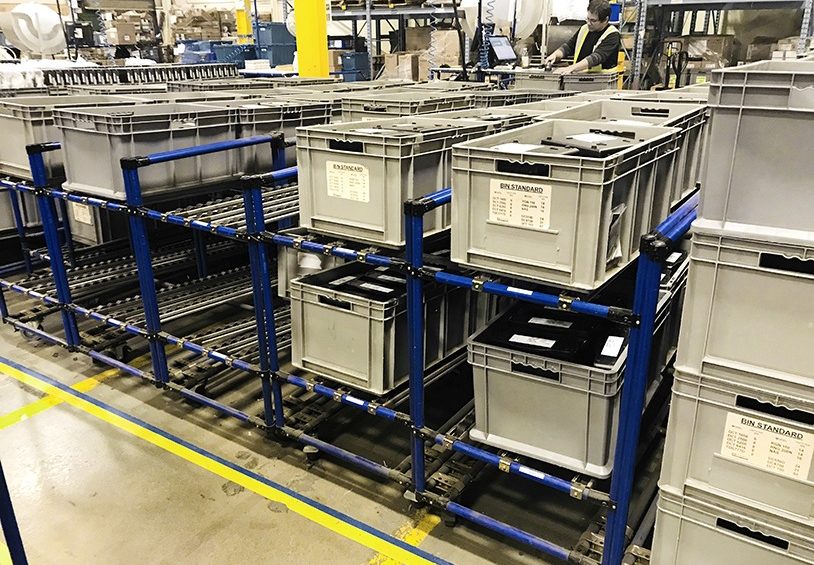
First-in, First-Out (FIFO) flow racks are the ideal solution for providing line-side technicians and battery production employees with immediate access to material bins. Everything on a Flexpipe FIFO flow rack can be customized. From customizing the height, width, and number of racking levels to adjusting the distance between each level and accommodating different material bin sizes, everything can be made-to-fit with a Flexpipe FIFO flow rack.

Each level of a Flexpipe FIFO flow rack is angled at 15 degrees. Each level has stoppers in place to keep the material bins stationary. As each material bin is removed, the next material bin slides down and takes its place. New bins are stored behind the FIFO flow rack, ensuring a steady supply of materials to battery production employees.

Everything on a Flexpipe FIFO flow rack is made from Flexpipe materials. From the steel tubes and joints, connectors, rollers, stoppers, and casters to angle joints – all are Flexpipe building materials.

The ultimate visual management system, Flexpipe FIFO flow racks for line-side component and material handling, reduce lost time and workflow interruptions caused by material shortages.

https://www.youtube.com/watch?v=n5GcZ60qHrE

2. Picking and Kitting Carts Delivering Materials to Workstations

Flexpipe kitting carts are the ultimate solution for delivering kitted work-order material requirements directly to various workstations and work cells. Whether needing ESD-compliant decking material to protect parts susceptible to static electricity, customized bin sizes for different materials, or simply requiring made-to-fit locations and shelving for materials, tools, and instructions, Flexpipe kitting carts can be customized to any kitting material size or requirement.

https://www.youtube.com/watch?v=ASjt1kIa95o

3. Tugger Carts, Trolleys, and AGV-Compatible Carts for Material Transport

The Flexpipe material system also allows for designing and assembling customized trolleys and tugger carts for manual transport or with an automated guided vehicle (AGV). Customized tugger carts are essential for efficient warehouse management and for transporting large volumes of materials to various areas of the battery production shop floor.

From thick square steel pipes for the base of the tugger cart or trolley to all the joints, casters, ESD-compliant decking material, steel pipes, industrial casters, roller tracks, and Kaizen foam, all are part of the Flexpipe material handling solution.

4. Work-in-Progress (WIP) Racks to Transport Semi-Finished Batteries

Flexpipe WIP racks and carts enable the safe and efficient transportation of heavy battery modules and casings. These WIP carts can be customized to hold semi-finished battery parts and casings in different stages of production, helping to protect the parts during transit.

With ESD-compliant decking and customized spacing, battery manufacturers can create WIP carts that securely and safely protect all surfaces of a given semi-finished battery part.

5. Ergonomic ESD-Compliant Modular Assembly Workstations for Increased Efficiency

With Flexpipe, battery manufacturers can design, assemble, change, and adjust ESD-compliant modular assembly workstations as needed. Incredibly ergonomic and sturdy, Flexpipe modular workstations can be customized to the specific battery component or casing being assembled. If the battery design changes or the workflow process changes, designs can be completed on-site with minimal downtime.

Flexpipe modular workstations improve worker efficiency, are incredibly adaptable, and provide improved safety as wires and cables can be attached to Flexpipe modular workstations with tie wraps.

6. ESD-Safe Mobile Workstations

For workflow, material flow, and assembly applications that don’t require fixed workstations, a Flexpipe mobile workstation is the best solution. Complete with ESD-compliant decking materials, these mobile workstations can be made to whatever dimensions are needed.

With industrial casters for easy maneuverability, these mobile workstations can be positioned anywhere on the battery production shop floor.

7. Heavy-Duty Battery Module Handling Carts

Large, mobile carts are the ideal solution for protecting large components and large battery modules when moving from one production workstation to another. Whether it’s creating a large mobile cart with protective foam to protect parts from damage, building a surrounding structure to protect each level of the cart, or needing a large mobile cart that is easily moved and ensures worker safety, Flexpipe’s steel tube and joint system is the ultimate solution.

https://www.youtube.com/watch?v=GtcbndU7FVM

8. FIFO Component Storage Shelving

With stationary FIFO flow racks, battery manufacturers have a steady supply of materials that acts as a visual inventory management solution. Much like the mobile FIFO flow racks, material bins are stored from the back of the FIFO flow rack. Each level is angled at 15 degrees and has a stopper to keep the material bins in place.

As each bin is withdrawn, another bin slides down the Flexpipe roller tracks and is held in place with stoppers. With stationary FIFO flow racks, visual inventory management is optimized, and inventory obsolescence dramatically decreases.

Real-World Benefits of Modular Structures in Battery Manufacturing

As a material handling solution, the Flexpipe steel tube and joint system addresses all the core industry challenges faced by today’s battery manufacturers.

Rapid product changes

Scalability and growth

Safety and ergonomics

ESD compliance

Quick implementation

Low-cost reconfiguration

Getting Started: Choosing the Right Modular Solution

Here is a list of essential criteria all battery manufacturers should consider when selecting what type of modular material handling structure they will build with Flexpipe.

Balance Current and Future Needs: The Flexpipe material handling system allows battery manufacturers to change their structures as needed. If you envision a given production line expanding, then focus on a design that allows for increased scalability.

Evaluating safety and Compliance Requirements: Battery manufacturers need ESD-compliant decking materials. Flexpipe provides numerous ESD-compliant materials to ensure battery manufacturers can assemble an ESD-safe material handling solution.

Consider Ergonomics and Workflow: Always remain vigilant about the need to design and assemble material handling structures that are ergonomically friendly and always safe for use. Also consider workflow and future changes to that workflow.

Flexpipe Material Handling Solution: The Ultimate Benefit for Lean Battery Manufacturers

The Flexpipe material handling solution is the best option for battery manufacturers in lean environments. The steel tubes and joint system are incredibly durable, strong, robust, and low-cost. Changes require minimal downtime and can be made as needed.

In a lean environment where continuous improvement is the guiding principle, Flexpipe’s steel tube and joint system ensures that lean best practices thrive.

Complete Guide to ESD Protection in Material Handling

Complete Guide to ESD Protection in Material Handling

Whether your company is a manufacturer in the medical device, electronics, automotive, or aerospace industries or manage critical environments like cleanrooms – at some point you’ll need to familiarize yourself with electrostatic discharge (ESD), adopt ESD protection processes and may need to become ESD-compliant.

What is ESD and Why Does it Matter?

Electrostatic discharge occurs when two different materials, parts, or objects with opposing electrical charges instantly release static electricity upon contact. However small and seemingly inconsequential, this spark can damage electronic components, assemblies, and electronic finished goods to the point where they are no longer operational and encounter constant failures.

In today’s electronic manufacturing facilities – where electronic devices are becoming smaller and smaller thanks to incredible advancements in microchip design – ESD can cause immediate or latent failure. An immediate failure is often manageable within a manufacturing facility whereas a latent failure is not. A latent failure can occur long after the electronic device has been shipped – and in the worst of cases – it happens when that electronic device is being used by customers.

ESD protection matters because repeated failures within manufacturing substantially increase production and assembly costs while also posing a serious safety risk. A single spark not only damages the electronic device, but it can lead to serious fires, accidents, and injuries to employees. Latent failures – once the electronic device is in the hands of a customer – can severely damage a company’s reputation and brand – allowing competitors to steal market share and customers.

Manufacturers who are required to be ESD-compliant but are not – or decide not to pursue compliance – can incur substantial penalties, fees, and surcharges for safety violations in addition to potentially becoming liable for personal injuries suffered by customers and production employees. Additional costs of non-compliance – or not adopting ESD best practices – can be summarized by high failure rates, rework and repair costs, production delays, safety hazards, employee accidents, employee absenteeism, lost customers, higher warranty costs, and injury liability claims.

Understanding ESD Compliance

When it comes to ESD compliance, it ultimately comes down to the processes your company uses, where it uses them, and the industry your company operates. In general, within the United States, ESD-compliance testing falls under the American National Standards Institute (ANSI) which enforces rules and guidelines set forth by the Electrostatic Discharge Association (EDA). The EDA also acts on behalf of US-based electronics manufacturers on the International Electrotechnical Commission (IEC) with a position on the 101-Elctrostatics Technical Committee.

What Does it Mean to Have ESD-Compliant Workstations and Processes?

Ensuring compliance means more than just using the right materials—let’s look at industry standards that guide ESD protection.

For a manufacturer to have ESD-compliant workstations – and adopt anti-static material handling best practices – requires them to enact ESD protection procedures in their production process and use ESD components and materials when assembling ESD-compliant workstations. These ESD-safe materials are used extensively in workspaces, and assembly practices to prevent our outright eliminate prevent electrostatic discharge. Regardless of the specific industry specification, there are some commonalities that all companies must follow when becoming ESD-compliant.

Success requires proper grounding procedures, using ESD components and materials when assembling ESD-compliant workstations, ensuring employees are properly trained in anti-static material handling, and that those employees have ESD-protected equipment. Designating a workspace or ESD-compliant workstation as an Electrostatic Protected Area (EPA) is also critical.

An EPA should easily be distinguished with placards and warning signs. Simply having an ESD mat for flooring isn’t sufficient. To have ESD-compliant workstations – and for those workstations to be considered an EPA location – all the above criteria must be met.

Here is an ESD-compliant workstation assembled using Flexpipe steel tube and joints that offer excellent ESD protection. Three separate ESD-friendly wrist straps are grounded to a table whose base material is ESD-compliant high-density polyethylene (HDPE) decking material covered by an ESD-safe work mat. The same material used to make this workstation is the same material used by customers when making anti-static material handling structures.

Building ESD-Compliant Workstations

To properly build ESD-compliant workstations requires a complete system approach. This means using materials in the construction of your workstation that offer complete ESD protection.

Employees must stand on dissipative ESD mats while also assembling electronic components of ESD-safe workspace mats. Grounding employees with ESD-protected clothing and ESD wrist straps that help to dissipate static electricity is also required. ESD wrist straps must allow for a free range of movement while being grounded to a ground bus bar or electrical outlet.

The Essential Workstation ESD Checklist

When assembling your ESD-compliant workstation or anti-static material handling structure, always choose materials that are certified ESD-safe. These ESD components must have passed the required testing requirements within your industry. This is essential whether you are assembling your own workstation or making an existing workstation ESD-compliant.

ESD-Protection Floor Mats: Whether you’re using two-layer rubber or three-layer vinyl, always choose dissipative or conductive mats that offer ESD protection.

ESD-Protection Clothing: Production employees should wear clothing that offers ESD protection and should always wear this clothing within the EPA. This includes ESD-compliant head covers, coveralls, foot covers or footwear, safety glasses or face shields, and ESD-protection gloves. 

ESD-Protection Wrist, Ankle, and Heel Straps: Wrist straps are essential to ensuring static electricity can easily be dissipated from an employee’s body to a grounded point. Ankle and heel straps also help to dissipate static electricity.

ESD-Protection Work Mats: ESD-safe work mats are essential when working on printed circuit boards, electronic devices, or assembling electronic devices and products.  

ESD-Protection Tools: Ensure your ESD-compliant workstation – and your employees – use static dissipative tools. Static dissipative tools have been specifically designed to reduce or eliminate static electricity. Simple solutions can include storing components or consumables in ESD-compliant bags, using ESD-safe rollers to remove static electricity, and having tools with ESD-compliant handles. Additionally, using ESD-safe or complaint swabs helps to reduce or eliminate static electricity while also protecting electronic components from being contaminated.

How Do You Create a Fully ESD-Compliant Workstation?

There are several misconceptions when it comes to having an ESD-compliant workstation or constructing anti-static material handling structures. First is the idea that all metal structures are ESD-safe and offer ESD protection. They don’t. Another is that a single ESD-compliant material protects the entire workstation, employee, and electrical components being assembled. It doesn’t.

One of the more common problems manufacturers face is having to make existing workstations ESD-compliant. While a steel workstation can be made to be ESD compliant, these steel workstations are static structures that cannot be changed without incurring substantial rework and repair costs. In addition, these steel workbenches and workstations still represent potential dangers concerning electrostatic discharge.

The best solution is to construct workstations using ESD components and materials that offer ESD protection. Flexpipe offers numerous ESD-friendly materials for ESD-compliant workstation assembly. Used extensively by electronic manufacturers and companies within the aerospace and automotive industries, customers use Flexpipe ESD-safe steel pipes and joints to make anti-static material handling structures like mobile picking and kitting carts, trolleys, flow racks, TAKT boards, point-of-use boards, shadow boards, and ESD-compliant workstations.

Flexpipe’s ESD-compliant materials for workstation assembly include steel pipes, joints, roller tracks, casters, round joints, connectors, and decking material – among others. Flexpipe’s steel pipes are galvanized steel covered in a light grey polyethylene (PE) which offers excellent ESD protection.

Example of an ESD-compliant workstation

This ESD-compliant workstation is entirely made from Flexpipe steel pipes and joints. Every part of this workstation is made from ESD-safe Flexpipe materials. The black steel pipes are covered with polyethylene (PE), the decking material is high-density polyethylene (HDPE), the joints are nickel-plated and the casters, connectors, fasteners, and other Flexpipe accessories are all ESD-compliant materials.

This modular and scalable structure can easily be modified, adjusted, or changed. The time required to make these changes is minimal compared to static workstations made of steel, wood, or other materials. The cost to change a Flexpipe ESD-compliant workstation is nothing compared to the costs of having a static, stuck-in-place steel or welded structure workstation.

Example of an U-shaped work cell

Another example of modular and scalable Flexpipe steel tube and joint ESD-compliant workstations and U-shaped work cells made from Flexpipe steel tubes, joints, and other ESD components for a medical device manufacturer. The mats on the floor are ESD-compliant. The decking material for the countertops and upper levels is made from high-density polyethylene (HDPE) and each level is covered by assembly mats that offer additional ESD protection.

Example of a pull-out drawer

Here an entire pull-out drawer is assembled using Flexpipe’s ESD-compliant high-density polyethylene (HDPE). This offers electronic assembly personnel the perfect location for placing static dissipative tools.

Example of a mount duster

A simple anti-static, carbon-infused cloth is conveniently located for any production employee to use.

Example of a pull-out drawer

A simple pull-out drawer positioned below a level. The level above and the pull-out drawer are made from Flexpipe high-density polyethylene (HDPE) decking material. 

Example of an ESD-compliant medical workstation

This ESD-compliant workstation was made entirely from ESD-safe Flexpipe steel pipes and joints. This is a one-piece flow process used in a medical device manufacturing facility.

Choosing ESD-Safe Materials for Workstations

In any manufacturing environment where electrostatic discharge is a constant concern, using the right materials for anti-static material handling structures and ESD-compliant workstations is essential. This ultimately comes down to understanding conductive, dissipative, insulative, and anti-static materials.

What Makes a Material ESD-Safe?

A material is considered ESD-safe when its surface resistance reaches a static dissipative level between 105 to1011 ohms. At this range, the material’s surface can sufficiently dissipate static electricity at a “dissipative” level – which is a level that is not too fast or too slow.

This is why some metal workstations – whether they are made of steel or aluminum – can still be made to be ESD-compliant provided the workstation has been sufficiently grounded and has ESD-compliant materials. In this case, a workstation made of steel can become ESD-compliant if it has an ESD-compliant work surface, an ESD-compliant mat for assembly, ESD-compliant flooring, a common ground point, ESD-safe tools, and the employee within the workstation has been properly trained and has the right protective clothing, tools, etc.

Why is Certification and Resistance Testing Important for Materials?

There are several important reasons for ESD certification and surface resistance testing.

First, concerning ESD-compliant workstations and anti-static material handling structures, surface resistance testing is critical for companies wanting to retain their ESD certification. That certification attests to the company’s adherence to established standards for managing and eliminating static discharge. This certification is an absolute must in the electronics, automotive, and aerospace industries in addition to the medical devices, healthcare, military, and defense industries.

Second, regularly testing for surface resistance within ESD-compliant workstations is a quality control measure that helps to reduce the likelihood of an immediate or latent product failure. By regularly testing, electronic manufacturers can reduce electronic component failure rates, increase production throughput, better control costs, protect their employees, and ensure their reputation and brand remain intact.

Third, regular resistance testing of different materials in the design stage of a new product allows engineers to avoid costly mistakes in design while ensuring the finished product is less likely to fail. Finally, the traceability of materials is also addressed through regular resistance testing as it allows electronics manufacturers to segregate defective materials or materials that could result in electric discharges.

Testing and Verification

The most common ESD testing covers ESD-safe flooring or ESD-safe mats. So, how do you perform ESD testing on floor mats and work mats in an ESD-compliant Workstation?

Point-to-Ground ESD Test

Step 1: Do not use a standard voltmeter. The pins of a standard voltmeter do not make enough surface contact with ESD-safe flooring, mats or even clothing to generate a sufficient reading. Instead, when doing ESD testing, use an ESD resistivity meter (ohmmeter) that comes with NFPA probes. 

NFPA probes provide a larger surface area for ESD testing and ensure proper surface contact. Ideally, the NFPA probes should have surfaces that are up to 3 inches in diameter.

Step 2: You’ll now need to ground the floor mat, clothing, or assembly mat. In the case of ESD flooring, it’s common practice to use copper sheets when doing ESD testing. Place the floor mat on the copper sheet. Ensure the copper sheet protrudes beyond the mat. Place one of the NFPA probes onto the mat. Place the second NFPA probe directly onto the copper sheet.

Step 3: Once the NFPA probes are in place, push the test button on the ohmmeter. The ohmmeter will provide a reading. Compare that reading from the ohmmeter to the specification sheet of the flooring or mat.

Summary: With the point-to-ground ESD testing process, you’re testing the electrical resistance point of the mat, flooring, or clothing and how well it dissipates electrostatic discharge to a grounded point. This is a test whereby generating a low resistance value or score means the material effectively discharges static because that material has good conductivity.

Point-to-Point ESD Test

Step 1: Using the same NFPA probes, place both on either end of the ESD-compliant mat, flooring, or clothing. Ensure the NFPA probes are at least 40 inches apart. There is no grounding involved in this step.

Step 2: Once NFPA probes are on the material, press test.

Step 3: Take the reading of the point-to-point test and compare them to the results from the first test (the point-to-ground test).

Summary: With point-to-point ESD testing, you’re testing the electrical resistance of two separate points on the same material – be it a floor mat, assembly mat, or clothing. This test measures how conductive the material’s surface is and how well that material dissipates static electricity. By comparing the results of this test to the first, you’ll determine if the material is more conductive point-to-point (two points on the same surface) than it is point-to-ground. If it is more conductive, then it could point to a potential hazard.

Both the Point-to-Ground and the Point-to-Point tests are based on ANSI/ESD STM 7.1 Resistance Tests.

Real-World Implementation Mistakes

There are several mistakes that manufacturers make when working towards ESD compliance and assembling ESD-compliant workstations. One of these includes improper ESD testing tools, processes, and procedures. In the previous point-to-ground and point-to-point tests, it’s not uncommon for companies to do the tests with a standard voltmeter.

Other problems include adopting stop-gap measures where a manufacturer assumes that only one or two ESD-compliant solutions are needed. In this case, a manufacturer might assume that simply having ESD-compliant flooring, mats, and wrist straps is enough. It isn’t.

Additional mistakes include improper grounding processes for wires, ground bars, and wrist straps or not providing employees with sufficient ESD-safe clothing, tools, and gear. Finally, allowing floor mats and work mats to degrade while not properly training employees on proper ESD procedures is also a common mistake.

Maintaining ESD Compliance

Maintaining ESD compliance is a 24/7 responsibility that all production managers, supervisors, and employees must share. This means enacting quality control processes that ensure all ESD-compliant workstations and EPA-designated locations have employees who have been properly trained, are well-equipped with ESD-safe clothing, and have ESD-compliant workstations.

How Do You Maintain an ESD-Protected Environment?

The first step to an ESD-protected environment is to ensure that all materials used to construct ESD-complaint workstations are certified ESD-safe, and have undergone ESD testing.

Second, adopt proactive ESD-testing schedules and maintenance programs to maintain safe and well-grounded workstations. This ensures that damaged or outdated ESD mats, flooring, dissipative tools, and clothing are immediately replaced.

Third, not only should ESD-compliant workstations and workbenches have ground checks, but you may be required to install air filtration systems if dust is a common problem within your manufacturing facility.

Fourth, relative humidity (RH) should be optimized between 40 to 60 percent throughout your facility with 55 percent RH being the target area for eliminating electrostatic buildup.  

Finally, ensure all employees are properly trained on proper ESD procedures and that they clean up their workstations at the end of a given shift. ESD rollers help to remove dust particles – which can create electrostatic discharge – from ESD mats and ensure the next employee has a more presentable work area.

Industry-Specific Applications

There are multiple different types of ESD compliance with industry-specific and process-specific requirements. Some focus on cleanroom environments, others on manufacturing and assembling electronic devices in factory settings, and still others provide guidelines and requirements when painting, printing, and packaging finished goods.

Different industries may require different ESD compliance. While there may be some similarities, there are sufficient differences between automotive – which often relies on the ISO 10605 standard – versus aerospace which typically calls upon ANSI/ESD S20.20.

The best course of action is to define your position within your industry, determine the requirements for your end-user customers and ensure your internal ESD procedures are compliant with those requirements. Given the numerous differences across multiple industries, it’s critical to ensure you have the right certification for your ESD processes.

Does Your Industry Need ESD Protection?

ESD protection is essential in many industries to prevent costly failures, ensure compliance, and maintain product reliability. See how ESD impacts your sector :

AUTOMATIVE

Prevent electronic failures in modern vehicle components.

Learn More

Aerospace

Protect sensitive avionics and electronic systems.

Learn More

Electrical Equipment

Ensure safety and durability in electrical manufacturing.

Learn More

Flexpipe: Your Anti-Static Material Handling and ESD-Compliant Workstation Partner

At Flexpipe, we’re driven by innovation. As a critical supplier to numerous manufacturers in multiple industries, Flexpipe is seen as the go-to solution for companies wanting to make modular, scalable and easily changeable anti-static material handling structures and ESD-compliant workstations and work cells.

With an established global reputation for helping electronic manufacturers create modular and scalable workstations while providing essential guidance on adopting lean-manufacturing best practices, Flexpipe is the single-source solution for all your material handling needs.

In addition to the many different types of material handling structures that can be made with Flexpipe, we are proud to offer the following services to electronic manufacturers needing Flexpipe to help them with ESD-friendly workstations and material handling solutions.

If you need Flexpipe to ensure your workstation is ESD compliant and want to us to assemble it for you, then please visit our Assembly Services Page.

If you would like to assemble your own ESD-safe workstation but want the Flexpipe design team to design a customized ESD-friendly workstation or work cell, please visit our Design Services Page.

If you have any questions about our services or would like to know more about the ESD compliance services we offer, contact us now.

Industrial Caster Selection Guide for Lean Manufacturing

Industrial Caster Selection Guide for Lean Manufacturing

Industrial casters are wheel-mounted, solid, durable circular rings or discs that are positioned at the bottom of material handling carts. Casters ensure manufacturing, shipping, inventory, order fulfillment, and warehouse employees can easily move push carts, order fulfillment carts, kitting carts, finished product carts, and trolleys from one location to the next.  

Without industrial casters, employees would risk severe injuries having to lift and carry large volumes of semi-finished or finished products. A mobile material-handling cart with heavy-duty casters ensures easy transportation and maneuverability of carts with materials, parts, tools, consumables, and finished products.  

Casters work best when they encounter minimal resistance when rolling on different types of flooring and terrains. If the material of the wheel isn’t suited to the flooring, then the friction generated between the wheel and flooring will make moving various material-handling carts more difficult and strenuous.

Why is Choosing the Right Industrial Caster Crucial for Your Facility?

Choosing the right industrial casters ensures the safety of your employees, protecting the contents with material handling carts and mobile trolleys, and optimizing transit or transportation efficiencies and costs.  

Opting for an expensive industrial caster with specialized material when it’s not needed is costly and wasteful. Not matching caster dimensions, wheel diameter, and wheel material types to the flooring in your facility means transit or transportation times will be longer than needed, casters may break, contents may fall and get damaged – or worse – employees may have an accident.  

In the best of outcomes, using the wrong type of material handling casters leads to endless frustration for employees and longer workflow processing times. At worst, it means damaged materials and products, unusable carts, and injured employees.

Quick Selection Guide

When choosing material handling casters in heavy industrial or commercial settings, it’s essential to account for the durability, strength, and load-bearing capacity of the caster. Understanding the type of materials, tools, consumables, work-in-process (WIP), semi-finished, and finished parts that will be transported on your carts is also important.  

Finally, determining the type of flooring or terrain the caster will travel on as well as the total weight the material handling cart needs to support are other important considerations.

Caster Load-Bearing Capacity: Each caster is designed to support a certain amount of weight. Understanding that weight is critical as all material handling structures are designed around a maximum supportable weight. 

Contents With Material Handling Structures: What is the custom material handling structure designed for? Knowing what types of contents will be placed on the material handling structure is essential to understanding the type of caster to choose. Some material handling structures transport large volumes of raw materials within manufacturing environments, while other mobile carts are merely for consumables and tools.

Type of Flooring or Terrain: The wheel within the caster must encounter minimal resistance and friction when rolling across the floor of your warehouse or manufacturing location. That makes choosing the right type of wheel material extremely important. Whether it’s a polyurethane, nylon, rubber, or polyolefin wheel – all will have different rolling characteristics.

Total Weight of Material Handling Cart with Contents: Every material handling structure design starts with determining the amount of weight the structure can withstand. That total weight must then be divided by the total number of casters used.

What Are the Most Common Types of Casters in Manufacturing and Warehousing?

https://www.youtube.com/watch?v=M4AWVys7eqo

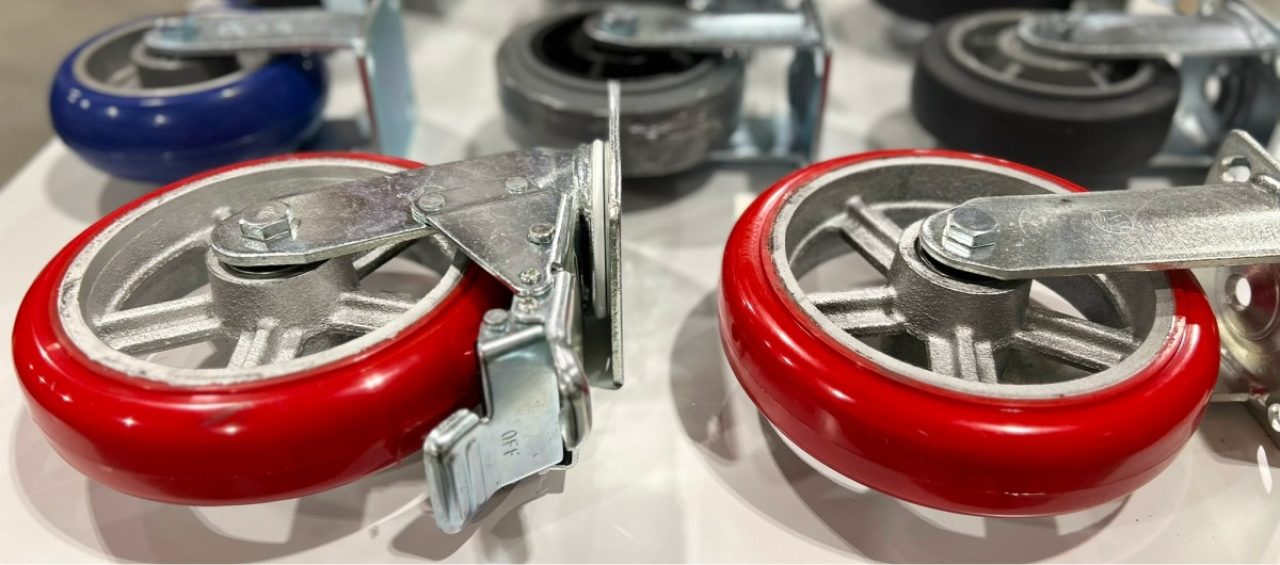
The most common types of industrial casters include swivel stem, rigid stem, swivel plant, and rigid plate casters. Foot brakes are a good accessory on casters as they allow the material handling structure to be held in place. Rigid stem and rigid plate casters can only move forward or backward in a straight line, while swivel stem and swivel plate casters allow for full 360-degree rotation.

Stem vs. Plate Casters Comparison

The primary difference between stem casters and plate casters is how they are connected to material-handling carts. Stem casters have a stem or straight vertical location pin that allows the caster to easily slide into the base of mobile carts.

Plate casters include a square plate with four or more pilot holes where fasteners – such as screws, bolts, nuts, and washers – are used to connect the caster to the material handling cart. With plate casters, the weight distribution across the caster is optimized given the surface area of the plate whereas, with a stem caster, the weight distribution is focalized on the stem itself.

As such, plate casters are designed to hold heavy weights – or have a higher load-bearing capacity than stem casters.

4" ESD Swivel Stem Caster with Brake

6" ESD Swivel Plate Caster with Brake

Stem vs. Plate Casters: Which is Right for You?

A plate-mounted swivel or plate rigid caster is the best caster when moving heavy loads on material-handling carts. Swivel stem and rigid stem casters should be relegated to mobile carts carrying lower weights, shadow boards, rotating cube boards, meeting space boards, and three or four-sided TAKT boards.

Load Capacity Guide

Every caster has a specific weight it can support. This weight – or load-bearing capacity – is always provided on each caster type. Understanding the weight that each caster can support is critical to designing and assembling any steel tube and joint material handling structure.  

In the table below, the first number listed – 3, 4, 6, and 8 – refers to the diameter of the wheel in inches.

It is essential to match the type of caster used to the given application. Industrial and commercial-use casters specifically designed for material handling structures should always be used for manufacturing and warehousing environments.

How Do I Determine the Number of Casters for My Material Handling Structure?

The first step in determining the number of material handling casters to use is to calculate the weight your material handling structure is designed to support. Once the weight of your structure is determined, take that weight at divide it by a minimum of four casters for each corner of your material handling structure.

An example might include a material handling structure that is designed to support 1800 pounds. That means that a minimum of four 6-inch Rigid Stem or Rigid Plate casters would be needed as each supports a weight of 500 pounds. In some cases, adding a caster helps to further support the mobile cart or trolley.

Application-Based Recommendations

Choosing between rigid or swivel – either for plate or stem – ultimately comes down to functionality. If a given material handling structure or material cart is only meant to transport raw materials from one warehouse or manufacturing location to the next, then rigid casters can be used. However, if that material handling cart must be maneuverable to account for different obstructions or tight corners, then swivel casters are best.

In the above application, four swivel plate industrial casters are used on a mobile trolley or trolley cart with a towbar in the up position. A single trolley cart – as part of a mobile trolley cart train – can easily be removed from the remaining carts and its swivel plate casters all that trolley cart to easily be positioned in front of a given manufacturing workstation.

Rigid plate material handling casters are used on the trolley cart above. In this application, the trolley cart is used within a large, open-spaced warehouse with more than sufficient space.  

In both applications, all four swivel plate casters and rigid plate casters are connected to 1.575" x 1.575" / 1 9/16' square tube (~40mm) black steel pipes – specifically designed for the base of tugger carts and tugger trolleys transporting heavy raw materials or finished goods.

https://www.youtube.com/watch?v=ATBJ5QJbQ5s

Exemples of caster applications

1 and 2-sided Boards

4 sided Boards

In both applications above, swivel stem industrial casters are used and allow both the 1 and 2-sided Board and 4-sided Board.

For the above mobile flow rack, swivel stem casters are used. The weight allows for swivel stem casters as the flow rack is used for lightweight parcels, bins, and raw materials within a manufacturing facility.

Ergonomic Stand-Up Workstation

U-cell Workstations

Which Caster Should I Use for Different Applications?

For heavy-duty applications where heavy materials or parcels are being transported throughout your facility, then swivel or rigid plate industrial casters must be used. For static structures such as mobile workstations, and flow racks that hold lightweight consumables, then swivel or rigid stem caster can be used. Finally, mobile picking cards, order fulfillment carts, and light material carts can also use swivel or rigid stem casters.

ESD Requirements

In the electronics industry, having Electrostatic discharge (ESD) compliant materials is an absolute must. Regardless of the type of material handling structure, workstation, or TAKT board you design, it must have ESD-compliant materials.

When Do I Need ESD (Anti-Static) Casters?

ESD-compliant material handling casters are especially important in any electronics or aerospace manufacturing, storage, or warehousing facility. Using ESD casters ensures microelectronic materials, components, and products are protected from accidental release of static electricity.  

Even the smallest release of static electricity can have serious consequences, all but destroying small electronic subcomponents, materials, and devices. This means always using 3-inch, 4-inch, 6-inch, and 8-inch swivel stem, rigid stem, swivel plate, and rigid plate ESD casters at all times.

Not only are ESD casters essential to protecting electronic devices, but they’re often an absolute safety and regulatory requirement.

Technical Specifications & Considerations

Not all casters are the same. Not all caster manufacturers use the same materials or have the same designs and configurations. Choosing the right caster type – whether it is swivel stem, swivel plate, rigid stem, or rigid plate – is only the first step. There are several other variables to consider.

What Technical Factors Should I Consider When Choosing Casters?

In addition to the caster’s load-bearing capacity, the caster wheel frame and tread material type – along with the type of flooring or terrain in your manufacturing or warehouse facility should all be considered when choosing casters.

Caster Wheel Frame: The best industrial and commercial-use casters are typically made from high-strength steel with industrial-strength fasteners and durable ball bearings for easy sliding.

Tread Material (Wheel) Type: All treads should be made from non-marking materials like non-marking grey thermoplastic rubber with TPR soles, polyurethane, or nylon synthetic.

Flooring and Terrain: Given the wide variation of flooring materials, it’s best to always focus on tread materials that leave no marks, film, or sticky residue. The three tread materials above are among the most widely used in industrial and commercial settings and ensure minimal marks on flooring surfaces.

Installation & Maintenance

With swivel stem or rigid stem casters, the stem simply slides inside the steel tubes, ensuring a nice, snug fit. Installation requires locking the break first and tightening the nut so that the caster’s bushing can expand inside the steel tubes.

For swivel plate or rigid plate casters, use the holes on the plate of the caster to drill pilot holes into the square piping (for large trolleys and carts) or use brackets to connect them to the steel pipes.

Given their repeated use, it’s important to adopt a proactive caster maintenance program. Inspect the casters every three to four months and ensure the fasteners – nuts, bolts, bearings – aren’t loose or otherwise dislodged.

Do not allow structures to stand idle for too long. Ensure you move them a bit back and forth to ensure the casters don’t create flat spots. Finally, when inspecting the casters, ensure nothing is interfering with the tread movement and use grease if need be.

Flexpipe: Your Source For Industrial Casters

With upwards of 42 variations of industrial casters, accessories, and kits, Flexpipe ensures its industrial and commercial customers have an extensive selection of material handling casters to choose from.

As part of the Flexpipe material handling solution, our extensive lineup of material handling casters is uniquely tailored to the modular and scalable material handling structures that can be made with our steel tube and joint system.

A solution that has been used extensively worldwide, the Flexpipe steel tube and joint system has a history going back 80 years to the early days of the Toyota Production System (TPS).

To view our extensive selection of Swivel Stem, Rigid Stem, Swivel Plate, and Rigid Plate industrial casters, please visit our material handling casters section.

To get an idea of the many variations of Flexpipe steel tube and joint material handling structures that would use our industrial casters, please visit our structures page.

To have your questions answered about our material handling casters in a consultative call, contact us now.

Introducing Flexpipe's Fall 2024 Product Line

Introducing Flexpipe's Fall 2024 Product Line

As the demands of lean manufacturing continue to evolve, so does the need for innovative, adaptable, and efficient solutions. Flexpipe is excited to announce our new product line for Fall 2024, designed to complement our existing offerings, enhance operational efficiency, and provide even more versatile solutions for streamlining workflow in industrial environments.

This product launch is just the beginning. At Flexpipe, we believe that continuous improvement is the foundation of Lean Manufacturing. Every quarter, we’ll introduce new solutions designed to optimize your operations, eliminate waste, and boost productivity. We’re excited to bring innovative products to the market, keeping your processes agile and efficient. Stay tuned for more to come!

What's New for Fall 2024?

D-HSCORG-48516

Rigid Honeycomb Board

See details

R85-RT96SR

Staggered 3" Roller Track

See details

W-8PF

8'' Fix Plate-Mount Caster

See details

W-8PF-KIT

8'' Fix Plate-MountCaster Kit

See details

W-8PSB

8'' Swivel Plate-Mount Caster with Brake

See details

W-8PSB-KIT

8'' Swivel Plate-Mount Caster with Brake Kit

See details

AW-PEG

Multi-Purpose Modular Pegboard Hooks

See details

EP-96-ST11

Stainless steel 8' pipe 1.1 mm thick

See details

F-BUS-11MM

Bushing for 1.1mm Stainless Pipe

See details

F-BUS-2MM

Bushing for 2mm Pipe

See details

L-C100012K4C

Crank Driven Lift Kit with Casters

See details

L-M132012K4C

Motor Driven Lift Kit with Casters

See details

Optimize Your Tool Organization with our Modular Pegboard Hooks

Designed for seamless integration with 5S shadow boards, the AW-PEG Modular Pegboard Hooks provide a flexible and durable solution for organizing tools and equipment.

Learn more about shadow boards

Looking for that essential part to streamline your operations?

Reach out to us and let us know how we can expand our product line to better serve you.

Contact Us

Stay ahead of the curve

Incorporate these cutting-edge products into your workflow today.

Shop online now

Top Lean Strategies for Optimizing Your Warehouse Layout

Top Lean Strategies for Optimizing Your Warehouse Layout

Running a lean and efficient warehouse provides endless benefits for warehouse managers and employees. Warehouse waste reduction lowers costs, improves employee morale, simplifies material handling, and ensures a seamless workflow. With the right warehouse layout optimization strategies, inventory damage is minimized. However, getting there requires a plan, one where your warehouse layout is maximized for efficiency and complemented with customized material handling carts, trolleys, flow racks, and other structures.

Want to master all aspects of lean warehousing?

Get our comprehensive 57-page guide to reducing waste and optimizing warehouse operations.

DOWNLOAD FREE GUIDE

The Simplicity of Lean Processes

Warehouse managers who embrace lean concepts rely upon well-established continuous improvement methodologies like Kaizen and 5S. Kaizen emerged from the Toyota Production System (TPS). It borrows aspects of statistical process control, and the Shewhart Cycle – a simple but incredibly effective process commonly used in manufacturing and often referred to as the PDCA (Plan, Do, Check, Act) process.

5S stands for Sort, Set in Order, Shine, Standardize, and Sustain. It is a continuous improvement methodology aimed at improving workflow by streamlining individual workstations so that all parts, materials, tools, and consumables have their rightful place and are easily found.

By combining Kaizen’s focus on warehouse waste reduction, 5S’s ability to create an improved workflow and more organized workstations, and the Shewhart Cycle’s simple process of identifying problems and eliminating them, warehouse managers can enact substantive changes that increase efficiencies.

Here is some insight into some simple warehouse layout optimization strategies with examples of modular systems for warehouses.

Strategy 1: Eliminate Motion Waste with Efficient Kitting and Picking Carts

Motion waste is perhaps the most overlooked of the eight forms of waste in Kaizen. Motion waste in manufacturing refers to any movements or repetitive processes that do not add value. In terms of warehouse management, this can include warehouse employees performing redundant and repetitive material handling tasks.

Think about how much time your employees spend traveling to different parts of your warehouse to store or pick up different materials and finished goods. Think about what’s involved when those employees perform these material handling tasks. Warehouses must allow for efficient material handling movements. There should be a seamless transition when moving items from one warehouse location to another.

Warehouse employees encounter issues in material handling, such as having to move these items with kitting and picking carts that can’t support the weight of materials or items, don’t have proper placement locations or storage areas for materials, consumables, or bins, or don’t properly secure large materials or parts.

To better understand this problem, think about the two most common carts found in warehouses. The one on the left is a standard welded platform truck and the one on the right is a simple two-level welded cart.

Both carts lead to a substantial amount of motion waste. Neither of them allows warehouse employees to properly secure materials or parts. Neither provides slots or designated locations so that warehouse employees can properly store parts and maximize their transit times. Instead, the material is allowed to move freely.

In most situations, warehouse employees simply pile on as much as possible onto these carts as a way of cutting down their material handling transit times. Invariably, inventory damage becomes commonplace. The material often falls off platform trucks or even causes injury to other warehouse employees if the material exceeds the platform’s width.

In terms of the two-level welded cart, with no placement locations for bins, material, or parts, inventory damage occurs frequently as these items are allowed to hit or bounce off each other. In every measurable way, both carts lead to high levels of warehouse waste.

Flexpipe Kitting and Picking Carts

With Flexpipe’s steel tube and joint system, warehouses can create, assemble, and change customized kitting carts and picking carts. These can be specifically designed to hold materials, parts, and consumables with different profiles and part geometries. 

Each Flexpipe cart can be configured to support a different-sized material and support that material with safety foam to ensure parts are not damaged or become dislodged.  

Flexpipe kitting and picking carts can be designed and assembled with customized bin locations to ensure the safe transport of materials, consumables, and parts directly to their destination. 

Parts don’t move, and won’t become damaged, and warehouse employees can only place the right-sized parts in their proper locations to properly transport materials to their location.  

Whether it’s a stand-alone warehouse solely responsible for processing incoming and outgoing shipments or a warehouse that supports manufacturing, Flexpipe kitting carts and picking carts provide endless advantages.

For warehouses responsible for providing kitting bins to production, Flexpipe kitting carts can be assembled so that a complete kit can be provided to manufacturing with just a single transit time. That kitting cart can then travel through production until its eventual return to the warehouse for the next kitting requirement.

Customized Flexpipe kitting carts can be designed and assembled with right-sized placement locations for bins, materials, production packages, work orders, and other instructions. Easily changed and modified to fit any material handling need, Flexpipe carts can be made to fit between any standing shelving or racking.

Flexpipe kitting and picking carts can be configured for any material dimensional requirements. This kitting cart includes electrostatic discharge (ESD) material, boards, and panels of different sizes for one kit requirement. The kitting department adjacent to the warehouse assembles the kit – ensures that each is placed in the right-sized location and then the entire kitting cart is provided to production.

Strategy 2: Minimize Inventory & Motion Waste with FIFO Flow Racks

Companies typically have two options in terms of how they manage or consume inventory. They can adopt a Last-In-First-Out (LIFO) approach where the inventory received this week is used before the inventory received in the prior weeks. However, this involves holding older inventory longer which means inventory carrying costs – financing, inventory damage, obsolescence, storage, and handling – are higher, which means warehouse and inventory waste is higher.

LIFO increases the cost of goods sold (COGS) which means profit margins are lower on sales. However, LIFO provides some tax advantages as a company’s taxes are lower when running LIFO.

Unfortunately, running a lean warehouse doesn’t lend itself well to the waste within LIFO. The goal of a lean warehouse is to minimize inventory carrying costs, which means having an inventory that is used or consumed quickly. Just-In-Time (JIT) inventory and supply chain management is an essential aspect of Kaizen and lean methodologies. JIT reduces inventory waste by focusing on quick-moving inventory. LIFO doesn’t do that, but FIFO does.

FIFO inventory practices reduce the cost of goods sold (COGS) because FIFO ensures that the first inventory received within the warehouse is used first. In layman’s terms, inventory received last week would be used before any inventory received this week or next. With FIFO, inventory carrying costs – in terms of financing, storage, handling, obsolescence, etc. – is lower and therefore the profit on sales is higher.

Flexpipe’s FIFO flow racking systems are the ideal solution for running lean FIFO warehouse management practices.   

Slightly angled roller tracks ensure that bins and packages are held in place by the bins and packages in front of them. Stoppers at the bottom of each level ensure the next bin or package is safely secured. 

Multiple Flexpipe FIFO flow racks in use within a warehouse.

Easily customized, Flexpipe FIFO flow racks can be adjusted or modified, allowing for the inclusion of additional stocking levels, a wider rack, or additional roller tracks. 

Inventory waste is minimized with Flexpipe flow racking. Damage to inventory is less likely to occur both because of how securely the inventory is held and because of how quickly the inventory is used. 

With Flexpipe FIFO flow racking, inventory is stored in the rack from behind, ensuring that the inventory in front (older inventory) is used first. Motion waste is also eliminated as warehouse employees aren’t forced to constantly adjust packages or materials on shelves to perform their pick and place responsibilities.

With Flexpipe, you can customize your FIFO flow racks to match the exact size of the packages and bins your warehouse receives, moves, and ships.

Strategy 3: Reduce Waiting Waste with Flexible Workstations

Another often overlooked form of waste includes waiting for waste. In Kaizen, this is commonly referred to as unused resources or misused talent. However, they ultimately mean the same thing; employees standing idle because of uneven workflows, poor work instructions, or because they lack the proper tools and consumables to complete their material handling processes. All are forms of waste.  

In many instances, warehouse employees will travel repeatedly to get tools or consumables to perform a specific work task. This form of waste is easily solved with a mobile workstation.

The Flexpipe steel tube and joint system allows for the design and assembly of customized mobile warehouse workstations that can easily be positioned at different warehouse locations. 

This mobile Flexpipe warehouse workstation perfectly encapsulates the importance of adopting 5S practices – Sort, Set in Order, Shine, Standardize, and Sustain. 

By using Flexpipe Kaizen foam, each tool has its proper place. The Kaizen foam acts as a fail-safe Poka Yoke solution that ensures only the specific tool fits in the given slot.  

Poka Yoke is a common approach in Kaizen philosophy and is used to eliminate human error. Instead of randomly throwing tools and consumables on a welded cart where they can damage one another, this Flexpipe mobile workstation ensures every consumable, tool, and material needed is properly secured and protected.

With Flexpipe’s steel tubes and joint system, mobile 5S workstations can be created in any configuration and use simple Poka Yoke solutions like Kaizen foam to ensure warehouse employees put the right parts and consumables back in the correct places.

Strategy 4: Enhance Efficiency with Narrow Aisle Pushing Carts

One of the more common forms of waste within warehouses is when the physical space between in-place shelving makes it extremely difficult for warehouse employees to perform common pick-and-place work tasks. This issue is only made worse by fixed welded carts whose dimensions leave little to no room for warehouse employees.

In many instances, warehouse employees must move welded carts back and forth to access different portions of the inventory on racks. This unnecessarily wastes time and can be a safety concern as employees must constantly work around obstructions.  

Flexipe steel tube and joint system is a simple solution that allows for the design and assembly of narrow-aisle push carts and trolleys. Instead of adjusting existing in-place shelving to accommodate a fixed welded cart, the approach is to design and assemble a customized narrow-aisle Flexpipe cart to fit the current space between that shelving. 

A Flexpipe narrow-aisle cart can be customized for maximum efficiency, giving warehouse employees more than enough room between tight-fitting, in-place shelving and racking.

Strategy 5: Optimize Space Utilization with Customizable Packing and Cutting Stations

Fixed-structure packaging stations are not the ideal solution when adopting lean methodologies. Given how often packaging requirements change within warehouses, fixed-welded packaging stations are anything but efficient. Consuming more space than needed, fixed welded workstations lead to high amounts of waste and inefficiency. They consume important space, can’t be changed, and quickly become obsolete.

Optimize Your Packing Station with Lean Principles 🎥

Check out this short video to see how an effective packing station setup can eliminate waste and boost efficiency in your order fulfillment process. Learn how the right layout, tools, and ergonomic setup can help you implement Lean principles in your packing stations. 👇

https://www.youtube.com/watch?v=pqp2ItrjRMg

In addition to packaging, warehouse employees are often asked to perform additional work tasks outside of picking and placing. These work tasks often include reinforcing shipments with wood pallets or creating much-needed temporary wood support structures.

The image on the left is a 5S Flexpipe mobile customized packaging station. Easily moved and transported to different locations within a warehouse, this mobile packaging station can be configured or adjusted as needed. On the right is a Flexpipe mobile cutting station, allowing for easy transport to different locations within the warehouse.  

Both structures can be modified and adjusted based on the constantly changing requirements that are common within warehouses.

Mobile warehouse packaging stations can be designed and assembled to any dimensions and include whatever features your warehouse needs.

Strategy 6: Reduce Transportation Waste with Customized Trolley/Tugger Carts

Another common form of waste includes the material handling transit times to move incoming shipments to different warehouse locations. In worst cases, multiple trips must be taken to transport what should only take a single trip.

Welded platform trucks have fixed dimensions and are often inhibited by weight restrictions. Two-level welded carts simply don’t have the space to accommodate larger incoming shipments. The solution lies in designing and assembling customized trolley/tugger carts which can be linked together in a single tugger or trolley train.   

This Flexpipe tugger cart includes an upright tow arm for a battery-operated tugger, allowing for multiple carts to be combined within a tugger train to reduce material handling transport times.   

The tugger cart uses a high-strength square steel base for increased weight support and industrial-strength casters for easy transport and maneuverability. 

Another important feature is the incorporation of rollers which are positioned at an angle to allow for easy loading and unloading of bins, parcels, and packages.

When multiple tugger carts are connected by each cart’s tow bar, they form a tugger cart train. This simple solution reduces the amount of time needed to move parts and materials within large warehouses. Instead of making multiple trips with a forklift, a single trip can be accomplished with a tugger cart train.

Using Modular Systems for Warehouse Waste Reduction

Adopting lean methodologies within warehouses requires lean tools. Flexpipe is that tool. Its origins come from the very same company that created the Kaizen and Lean philosophy. Toyota was the originator of the steel tube and joint system and relied upon it for its flexibility and ease of use. 

Warehouse waste reduction is a never-ending process. It always requires a commitment to continuous improvement. Fixed, welded material handling solutions like truck carts and welded carts do not lend themselves well to lean environments – but Flexpipe’s system does.  

If you would like to learn more about how Flexpipe’s modular systems can reduce waste and optimize warehouse layout, visit our custom-made structures page. 

If you are a warehouse manager wanting to implement some of these waste-reducing strategies and are interested in a free consultation, contact us now.

Ready to implement these strategies in your warehouse?

Our free 57-page Lean Warehousing Mastery guide includes:

Detailed implementation steps

Real-world case studies

Performance measurement tools

Download Now

CI Workshop: Where Lean Manufacturing Starts

CI Workshop: Where Lean Manufacturing Starts

Every journey starts somewhere. In lean manufacturing, that journey begins with a continuous improvement (CI) workshop. A CI workshop provides the foundation by which your company can make significant lean improvements that reduce waste, increase throughput, and reduce costs. When Flexpipe customers want to learn the most efficient, proven ways to run a successful CI workshop, they combine the scalability of Flexpipe’s steel tube and joints with the insight, expertise, and lean teaching solutions provided by Flexpipe’s global partner – Quadrant 5.  

So, how can the combination of Flexpipe’s ease-of-use material handling system and the lean subject-matter experts at Quadrant 5 help your manufacturing location adopt a continuous improvement, lean manufacturing mindset that provides endless returns?

A Global Partnership Focused on Lean Manufacturing

An experienced consultancy group based out of San Francisco California, USA, Quadrant 5 comprises Toyota Production System (TPS) experts with extensive international experience over three continents and 17 countries. Quadrant 5 has helped some of the most recognized global manufacturers adopt lean manufacturing solutions and best practices. 

Needing a lean manufacturing workstation and material handling assembly system that allows for quick, immediate, low-cost, near-instant changes to workstation structures led Q5 to Flexpipe’s steel tube and joint system. Flexpipe’s system – whose origins can also be traced back to the Toyota Production System – was a natural fit for Q5’s CI workshops and continuous improvement initiatives.  

This partnership provides customers with the tools, training, and expertise needed to make CI workshops that all-important first step to adopting lean manufacturing.

What is a CI Workshop?

Think of a CI workshop as a sequential, step-by-step process to prototyping the perfect manufacturing workstation. In the case of Q5 and Flexpipe, that includes using the steel tube and joints to create a new, lean, much improved, and far more efficient workstation. So, what’s the first step? 

1. Embrace Kaizen 

Long before any changes begin, management and employees must embrace the Kaizen, lean manufacturing doctrine. Kaizen is Japanese for “change for the better”. However, Kaizen is not a one-time event – as some North American manufacturers sometimes assume. It is an every-second-of-the-day, never-ending process where daily improvements are made to increase efficiencies and eliminate waste. 

Within manufacturing, waste can take many forms. Think of waste not just in terms of physical parts and defects, but in the extra movements and steps production technicians often take unnecessarily. Waste can include excess inventory. It can include lost time from machine downtime, and missing parts, tools, and instructions.  

Waste can include high transit times to move work-in-process (WIP) parts across the shop floor and between each workstation. It can include redundant and time-consuming work processes, incomplete and unclear work orders, confusing bills of materials (BOM), repetitive work tasks, and redundant approvals. Most importantly, waste can include production technicians lacking sufficient clean workstations. 

Ultimately, waste becomes much easier to spot once you start the CI workshop. The essence of lean is to allow production technicians to eliminate this waste by empowering them to be proactive. This is the mindset that must be adopted for a CI workshop to be successful. Without this all-important mindset, any incremental improvements will be abandoned. 

2. Identify a Production Area That Requires Improving

In our example, we’ll focus on a workstation that is poorly laid out, poorly structured, and needs to be properly redesigned. We’ll assume this workstation has been chosen because it has high manufacturing cycle times that create unnecessary backlogs for the adjacent workstation. Ultimately, cycle times to complete work tasks are high, backlogs build up, space is at a premium, workflow is constantly interrupted, and production volumes suffer as a result.

Quadrant 5 hands-on consulting provides production technicians will all the tools they need to design lean manufacturing structures and workstations

3. Focus on Small Incremental Improvements

This particular workstation’s frame includes a wooden structure that is dilapidated and warping, insufficient space for the operator or technician to perform their work tasks, and an obvious lack of structure and organization for tool placement and storage. In addition, there is an oversized welded worktable and steel cabinets.

Tools and consumables are often misplaced, and semi-finished parts are often strewn about. With no designated place for tools, accessories, and consumables – and with limited space to perform work tasks – it’s easy to see how this workstation has high cycle times and why backlogs are commonplace.

By focusing on small, incremental improvements, this waste can eventually be eliminated. A new workstation structure can be designed, assembled, changed, and quickly adjusted with Flexpipe’s steel tube and joints and the insightful guidance and lean teaching of the Q5 team.

The welded worktable can be replaced with a right-sized, tailor-made Flexpipe worktable with the proper decking material while all the tools, accessories, and consumables can be properly stored using 5S principles, Flexpipe’s Kaizen foam and either Flexpipe’s white HDPE Peg Board or Flexpipe Rigid Honeycomb Board.

A perfect example of how 5S principles ensure that every tool and consumable has its rightful place.

While this is just an example, the experience, guidance, and insight provided by the Q5 lean manufacturing team along with the scalability and flexibility of the Flexpipe steel tube and joints system allows these incremental changes to produce incredible results.

4. Measure the Performance of the New Workstation

Throughout this entire process, it’s essential to gather feedback and suggestions from the production technician. Their input is invaluable, and they must feel like an active participant in this process. Determining the success of these adjustments ultimately comes down to measuring the performance – or put differently – the production throughput of the newly designed Flexpipe Workstation.

The Q5 team can provide invaluable insight into how this improved performance can be measured and quantified. The result is a much-improved workstation layout where cycle times have decreased, production volumes have increased, the production technician has a cleaner work environment, tools are easily found, and future backlogs have been eliminated.

Quadrant 5’s consulting provides in-class training for senior management, line-side managers, and supervisors.

5. Duplicate Success

The goal is to duplicate this success throughout all the workstations on the shop floor with the overriding purpose of creating a true, lean manufacturing environment. This quickly becomes a necessity as improving one workstation – while not improving the next – would eventually lead to additional backlogs as the improved workstation would easily outproduce and outpace its counterparts.

Customers and Industries that Use Flexpipe and Q5

The strategic partnership between Q5 and Flexpipe has helped numerous manufacturers in the USA, Canada, and Mexico. From automotive manufacturers to aerospace Primes and contractors to corrugated packaging companies and furniture manufacturers, Q5 and Flexpipe’s partnership has had a direct, bottom-line impact on numerous manufacturers.

Some of Q5’s most recognized customers include Acme Corrugated, Bay Cities, President Container, Kento US, AICC, Cartro SAPI de CV with current projects including L&M container, Royal Container, Construction Innovations, Rexmoore, and M3 Components – just to name a few.

A clearly defined daily plan of attack, metrics, KPI, Master Schedule, and performance tracking are staples of Q5 lean manufacturing training and consulting.

A newly transformed crib station designed and implemented by Q5 using customized Flexpipe portable workbenches, customized flow racks, and shelving units with special bins to hold consumables, fasteners, and hardware as well as Flexpipe shadow board for tool placement and storage.

Q5 Workshop Consulting Services With Flexpipe Steel Tube and Joints

The global partnership between Quadrant 5 and Flexpipe provides the tools, training, and insight manufacturers need to create bespoke workshops and lean manufacturing best practices that increase speed, eliminate waste, improve product quality, and reduce costs.

This unique global partnership empowers manufacturers to create unique solutions for their operational teams allowing them to reduce costs and increase production throughput faster than any other solutions on the market today.

To make the best of your CI Workshop with Quadrant 5 and Flexpipe’s steel tube and joint material handling system, training for senior managers (10 Hours) is available to ramp up everyone in the latest lean techniques.

Technical training is also given to your CI personnel during the construction of the workshop. Additional visits can be created, depending on the level of support needed.

Quadrant 5 and Flexpipe: A Global Lean Manufacturing Consultancy Partnership

As a North American designer, assembler, and provider of modular, scalable material handling systems, Flexpipe combines its steel tube and joint system with multiple support products to help manufacturers improve efficiencies and reduce costs.

To learn more about Flexpipe’s modular and scalable material handling solutions, please visit Flexpipe.

By combining its services with the knowledge, experience, and in-depth TPS and lean manufacturing consulting offered by Quadrant 5, both companies provide global manufacturers with the best and most proven solutions for improving operational effectiveness. 

To learn more about how Quadrant 5’s consulting services can help your business gain the upper hand, please visit Quadrant 5.

Supporting manufacturing innovation through engineering universities

Supporting manufacturing innovation through engineering universities

Innovation and continuous improvement are essential pillars of modern manufacturing, and Flexpipe is proud to support university engineering programs. A perfect example of this fruitful collaboration is the recent project carried out by the robotics department at the University of Memphis.

A robotized gravity flow rack project

The robotics department at the University of Memphis undertook an ambitious project using the Flexpipe tube and connector joint system and 80/20 aluminum extrusions to design a gravity rack. Their aim: to create a gravity rack structure that is robust, efficient and compliant with lean manufacturing principles. This rack will serve as a demonstration and will be integrated into a supply chain where a robot, equipped with a radio frequency identification (RFID) system, will load and unload boxes.

Using RFID for efficient management

At the heart of this project is the Radio Frequency Identification (RFID) system. Thanks to this technology, the robot can determine the destination of each box with greater precision and speed, optimizing workflow and reducing errors. This intelligent inventory management system not only saves time, but also improves product traceability.

https://youtu.be/Br2rkDApyHk

The video comes from Kevin Berisso, Associate Professor and Director of the Automatic Identification Laboratory at the University of Memphis.

An innovation laboratory for students

The gravity rack structure created with Flexpipe and 80/20 offers students at the University of Memphis an exceptional platform for developing and testing their own solutions. They can work on similar activities, such as loading and unloading pallets of products using barcodes and RFID systems for box identification. This hands-on approach enables students to implement lean manufacturing principles and innovate in a real-life environment.

Flexpipe; A partner for engineering education

By supporting projects like this, Flexpipe demonstrates its commitment to engineering education and innovation. By providing robust and adaptable solutions, Flexpipe enables universities to train the next generation of engineers with state-of-the-art tools. This collaboration with the University of Memphis is just one example of how Flexpipe is helping to shape the future of lean manufacturing.

Collaborations between companies and academic institutions are essential to promote innovation and continuous improvement in the manufacturing sector. Thanks to Flexpipe, engineering students can acquire practical skills and develop innovative solutions that will benefit the industry as a whole. By integrating advanced technologies such as RFID into educational projects, Flexpipe paves the way for more efficient, smarter manufacturing.