Flexpipe Blog

Learn more about the Flexpipe system and its applications with our inspirational articles on continuous improvement, Kaizen Blitz, Lean Six Sigma, 5S and corporate social involvement.


Four Benefits of Karakuri in Lean Operations

Four Benefits of Karakuri in Lean Operations

The term Karakuri -or Karakuri Kaizen- is derived from the Japanese word meaning machinery or mechanical device used to assist a process with limited (or no) automated resources. Its origins come from the mechanical dolls in Japan that essentially helped lay the foundations of robotics.


Instead of being controlled by software or a computer, the basis of its functionality lies entirely in the overall design of the device. This can range from the simple use of gravity to the use of springs, weights, pendulums, etc.

Many facilities and operations are coming to the conclusion that mechanical automation is the only way to go, as Karakuri Kaizen can provide advantageous and relatively inexpensive solutions that can improve operational processes. This can be achieved by using the "Kaizen" approach, which is based on the idea that the "Kaizen" approach is the only way to improve productivity and reduce costs.
Example of the use of Karakuri in Lean Manufacturing
Karakuri is one of the many tools associated with Lean concepts and methodology. Using its fundamentals allows you to dive deeper into business process improvement, but from a cost reduction perspective - it will ultimately allow you to find innovative solutions with a smaller budget. This is why Karakuri Kaizen is commonly used in Lean Manufacturing. Consider this example:

Toyota had identified an inefficient process within its automotive assembly line in which operators were pushing their material/tool carts by hand. This was resulting in lost productivity and an overall extended production cycle time. So Toyota developed a Karakuri-style cart that can be mounted on the car's engine. Once a car is finished, a weight is released that allows the cart to move to the next vehicle. Toyota also incorporated a tray with parts placed on the fender that allows operators much easier access to materials and tools. Removing non-value-added steps as Toyota has done will progressively reduce process times and allow your operation to produce more, in less time.

Want to know all the ins and outs of building a karakuri structure? Esteban lived the experience and can tell us all about the trials and errors Here is his story

Four benefits of Karakuri in Lean Manufacturing
Taking an approach like Toyota, one of the world's largest automakers, can provide substantial benefits to a facility attempting to move to a more Lean approach. Using Karakuri Kaizen can provide you with the elements necessary to maintain a competitive edge within your industry.

• Cost reduction - As mentioned throughout this article, Karakuri Kaizen enables significant cost reduction in a variety of ways. By reducing production cycle time and lowering automation and overall material costs as processes are optimized, operations will be able to reinvest in themselves more, as their bottom line will be positively impacted.

• Process improvement – In synergy with other Lean concepts, Karakuri reduces the overall cycle time by "automating" the process with a device, instead of relying on manual movement. Like the Toyota example, breaking down the process and locating non-value added steps will help determine which elements would benefit from innovative Karakuri solutions and structures.


• Quality improvement – Process improvement has a direct impact on product improvement. An inefficient production process increases the chances of manufacturing defects and potential errors, so process planning and establishing the most efficient route can only further improve product quality.

• The simplicity of maintenance – Automated systems lead to increased maintenance costs, especially for operations that are almost entirely dependent on their automation. This will usually result in the need for a 24/7 maintenance team in case the system fails - which it inevitably will. Karakuri devices are easy to maintain because of their simplicity and the materials they are made of, so managers don't have to spend a fortune on a new department and team to keep everything running well.

Karakuri Kaizen provides a beneficial foundation and framework that ensures your production system continues to optimize processes and operational flow. If you are looking to improve operational efficiency, Karakuri is an indispensable tool that will improve performance and enhance the bottom line.
The mechanisms used to make a karakuri
[caption id="attachment_37825" align="aligncenter" width="871"] Le système de levier est un mécanisme couramment utilisée.[/caption]
1- The lever is one of the most important inventions of karakuri style


The lever system is a commonly used structure, especially in simple devices. It allows for easy lifting of heavy objects, as it involves a bar moving on a fixed point (the fulcrum) when a force is applied to it.
2- Inclined planes


Inclines are everywhere - they are almost impossible to avoid. Sloping roads, hills and ramps are examples of inclines we encounter every day. The incline is a simple but effective way to transport an object on an elevated surface or to use gravity to your advantage to send an object down.

 
3- The winch


A winch is a device that creates or releases tension on a rope or wire to adjust its length, usually by means of a crank. Winches are commonly used in tugboats, fishing boats, cranes and even rescue helicopters.

 
4- The spring


The spring is another element frequently used in everyday life by many people. It can be found in a mattress, an enclosure and even in a mouse trap. Springs are made of steel and are available in a variety of designs, including the coil spring. Springs store mechanical energy and release it when a restraining force is removed. One can easily picture a spring when thinking of a retractable pen.

 
5- Magnetic energy


It is said that opposites attract - at least that is the case with magnets. Magnets allow for attraction or repulsion and are another commonly used karakuri-style structure, especially in refrigerators and freezers.

 
6- The pulley system


Like the other simple systems on this list, the pulley system was a revolutionary idea used in all types of industries. The pulley involves the use of a rope or cord around a rim, which allows for the transmission of energy and motion. It is especially useful when lifting heavy objects; in this regard, the more pulleys added to the system, the more weight is distributed among them, making it easier for the user.

 
7- Pascal's principle

In the visual below, Pascal's principle demonstrates that a force applied at one point to a liquid in a container is accompanied by equal pressure in all directions. F1 pushes down on A1 in a smaller, more condensed area, but this equal force and pressure will be exerted in A2 and up to F2, thus illustrating the principle.

This principle is widely used in many pieces of equipment such as hydraulic systems, car brakes, barber chairs and a variety of equipment.
The first steps with the Karakuri
Like many other facilities, you may be wondering where to start. Flexpipe offers innovative solutions to your process constraints and understands the importance of having the best equipment available for maximum production efficiency. Our project managers can help you generate ideas and assemblies for your Karakuri structure to take productivity and operational efficiency to the next level. Flexpipe offers innovative solutions to your process constraints and understands the importance of having the best equipment available for maximum production efficiency.Our project managers are able to help you generate ideas and assemblies for your Karakuri structure, to push productivity and operational efficiency to the next level.

You don't have to spend a small fortune to be operationally efficient. Karakuri structures are simple, innovative solutions that are a must for any team looking for cost-saving solutions. Reduce cycle time, improve processes and production quality by contacting Flexpipe for assistance in designing and building a Karakuri structure for your facility.

Post-Covid 19 protective structures

Post-Covid 19 protective structures

In the current crisis, companies must quickly adapt their production. Certain security measures will be necessary to ensure the protection of all employees. You will find in this page a panoply of protective structures which want to be inspiring, simple to realize and at low price.

Why buy Flexpipe in times of crisis?
The needs linked to Covid-19 being temporary, when the pandemic is over, it is very easy to dismantle the tubes and joints in order to find them a second life!
Here are some structural ideas. All of these ideas are adaptable. Our strength is tailor-made! Send us the required dimensions and we will assist you in the preparation of your project.
Protectives separators between production employees

We design plans for you quickly.
We can pre-cut and send you kits.
We can pre-assembled structures and deliver turn-key projects.
Mass production can be put into rapid action.

DOWNLOAD ALL COVID-19 PROTECTION STRUCTURE HERE
Line guard: download this plan


Sneeze guard: download this plan


Sneeze guard: download this plan

Sneeze guard: download this plan

The next picture was sent by one of our favorite people in the Flexpipe Community! Jason Blain from Winpak who shared with us his brand new installation: sneeze guards that  allows the workers to keep going in security.

And as he said, it was ”built while they were working and installed while they were on lunch. A fast but an effective build.” Quick and simple!

 
Sneeze screen 32x32: download this plan

 
Sneeze wall: download this plan

 
Sneeze wall: download this plan


Employee / customer protection or for office workers
Sneeze screen 32x32: download this plan

Sneeze screen 32x32: download this plan

 
Cleaning and disinfection station

 
Handwashing station: download this plan

Hand sanitizer rack: download this plan

____________________________________________________________________________

WHAT CAN FLEXPIPE DO TO OPTIMIZE YOUR PLANT EFFICIENCY?

Flexpipe Modular materials handling systems can help you with implementing continuous improvement principles. Your team’s creativity can result in a 10% increase in productivity per year. It has been a proven system for more than 50 years now.

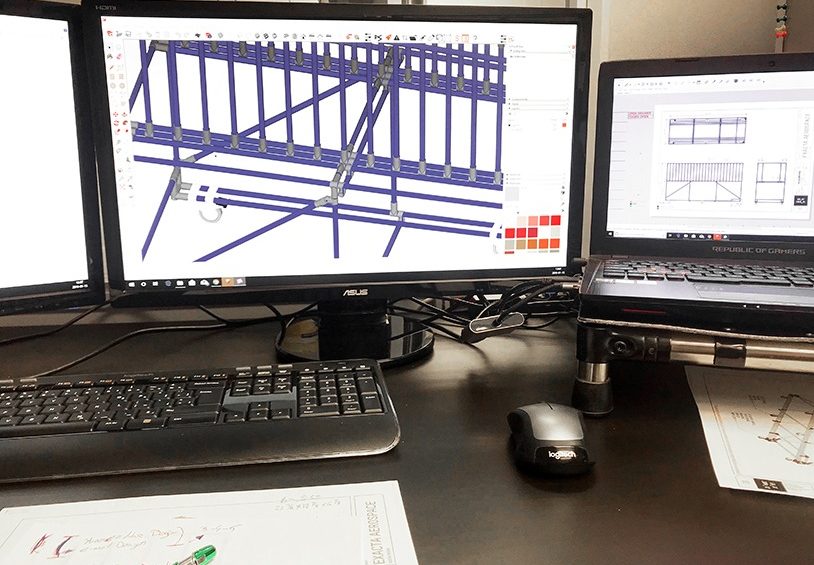
When should I draw with CAD or do a freehand sketch?

When should I draw with CAD or do a freehand sketch?

Estimated reading time: 5 minutes
Is training your staff to use 3D CAD software to design a structure necessary for all your projects? In our opinion, absolutely not! Depending on the complexity of the required structure, a freehand sketch may be faster than a computer drawing with CAD software. Read on to know when to design a structure using CAD software versus only doing a freehand drawing.

At Flexpipe, when we need a structure for internal use, we draw by hand instead of using CAD. When we say this to clients that are using 3D CAD software, they are quite surprised!

First, we carry out some "try-storming" with sketches, and, once tested and approved, we do reverse engineering and create a 3D design. This way, we speed up the process considerably rather than waiting for the design department to model a structure that we're not 100% quite sure will work.

In 90% of cases, you'll want to change and improve the initial concept after just one day of use. A pipe and joint system will allow you to tweak and fine-tune the structure easily. If you make the design process longer, you'll end up wiping out the quick improvement advantage of the product.

In some cases, a CAD design is not what the situation calls for.

With these wise words in mind, "Problem in the morning, solution in the afternoon," we'd rather waste a few pipes and joints on a quick structural test rather than spend a long time thinking of the ideal design in front of a computer. Our motto is "Fail fast – Learn fast – Improve fast!"

 
Benefits of freehand sketching
One of the significant benefits is that freehand sketching is a simple solution that requires only a few types of equipment. There's no need for software or computer or special skills that require you to be in an office setting. You can draw the sketch where the action is taking place and with the people who are most impacted by the structure.

Here are other benefits of doing your project design on paper instead of using computer software:

Lower development costs: a CAD drawing can get expensive as each picture requires an average of 5 hours of staff time.
Reduces wastes, improves efficiency and saves on costs when improvements are implemented within a shorter timeframe.
Stronger employee involvement: a key for better engagement is to act fast, especially when operating with a suggestion system!
Increased employee reach because freehand sketching is easily accessible to everyone. The employee suggesting a new structure or improvements on an existing structure is, logically, the best person to do the sketch.
It's easier to think outside the box because you are making multiple drawing iterations; ideally 7 - see our 7-Ways Idea Template to Avoid Tunnel Vision article. Getting various departments and workers participating in this brainstorming process is invaluable and can reap numerous rewards, such as different perspectives and diversified work techniques.


Benefits of making a CAD drawing after a first structure is built
Most of the time, we suggest making a 3D CAD drawing once the prototype phase is over because the final result will be accurate measurements, a bill of material, and a precise cut list.

Here are some other benefits that it's essential to document, using CAD software, a project that will be reproduced:

Avoid the occurrence of mistakes or leaving details up to an assembler's preferences. It's best to stick to a final design, so each structure is identical.
Reduces the time spent cutting pipes and assembling the structure. This is especially true when making multiple copies of an existing and tested structure.
Keeps a detailed record of your structure's components if you need to build additional units in the future. Regardless of who makes the structure, the "recipe" will be the same.
Enables you to share improvements made to structures with other departments or factories to share best practices and standardize work methods.
Helps you order the exact quantity of material needed or calculate the cost of a large project.
Makes requesting quotes from pipe and joint suppliers easier. Though we hope you'll choose Flexpipe!


Better to develop a concept with CAD software for these types of structures
For complex structures with over 20 pipes and 50 joints - for example, a flow rack 60" long with five levels and a 40" depth with multiple roller tracks. A CAD design will make it easier to draw up a bill of material, reduce the risk of errors and reduce waste, and save money.

For critical structures with a heavy loading capacity exceeding 1000 lb - for example, a WIP (work-in-progress) cart that will hold parts weighing 1200 lb and is to be moved around the production floor. Calling upon the CAD design team members is a wise move as they are specialized in calculating loading capacities and optimizing work methods.

For projects bringing about resistance to change - for example, replacing workbenches that have been used for the last 15 years by new workstations. Some projects generate more passionate debate than others. In such cases, presenting a 3D CAD drawing with multiple perspectives to the team can provide reassurance, bring about product improvement suggestions, and motivate employee engagement.

Projects that require a significant financial investment - for example, new kitting carts to reduce the use of wood pallets and forklift traffic. These types of projects generally require formal approval as it takes a certain amount of time to recoup the investment. Therefore, a 3D software design will help justify the expense of key decision-makers. They will be able to visualize the project and understand its benefits.

It's essential to evaluate the scope of the structure that you want to create; that is, don't overthink the process. Large projects should be done on CAD once the prototype phase is done. Major projects should be drawn on CAD once the prototype is done. Other than that, we suggest that you encourage people to keep it simple: do a freehand sketch, start assembling the structure, and test it quickly!

A coated pipe is less than a $1 per foot, and you will be able to reuse the casters and joints if the structure does not work or has to be improved upon—but at least you'll be getting closer to a structure offering top-notch efficiency.

Why buy 8-foot pipes instead of 4-meter pipes?

Why buy 8-foot pipes instead of 4-meter pipes?

Estimated reading time: 4 minutes
Are you wondering about which pipe length you should buy to reduce costs? Read on for details about transportation and scrap costs in the comparative study we did on eight different projects built with 4-meter and 8-foot pipes.

True or false #1: buying 8-foot pipes reduces freight costs?
True or false #2: 4-meter pipes generate fewer scrap pieces?

In 2017, we began offering 4-meter pipes to accommodate some of our customers' needs. Recently, we decided to look into the benefits of these 4-meter pipes and did some investigating of our own. Keep reading to learn the reasons why - following our tests - we recommend purchasing 8-foot pipes instead of 4-meter pipes.

We know that the industry norm in pipe and joint systems are most likely 4 m pipes because Japan's Yazaki introduced the product in 4-meter lengths many decades ago. However, when it comes to standard building materials such as plywood or timber, 8-foot lengths are most often used. This is mainly due to housing construction standards, and for reasons regarding health, safety, and freight costs.

The table below compares the cost of purchasing 8-foot versus 4-meter pipes for use in 8 different pipe and joint projects. Since most of our customers obtain 4-meter tubes from our competitors, we've since introduced Creform 4-meter pipe pricing. To round out the table, we also calculated the monetary value of scrap pieces shorter than 12 inches, since they are generally not reusable.

*Prices based on 2018 regular catalogs from Flexpipe and Creform.
 

According to the numbers in the table, it's safe to say that the average piping cost per project is just about the same. While the value of the scraps under 12 inches long is a little less expensive in the "8 feet" column, we can affirm that you'll get better reusable scrap pieces with 4-meter pipes.

Regarding work-related illness and injury, 4-meter pipes need to be handled with greater care than 8-foot pipes. There is an increased risk of self-injury or harm to others, regardless of whether you are handling the pipes manually or using a forklift. For these reasons, and to adhere to ergonomic guidelines, we decided to keep 8-foot pipes as our main product offering.
Drawbacks of 4-meter pipes:

Require extra-long forks to handle 4-meter pallets. This can be a waste of time for the forklift driver.
Require a more considerable amount of floor space to get the pipes out of the truck and to move non-standard pallets throughout the plant.
Require a more significant footprint or specialized racking to store the pipes vertically or horizontally.
Require a larger cutting table, thus take up more space.
Require a wood crate for handling and shipping, which is an additional cost.
May require time or money to get rid of the wood crate.
It cannot be shipped by UPS or FedEx, as the authorized maximum length is 10 feet.
Increase freight costs by 42% (see below).


As a side note to the freight costs mentioned above, 8-foot pipes can be shipped with regular carriers, while the 4-meter ones must be sent with LTL carriers.

In the chart below, you will find prices listed on freightcenter.com, which were calculated on October 25, 2018, with an $80 overlength fee. Since summer 2018, most LTL carriers charge an overlength fee on material exceeding 8 feet. We prioritize carriers offering delivery over two business days.

8-foot shipment values ; 24x96x30 500 lb
4-meter shipment values ; 24x157x25 500 lb
 
Drawbacks of 8-foot pipes:

Generate more reusable lengths to manage (exceeding 12 inches long).
Higher in cost if you are a one-time user and do not intend on re-using the scraps.
Require the use of AP-CNNCT or AP-CNNCT2 pipe connectors to build structured over 8 feet long - which is not always recommended!


So, to answer the first true-or-false question, which was, "Buying 8-foot pipes reduces freight costs?" The answer is TRUE: you will save on freight costs with 8-foot pipes and avoid the hassle of handling 4-meter units in the plant.

For the second question, "4-meter pipes generate less scrap?" the answer is also TRUE: 4-meter pipes reduce leftovers mostly for long structures. However, if you regularly build structures, you will be able to re-use leftovers quickly since most of them exceed 12 inches.

If you frequently work on continuous improvement projects for the plant, you are better off with 8-foot pipes.

If you use industrial pipe racking systems only occasionally for specific quantity projects, e.g., a contractor who builds new carts or FIFO rack for a client, you are better off with Flexpipe 4-meter pipes. If you use pipe and joint systems for small or in-house projects, opt for 8-foot pipes as they can quickly be shipped via courier.

We hope this comparison test was helpful to you. If you have any questions, please contact your project manager. He will be happy to provide any assistance you might need.

Shop the Flexpipe 8-foot pipes

Creform alternative Comparative Study

We have compared services, parts, technical specs, and prices from our most popular competitor.
Consult the complete Creform alternative comparative study


The Best Tools for Cutting Flexpipe Tubes (and Which One to Buy)

The Best Tools for Cutting Flexpipe Tubes (and Which One to Buy)

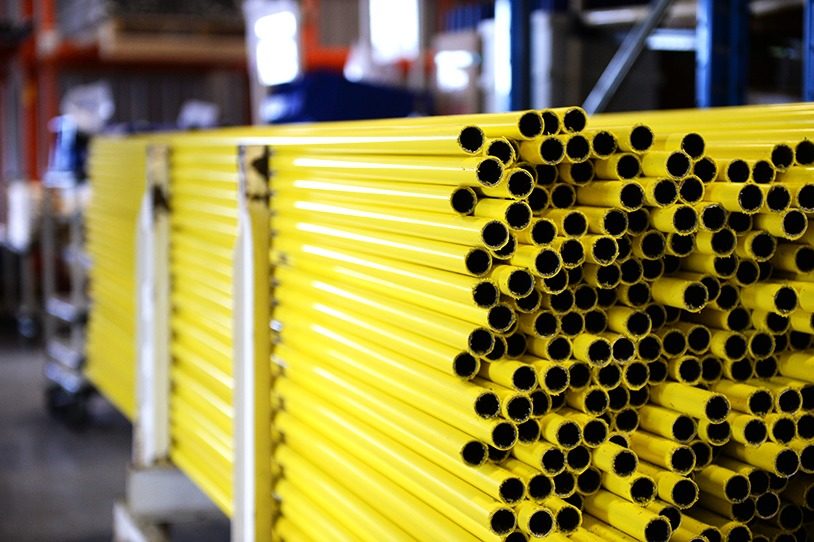
Cutting Flexpipe tubes cleanly and safely is the first step to building reliable modular structures. Whether you’re assembling a cart, rack, or workstation, the right tool makes all the difference in precision, safety, and efficiency. 

Over the years, our team and customers have tested dozens of cutting tools — from manual to high-end electric models. Here’s our updated list of the best options available today, with real-world pros, cons, and buying recommendations.

Don’t have cutting tools yet? Try our Flexpipe Cutting Service for precise pre-cut parts shipped to your door.

Quick Overview: Which Cutting Tool Do You Need?

ToolIdeal ForSpeedSafetyPrice TierBuy LinkPipe CutterSmall projects, occasional cutsModerateHigh$Shop →Portable Band SawFrequent use and medium projectsFastHigh$$Shop →Metal Cutting BandsawDaily industrial use, high volume Very FastHigh$$$Learn more →Power Tubing CutterLarge orders and precision jobsVery FastHigh$$$Shop →💡 Not sure which one fits your setup? Scroll to the bottom for our quick picker guide.

1. Pipe Cutter (T-CUTTER) – Simple, Clean, and Safe

+ PROS

Provides clean, straight cuts on Flexpipe tubes. 

Compact and easy to use — ideal for small jobs or prototypes. 

Manual tool = no sparks or noise, perfect for quiet workshops.

Tips for Best Results

Use steady circular movements.

Don’t overtighten the screw knob at the start — it makes cutting smoother and extends blade life.

- CONS

Slower than powered tools. 

Not suited for cutting dozens of tubes daily.

Recommended combo: Use the Pipe Cutter with a Reamer to ensure smooth tube ends that fit perfectly into joints.

https://youtu.be/RLbR1m87_5g?si=vKftaWZJb8hRY35a

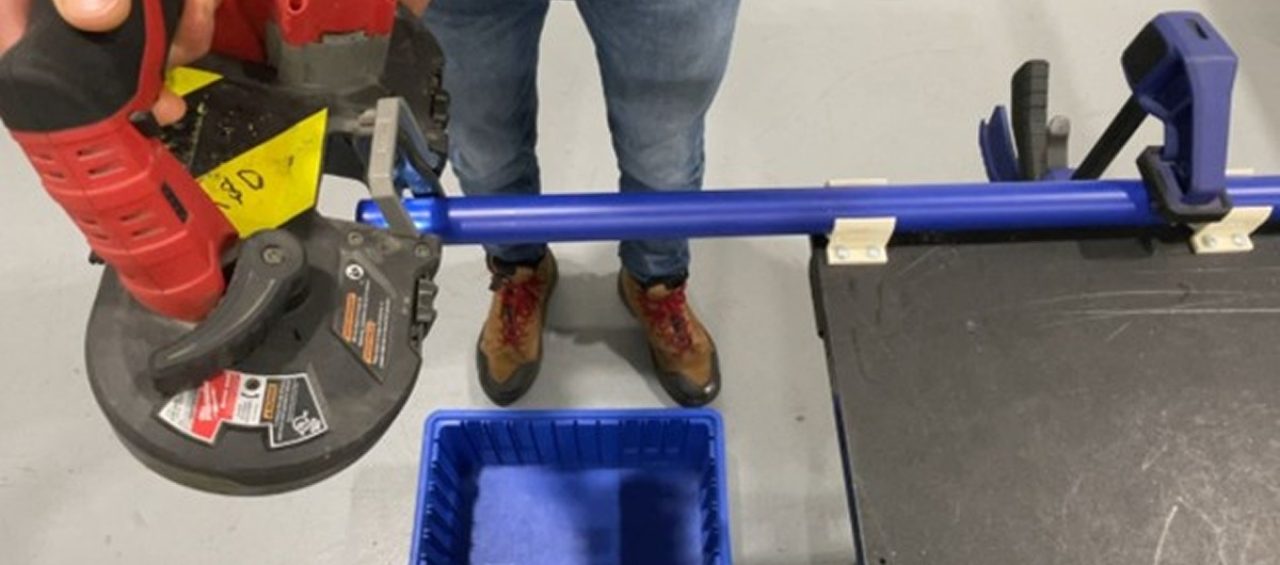
2. Portable Band Saw kit (T-SAW) – Efficient and Reliable

A favorite among frequent builders, the Portable Band Saw is a perfect balance between speed and safety.

+ PROS

Ideal for repetitive cuts or small-scale production.

Ergonomic and portable — works on pre-built structures.

Quieter and cleaner than most saws.

- CONS

Cuts one tube at a time.

Requires a stable setup for precise cuts.

Pro tip: Keep extra Saw Blades (T-BSAW) on hand — sharp blades ensure cleaner cuts and reduce vibration.

https://www.youtube.com/watch?v=S8BC0Bpj6z4

3. Metal Cutting Bandsaw – Stationary Power for Industrial Big Jobs or daily use

When precision and throughput matter, the metal cutting bandsaw is the top performer.This is the machine Flexpipe uses daily for high-volume, precision cuts — a key part of our own production setup.

+ PROS

Cuts up to six tubes simultaneously, saving time and labor.

Quiet operation and no lubricant required.

Safer than traditional circular saws and delivers perfectly straight cuts.

- CONS

Requires a dedicated, safe cutting station.

Not suitable for cutting assembled structures or field adjustments.

Best for: Large manufacturing facilities cutting Flexpipe tubes daily.

Learn more about this tool

4. Portable Power Tubing Cutter (T-PCM) – Fastest and Most Precise

The portable power tubing cutter is the ultimate cutting tool for professionals handling high volumes.

- PROS

Precision motor ensures clean, accurate cuts every time.

Ergonomic and portable — compact enough for mobile workstations.

Designed for long-term durability with minimal wear.

Tips for Use

Always secure the tube before cutting.

Check the blade regularly and replace when worn.

- CONS

Requires power access.

Higher initial investment — best for heavy use.

Best for : Production teams looking for high-speed, consistent, and burr-free cuts.

https://youtu.be/mGhDE6l5n4s

Should You Buy Cutting Tools or Use Flexpipe’s Cutting Service?

If you don’t have the tools in-house — or your order volume doesn’t justify buying a band saw — Flexpipe’s cutting service is the simplest and most cost-effective way to get precision-cut parts delivered ready to assemble.

Why choose Flexpipe’s Cutting Service:

Save time: Receive pre-cut tubes and surfaces directly from your bill of materials.

Reduce waste: Our online Cut Optimizer tool ensures maximum material efficiency.

Stay accurate: Each piece is labeled, measured, and ready to build upon delivery.

No setup required: Perfect for prototypes, small batches, or teams without cutting stations.

Ideal ForSpeedCostTools RequiredOccasional or prototype projects5–10 day turnaroundPer cutNone

How it works:

Use the Flexpipe cut optimizer to create your cutting list.

Add your list to your cart or email it with your order number.

Get your cuts shipped within 5–10 business days.

Pro tip: You can also request cuts on HDPE panels, Plexiglas®, or aluminum composite surfaces for your workstations and flow racks.

5. Finishing Tools – Don’t Skip This Step

Finishing Tool: The Inner-Outer Pipe Reamer (T-REAMER)

Once your tubes are cut, proper finishing ensures a clean fit and longer-lasting structures. Even precise cuts can leave small burrs or metal fragments that affect joint connections, reduce safety, or impact the overall appearance of your build.

The T-REAMER is a must-have finishing tool designed specifically for 28 mm Flexpipe tubes. It quickly removes burrs from both the inside and outside of the pipe, leaving smooth, bevelled edges that ensure perfect insertion into joints. This tool also works efficiently on stainless steel pipes.

Key Advantages:

Cleans and deburrs both the inner and outer edges of Flexpipe tubes

Helps improve assembly precision and extend the life of joints

Enhances safety by removing sharp fragments left from cutting

Durable and easy to use once you get the hang of it

Works on steel and stainless steel pipes alike

When to Use It:

The T-REAMER isn’t necessary for every single cut, but it’s highly recommended when your cutting process leaves visible metal chips or rough edges — especially if aesthetics and safety are priorities.

If you’re new to the tool, we recommend watching our short video demonstration to see exactly how our team uses the T-REAMER at Flexpipe.

Best for: Anyone looking to achieve professional, safe, and clean results after cutting Flexpipe tubes.

Shop the T-REAMER →

Quick Picker: Which Cutting Tool Should You Choose?

Builder TypeRecommended ToolsOccasional builderPipe Cutter + ReamerFrequent projectsPortable Band SawProduction teamsPower Tubing Cutter

Each setup balances speed, cost, and precision — choose based on how often you cut and the scale of your projects.

https://www.youtube.com/watch?v=5FsTvddrQ7c

Safety Reminder: Tools to Avoid

Avoid the following tools due to safety risks or poor cut quality:

Sawzall

Table Saw

Miter Saw

Handle Lopper

Hand Saw

Cut-Off Saw

Always wear safety glasses and gloves while cutting.

Next Step: Get the Right Tools for the Job

Now that you know which cutting tools fit your needs:

Shop All Cutting Tools →

Get Pre-Cut Tubes with Our Service →

Download Free Assembly Plans →

Build faster, cut cleaner, and work safer with Flexpipe tools designed for modular precision.

Key Takeaways

The Pipe Cutter (T-CUTTER) is the safest and most affordable choice for small or occasional projects.

The Portable Band Saw (T-SAW) offers the best speed and reliability for regular users.

The Metal Cutting Bandsaw is ideal for industrial, high-volume cutting operations.

The Power Tubing Cutter (T-PCM) provides the cleanest, most precise cuts for production environments.

Always use the Inner-Outer Pipe Reamer (T-REAMER) to remove burrs and ensure a perfect, safe fit after every cut.

For low-volume or prototype projects, Flexpipe’s Cutting Service delivers pre-cut, labeled parts — ready to assemble on arrival.

Frequently Asked Questions

What’s the best tool for cutting Flexpipe tubes?For small or occasional projects, the Pipe Cutter (T-CUTTER) is the most practical and affordable choice.For frequent or high-volume work, the Portable Band Saw (T-SAW) or the Portable Power Tubing Cutter (T-PCM) delivers faster, cleaner cuts with less physical effort.Industrial users cutting daily can rely on a Metal Cutting Bandsaw for continuous precision and speed.Should I buy my own cutting tools or use Flexpipe’s Cutting Service?If you build occasionally or don’t have cutting equipment in-house, Flexpipe’s Cutting Service is your best option.You’ll receive pre-cut, labeled parts based on your bill of materials — ready to assemble upon delivery.For regular or high-volume projects, investing in your own saw or power cutter becomes more cost-effective over time.How accurate is Flexpipe’s Cutting Service?Every piece is machine-cut to the exact length specified in your cutting list, then carefully identified, packaged, and verified before shipping through our Cutting services.By using the Cut Optimizer tool, you can also minimize waste and ensure perfect results across your order.What tool cuts the cleanest edge on Flexpipe pipes?The Portable Power Tubing Cutter (T-PCM) provides the cleanest and most accurate cuts thanks to its motorized precision.For manual cuts, the Pipe Cutter (T-CUTTER) followed by the Inner-Outer Pipe Reamer (T-REAMER) ensures smooth, burr-free edges ready for assembly.Do I need to ream or deburr after cutting Flexpipe tubes?Yes. Even precise cuts can leave small metal burrs that affect assembly or safety.Using the T-REAMER removes those inner and outer edges, ensuring a perfect joint fit, cleaner aesthetics, and safer handling.What’s the safest lean tube cutting tool for beginners?The Pipe Cutter (T-CUTTER) is the safest option for anyone new to modular assembly. It requires no power source, produces no sparks, and provides straight, controlled cuts when used properly.How can I order replacement blades or accessories?ou can easily reorder accessories and consumables from our online store:Pipe Cutter Blades – Pack of 2Deburring Blades – Pack of 5Saw Blades – Pack of 3These ensure consistent precision and extend the lifespan of your tools.Can I use Flexpipe’s Cutting Service for panels and surfaces?Yes. The service isn’t limited to tubes — you can request cuts for HDPE panels, aluminum composite sheets, Plexiglas®, and pegboard surfaces.Each surface is precision-cut and labeled for fast workstation or rack assembly.
Top 5 tools for assembling

Top 5 tools for assembling

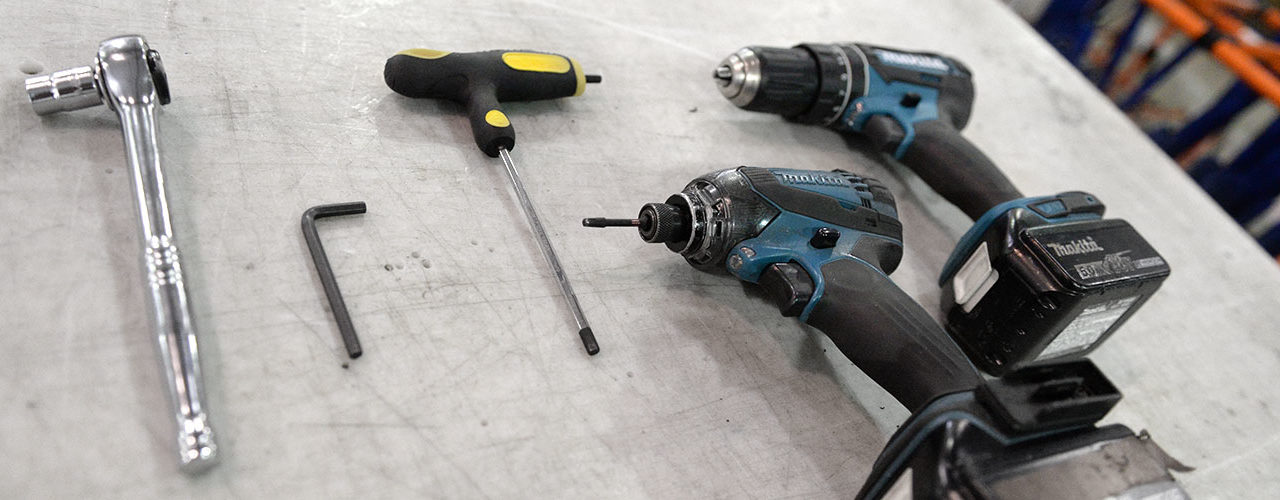
Assembling a Flexpipe structure can be an easy process and can be made even quicker if you use the appropriate tools. All Flexpipe joint sets are assembled with the same nuts and bolts. As such, you’ll just need a 5-mm hex head tool to carry out your project.

Depending on the scope of the project, it’s essential to know which tool can save you the most time and money. Here’s a list of the five tools we recommend, with their respective pros and cons.

Estimated reading time: 4 minutes


5 - The 5 MM Hex Key (Allen Key)

The hex key, or Allen key, is found in most toolboxes. This inexpensive tool, which is available in many stores, is perfectly adapted to carry out adjustments on existing structures or to build small projects. The hex key’s modest size enables you to work in those hard-to-reach places that other tools are unable to access.

TIP: Did you know that you can cut a long hex key into several pieces? These pieces can subsequently be used as a hex head on your drill. However, this tip does not work for impact drivers.

We don’t recommend using a hex key for assembling larger projects, as this may be painful for your hands and wrists. While the hex key is convenient, it’s not intended to be a time-saver.

 
4 - The Hex Socket (Dynamometric) Wrench

A hex socket wrench is a useful, light tool. One can choose a 5mm (1/4’’) unit with a preset cutting range of 2-100 inches per pound (9.8 Nm). This cutting range is the ideal strength to assemble Flexpipe structures. As such, your bolts will always be correctly tightened.

TIP: You may find it challenging to locate this preset tool, so we’ve done the searching for you! The tool is available for purchase on seekonk.com (US-based, delivery to Canada is possible).

While this tool is faster than the hex key and the T-handle, you’ll find others listed in this article that are quicker to use. You should keep in mind that a preset torque wrench is not a standard tool, and it can be challenging to find; it can be expensive, too.

If the one you are using is not preset, you’ll need to pay close attention to the torque setting. If it’s too tight, the bolt heads may become stripped, and you won’t be able to use the bolts again in future projects.

 
3 - The Cordless Drill

A cordless drill is a highly useful tool for projects that only require short assembly time. Given that most people have already used a drill, little employee training is necessary. Furthermore, you probably have one on hand in your facility!

It’s essential to adjust a drill before using it. You must select the “V1” speed setting: that is, the drill speed will be moderate, but with a high level of power. Failure to adequately set the speed level can lead to a wrist injury.

Also, be ready to compose with the tool’s weight when assembling a large-scale project. Speed is critical here; make sure you have the right torque setting, so you don’t strip the bolt heads and render them unusable for future projects.

 
2 - The T-Handle Hex Key

As a useful complement to the impact driver, the T-handle hex key is handy to tighten bolts, which are hard to reach. Its rubber grip makes it more ergonomic and comfortable than the hex key, and it is also very affordable.

As is the case for the hex key, this tool is not suitable for large-scale projects. If you do choose to use it, nonetheless, it may be painful for your hands and wrists. While it won’t provide the quickest execution time, the T-Handle hex key can prove to be useful in certain situations.

 
1 - The Impact Driver (Impact Gun)

The impact driver, also known as an impact gun, is the tool we recommend most. Why? Because it’s powerful, fast, and quite affordable. It’s best to set it at medium power for top performance.

Be sure to have the proper torque setting to avoid stripping the bolt heads, or else they will be useless for other projects. We also recommend purchasing a replacement battery, so your assembly process is not interrupted by a dead battery.

 
Tip about Flexpipe nuts and bolts:
All Flexpipe joint sets are assembled with M6-N nuts and M6-25B bolts. The term M6 refers to the outer metric diameter of the head, which is 6 mm.


Conclusion
Now that you know all the characteristics of these assembling tools, you should be able to determine which is the right tool to assemble your Flexpipe structures. Remember that it’s essential to evaluate the scope of your project correctly, so you purchase the tool that best suits your needs.


6 essential personality traits of the ideal assembler

6 essential personality traits of the ideal assembler

Now that you have determined the people most suited to building your Flexpipe structures, here's a list to help you choose the perfect candidate according to their primary personality traits.

The factor which will most influence the success of your project is the personality of the individual or the team who is assembling the structure. Please note that there's no precise order to this list. The more characteristics the chosen assembler has amongst it, the higher your project's success rate!

Haven't yet chosen the best people to assemble your modular system? First, take a moment to read our article on eight most likely people for an in-house assembly.

Estimated reading time: 3 min 20 sec.


1 - Be Creative
Customized modular structures; a significant asset for efficiency

Modular systems, such as Flexpipe, mainly need creative assemblers to be fully active. This attribute is most useful during kaizen events, but also when creating custom-made structures.

Remember that tube and joint systems are used to build all kinds of structures suited to various needs. The goal is to create a structure that you couldn't find in a store.

 
2 - Have a clear and straightforward perspective
The design's simplicity is key!

Flexpipe structures need to be simple, economical, and easy to test before implementation. The best designs can solve complex problems thanks to their simplicity and flexibility. This is one of the modular system's most significant advantages.

We can, therefore, establish a parallel to the KISS principle, which means "Keep it simple, stupid." This principle aims to eliminate any unnecessary complexity whenever possible when designing the structures.

 
3 - Be skillful and resourceful
Think outside the box

Although Flexpipe parts are easy to cut and assemble, complex manipulations can be needed. That said, we recommend using the person with the best skill set for this job. The use of specific tools may be necessary.

We believe that most individuals can assemble the Flexpipe system, with the help of a single training session on which tools to use. To find out more, read our articles Top 4 tools for cutting and Top 5 tools for assembling to determine the most appropriate tool for your project.

 
4 - Be ingenious
Knowing how to push back the limits

The Flexpipe system offers a multitude of accessories to customize your structures and maximize their potential. A skilled assembler will find what he or she needs to complete his project.

You may need more than pipes and joints to complete a project, however. Whether you choose to use a whiteboard, foam protectors, fasteners, or supports of any kind, the possibilities are just about endless!

 
5 - Have a lean mindset
An adapted work environment designed to be effective and ergonomic

You don't need to be a six sigma black belt professional to have a lean mindset! Knowing the basic concepts of lean production will help you optimize the structures of your modular system.

An ideal assembler should have assimilated 5S techniques beforehand.


6 - Be constant and committed
A stable workforce with high potential for adaptability

The use of tubes and connectors is a gradual process and requires continuous improvement. It's also worth noting that there's a significant learning curve when it comes to designing and assembling various structures of the system. The assembly of each new type of structure is sure to make an assembler proud!

This person should also be able to adapt and improve the initial structures. Keep in mind that assembling structures should not be a temporary assignment that comes to an end when the training session is over nor when the assembler is called back to the production line.


The best of the best
Modular systems are simple, customizable, and progressive. The person responsible for the design and assembly should primarily reflect the same characteristics as the product itself. An engaged assembler will be more likely to design the best structures according to your project and improve them over time.

8 most likely people for an in-house assembly

8 most likely people for an in-house assembly

One of our most asked questions is, “Who should build my structures?” The quick answer is that it depends on many factors. There are many types of people who can assemble Flexpipe structures. However, it will vary based on your resources, budget, time, available space, location and how big your project is.

Here's a top 8  of the most likely people to build your structures in-house and the best scenarios for you to utilize their specific skill sets optimally.

8 - The manufacturing contractor

This might be an individual or a small business you already have as a supplier. They already know your business and your facility because they’ve worked for you in the past or do so now.

These people are used to doing manual labor. It may be a supplier who has integrated new production lines for you in the past. This is common in big manufacturing businesses like the Automotive industry. These individuals usually have knowledge of fifo rack principles and one-piece flow.

However, even if they have vast experience in manual labor, they are not necessarily experts in industrial pipe racking systems such as Flexpipe, and they may only see this as a one-time contract. If this is the case, your contractor may have to spend time learning the system, and you will lose the know-how they acquired during the project once it is done.

7 - The mechanical or industrial engineering intern

Hiring an engineering intern is an excellent way to bring lean manufacturing knowledge into your business for a defined period. This is a good option if you have a project with a beginning and an end. The cost will be more affordable than doing business with a lean manufacturing consulting firm.

Some of these people have the manual skills necessary, and if you challenge them they can implement practices to save you time and money. Most of them will have design or at least technical drawing skills, which are an important part of building Flexpipe structures. If you are doing it right, they will merge with your business and bring a fresh and different perspective.

The risk of this option is the internship ending before your project is completed. Also, if this person is the only one with lean manufacturing experience in your company, you will lose this knowledge until you hire someone else with the same know-how. This isn’t optimal, since materials handling systems like Flexpipe are constantly evolving and demand continuous improvements to be optimal.

Before you go looking for an intern, make sure your business culture is adequate for this kind of solution. Interns are usually young people with big ideas and not necessarily mature professionals. They require a little more supervision, so you need to be able to provide him time and a good integration. Depending on the perception of your current experienced employees, this new team member may also create resistance to changes in your organization.


6 -The lean manufacturing engineer

This is the experienced engineer with knowledge not only about lean manufacturing but also with experience in this field. These people may already have worked with a system similar to Flexpipe, and if they haven’t, they will usually learn the system quickly. Like the intern, these individuals usually have a manual, design, and technical drawing skills.

Keeping an engineer like this in your organization will improve your productivity dramatically in the long run. They will keep improving the system as your business evolves so that you can benefit from the optimal potential of the Flexpipe system.

The lean manufacturing engineer would have been our first choice if it was to define the best person to manage your modular system. The problems with these people is that they may soon tire of spending half or more of their time building structures. Some engineers prefer to design other improvements, while some like to manage the projects. They usually have limited manual skills.


5 - The Flexpipe team

We wouldn’t be experts in pipe material handling systems if we didn’t construct structures ourselves. We have our team of assemblers which builds thousands of structures each year for some of our biggest clients. We also offer help with the designing stage so you can challenge your ideas and improve your concepts. Our team is ideal if you have a big Kaizen blitz coming, and if you lack the resources needed during the assembling stage.

This service is not available for small projects or for facilities too far from our sector. Other businesses who use our assembly team have their structures delivered via freight transporters to their facilities. This is also a less optimal option for facilities far away from Flexpipe since the shipping cost is much higher with complete structures than bulk materials. Furthermore, delays may be longer for our assembly service, plus your team will not have assimilated the knowledge of our assemblers.


4 - Pre-retirement worker

If you have a production worker in pre-retirement, it may be one the best options. Choosing someone with manual skills is preferred. This is an ideal situation for companies that don’t have enough assembly needs to hire a full-time employee. In addition, this existing employee already understands how the company operates.

If this is the first time you introduce a materials handling system like Flexpipe to your business, these people are going to be proud of being part of a new project at the end of their career. If these people are also long-time employees, it is even better because they already know every aspect of production practices that are not well designed and can be improved. They have probably already thought of some designs in the past and would be happy finally to build it to provide a better environment for their co-workers.

There are a few disadvantages to this option. First of all, this worker is probably not familiar with lean manufacturing principles. Secondly, this person will quit within a few years, so you will eventually lose the knowledge they had on the system. Lastly, the pre-retirement worker can have some difficulties with the data processing, which can be an issue on their competencies.


3 - The maintenance team

As far as we know, this option is the most popular in medium and large businesses. These people have the skills, the tools, and often the space needed to assemble structures. They usually have a good relationship with the production team, and they know their frustrations.

The members of this team know the facility equipment better than anyone and may be the best option for designing structures that support the production line. These teams usually love Flexpipe, because it allows them to build something instead of always fixing something. Some of the best concepts we have seen were built by maintenance workers.

The problem with using a team is usually that their primary goal is to make the maintenance of the facility and the equipment easier. This often means that materials handling systems come in second, which could hurt the productivity of the system. The maintenance team is overused most of the time, so tasking them with the assembly of Flexpipe and informing them about lean manufacturing principles could be the wrong decision.


2 - The production team

No one is better suited to building structures than the people who are going to use them. They already know all the little things that could mean improvements for their jobs. There are plenty of case studies out there that talk about how workers have changed even the smallest of steps in the production process and how those changes have saved millions of dollars over time.

A Japanese business allows their production workers to take the time to realize their improvement ideas in a room or place dedicated to building materials handling structures. These employees are supervised by a manager, who may be an engineer to verify that the structures are well built and respect security norms.

There are two major problems when using your production team to assemble Flexpipe structures: First, when they are building structures, they are not producing value at that particular moment. Every improvement they make will eventually pay off in the future, but this could disturb your production flow if not done correctly.

The second problem in making your production team assemble Flexpipe is that they usually don’t have a knowledge of lean manufacturing practices. So as you saw in the example above, you will need to involve an engineer to supervise their work.


1 - The dedicated lean manufacturing team (Moonshiners)

This team dedicates all its time to improving your productivity. This is a multidisciplinary team that will use the Lean Six Sigma principle and tools like Flexpipe to make the most out of your production line. These people probably have encountered a materials handling system before, and they are familiar with it.

Most of the time this team is a combination of the other seven types in this list. We call these people Moonshiners, because they will apply a technique known as the Kaizen Moonshine shop. This option is becoming an industry standard in fields such as Aerospace and Automotive manufacturing. We hope to see more of these teams in other industries in the near future.

The dedicated lean manufacturing team can be a significant investment. This investment will pay off with time. However, we don’t recommend this option for small businesses and if that’s you, we think you should begin with one of the other seven options.

 
Bonus for seasonal manufacturing companies
If you are a manufacturer with valleys and peaks in the annual production flow, you can use this trick. When the production decreases in the low season, take this time to have your floor workers and engineers work on Flexpipe projects and improve their work environment.

Ideally, those extra resources would only be used to support existing teams or individuals who work on Flexpipe year-round. This could be the right time to make that happen.

Why your workplace requires a Flexpipe Crib

Why your workplace requires a Flexpipe Crib

The Flexpipe Crib is a storage structure that requires assembly. The structure will allow you, among other things, to organize your various modular system parts, make the system far more intuitive to use. This equipment may appear to be somewhat costly to the uninitiated.

However, by reading below, you’ll get a comprehensive overview of the Crib’s potential and usefulness in your work environment.


An excellent example of 5S principles
The Flexpipe Crib was designed according to Lean Manufacturing
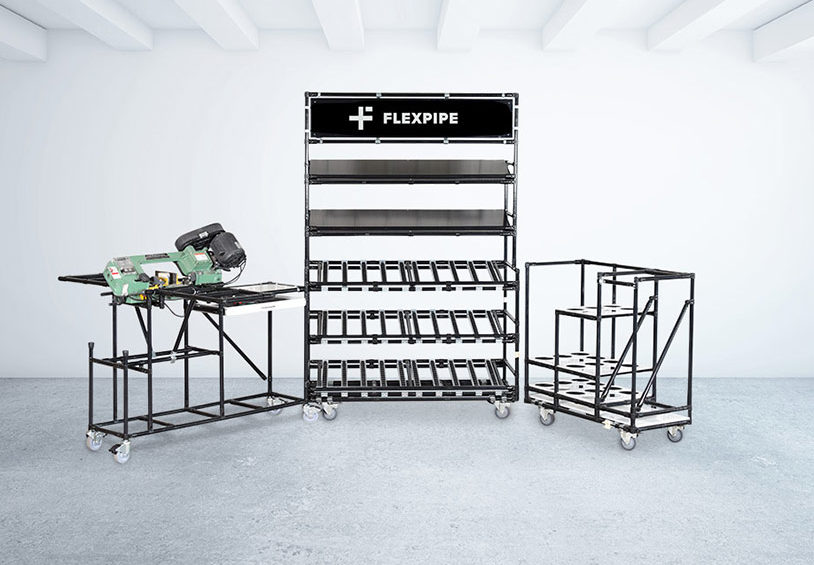
A place for everything and everything in its place is a crucial concept in 5S principles, and the Flexpipe Crib is an accurate reflection of this concept. This structure features three distinct sections: cutting workstation, centrally-located shelf unit, and tube storage cart.

The cutting workstation includes a platform to set up a saw, storage shelves for your tools, and a drawer with foam cutouts to store small tools.

The 5-tier central unit includes two shelves and three conveyor levels for optimal product storage.

The cart includes an 8’ section for tube storage as well as a section designated to manage scraps efficiently.

Each of these components is mounted on wheels making it easier to move each one around for quick configuration changes. Furthermore, you can quickly create a U-shaped cell to reduce movements during the assembly process. One can also choose to close off the Crib when not in use to save space.

The Flexpipe Crib was designed according to the Kanban “two-bin” system to facilitate the inventory of assembly parts at a glance. Two posters displaying all the possibilities of Flexpipe products grouped by category are also included in the Crib’s packaging. Why not do like our customer below and build lateral supports to display the posters clearly!

With these posters clearly visible, no matter who tries to build stuff, they can see what items are available

Michael Dumas - Manufacturing Manager at Barfield Inc.

Too often, structures are assembled directly on the floor or stacked pallets. This is probably the best way to lose parts and increase the risk of work-related accidents.

The Crib is an ergonomic and organized location specifically designed to assemble your modular structures.

Use it to show your team just what Lean Manufacturing standards are all about. In a best-case scenario, each of your facility’s departments should be organized in such a way that they are just as Lean as your Crib.


An excellent self-teaching opportunity
Fill two needs with one deed when learning about the modular system’s various uses
Each Crib comes with pre-cut parts, a detailed, step-by-step assembly plan, and two parts posters. The assembly instructions have been simplified to make the learning process more comfortable, regardless of your skill level.

It took us a while to begin assembling our Crib, but it turned out to be a training session in itself. When we got down to it, we discovered the modular system’s enormous potential. We also realized just how practical some parts were and put them in our structures. We should have taken it out of the box much sooner!

Jamie & Jamie - Maintenance workers at Robinson Innocations

More information:
How modular carts help this logistics company improve its efficiency


It is the most frequently used parts that will go into your Crib’s assembly.
When the time comes to assemble more complex structures, you will have already learned the modular system’s basics. It’s worthwhile to keep in mind that assembling the Crib enables you to understand each component’s usefulness in the overall system.

With over 150 different components, you’ll become familiar with certain parts that are often overlooked. Such as accessories (AO-CLIP, AC-STRAP, AI-CORNER, AS-REST), slide brackets (FL-COU), and two types of wheels: stem swivel caster (W-4ESB) and plate swivel casters (W-4PSB).

Here is the list of tools included in your Flexpipe Crib:

T-HANDLE;
T-BIT;
T-CUTTER;
T-REAMER;
T-DEBURR;
T-BCUT;
T-BDEB

Afterward, all you’ll need to do is equip yourself with cutting and assembly tools such as a saw, drill, driver, and measuring tape. Complete your lean manufacturing workstation’s setup with an assembly platform made of Flexpipe tubes! That said, you’ll be able to build it according to the size which meets your needs as well as the available floor space.

To determine which tools are best suited for your situation, please read our articles regarding the best tube and joint system cutting tools and assembly tools to get the job done.


Your mini moonshine shop
Where assembly and creativity go hand in hand
The location you choose to set up your Flexpipe Crib can be more than a mere assembly zone. Make it a place where creativity will fuel continuous improvement initiatives. This area should be accessible to all to encourage as many employees as possible to participate in the creative process.

To set up an efficient and productive moonshine shop, you need a dedicated space at the plant, equipped with basic tools and materials. For example, some companies have a moonshine shop right in the middle of their facility so that employees can see innovative work taking place in real-time.

You can also use your Crib as a storage unit for your 5S tools. Colored labels, floor marking stickers, visual learning tools, or any other 5S project-related items can all be kept in this location for quick and easy use.

As such, the Crib will become a purpose-driven location where 5S principles and Lean Manufacturing principles are highly visible for daily implementation.

More information:
9-step checklist for a Kaizen moonshine shop


Some even use the Crib as a meeting point to discuss essential topics and address urgent problems (Obeya) or for daily morning meetings (DMM).


In a nutshell, the Flexpipe Crib will be a valuable asset when integrating 5S in your facility.
On the one hand, it will help you become familiar with the modular material handling system. On the other hand, it will be an ergonomic and safe place for your continuous improvement projects.

Besides being an area dedicated to assembly and creativity, it can also be a designated gathering-point for Lean-themed meetings.

Supermarket Flowracks and their influence on Manufacturing

Supermarket Flowracks and their influence on Manufacturing

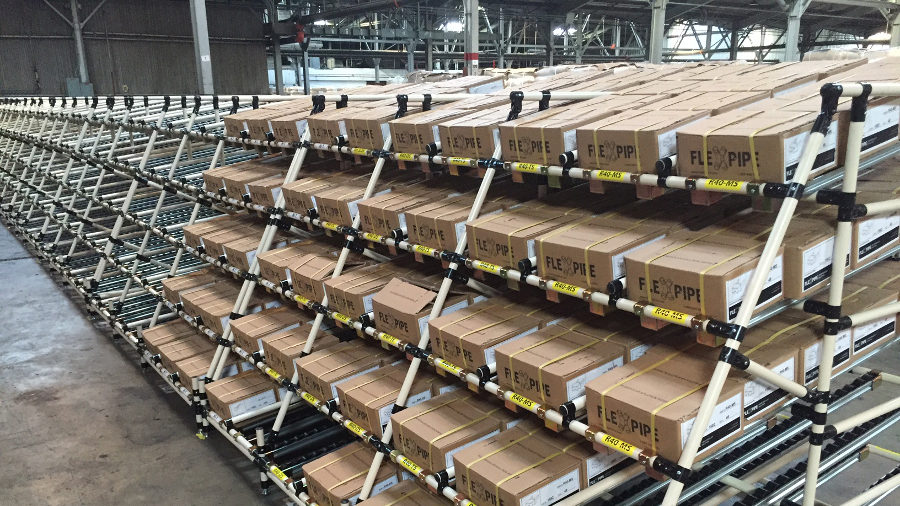
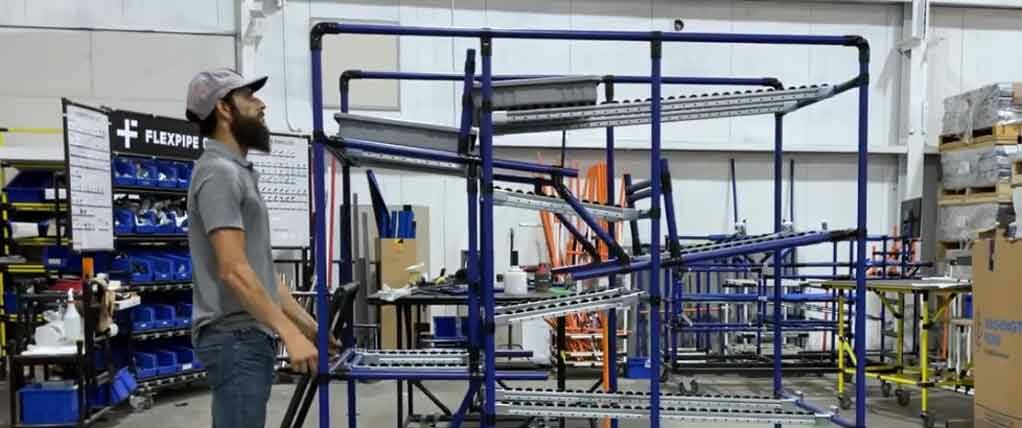
Lean suggests the elimination of large packaging. The use of small lots often requires constant supply. Gravity flow racks help realize this approach with a continuous flow in the factory. Flow racks are usually supplied from behind, and parts are consumed on the other side. Gravity racks can be used on the assembly lines or in the storage areas. The pipe and joint system facilitate the building of these custom roller racks.

The idea is simple: swap the palette of large material containers next to the employee (often representing one or two days of production) for a flow rack, with small boxes representing several hours of production and keeping the presentation neat.

This idea can easily be included in your organization during the design of a lean manufacturing workstation. The flow racks are not new. They were first known for their use in supermarkets for perishable items such as milk. Then in distribution centers with first-in-first-out racking systems (FIFO), but they are now present on assembly lines, services, and even in the health system.

Using small lots and small containers give you the possibility to use parts in a flow mode to transport parts at low cost, to easily follow operation schedules, and adjust to possible changes. This will also allow you to save space on the production line, improve the part presentation, and organize better workstations. An increase in productivity and an increase in production line density (the production volume per unit area) will be quickly achieved.

 
What are the advantages of this change?
For several years, organizations using FIFO racks have seen the following benefits:


Supplies are more organized.

Unlike a standard shelf, a flow rack requires a way to operate: Supplying from behind and consumption in front. This allows two people to accomplish their tasks without interference. Travel is also minimized because all products are found together in one place.


Merchandise is more organized

Some items may be more challenging to store because of their shape. The organization and preparation of components in a flow rack also eliminate wasted time searching for and unpacking parts.


More accessible

To facilitate the work of the operator, the flow rack can be integrated into a workstation. Some travel and unnecessary maneuvers could be eliminated. The ergonomics of the workstation must also be considered in the design of a position.

 
Creform alternative Comparative Study

We have compared services, parts, technical specs, and prices from our most popular competitor.
Consult the complete Creform alternative comparative study